Best Kantata Alternatives in 2026
7 PM tools ranked for professional services. Features, comparison table, and verdict.
Date Posted:
September 11, 2026
Share This:
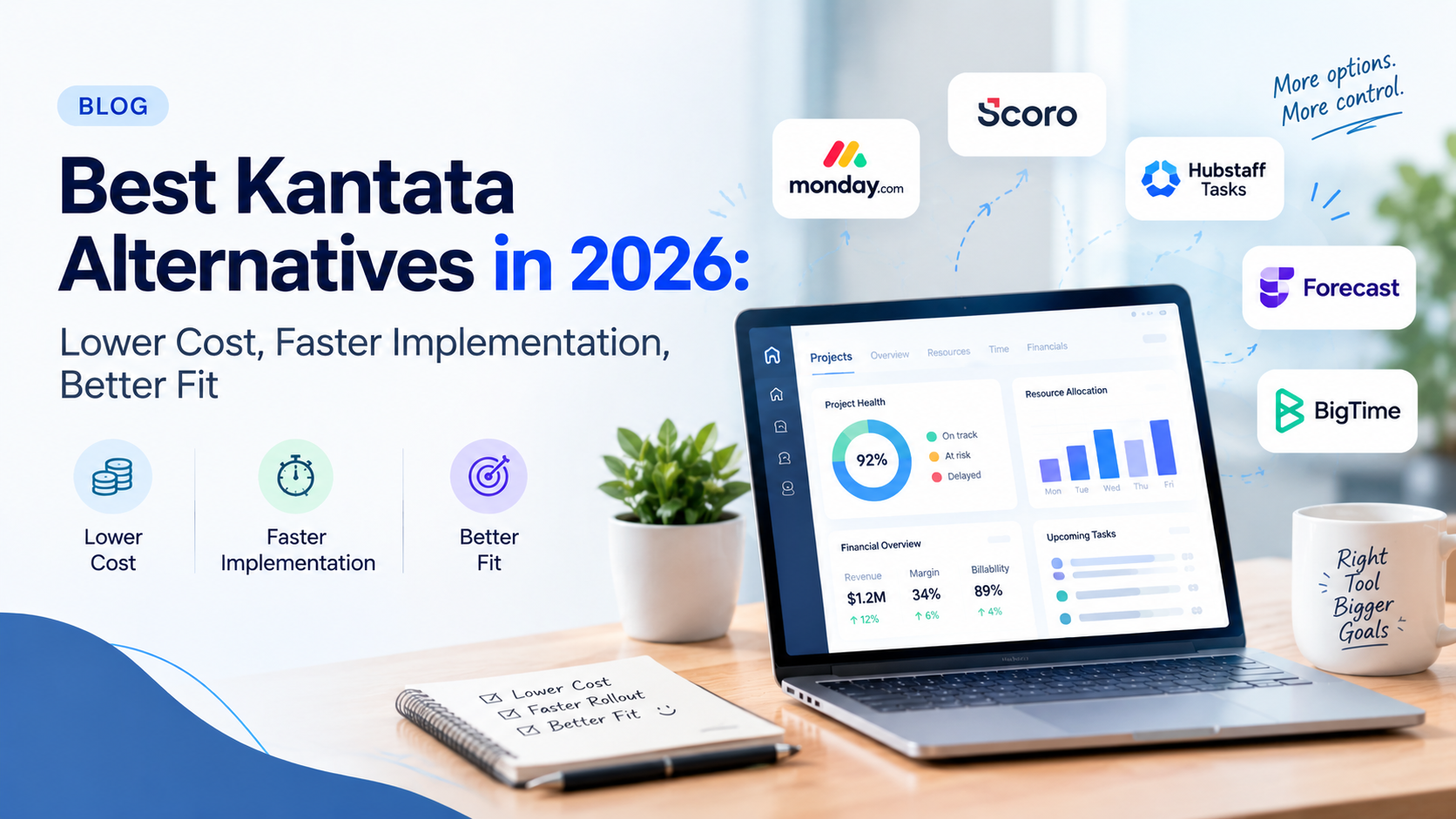
Best Kantata Alternatives in 2026: Lower Cost, Faster Implementation, Better Fit
Kantata is one of the most recognised names in enterprise PSA, and for large professional services organizations above 200 users with significant resource management complexity, the recognition is partly deserved. But Kantata is consistently cited in buyer research for three problems that drive firms to alternatives: cost (the $25,000-plus annual minimum contract floor before implementation), implementation timeline (3 to 6 months with mandatory SI partner involvement), and interface quality (consistently rated below the market average on G2 for usability). For IT services firms under 200 users, GCCs, managed service providers, and any firm that needs native Keka or SAP integration, Kantata is not the right platform. This guide covers who the right Kantata alternatives are and why.
For IT/ITeS firms, GCCs, and MSPs seeking full Kantata capability without the enterprise cost and timeline: KEBS at 4.7/5 G2, $5 to $49/user, 4 to 8 week implementation, with native Keka/SAP integration and KAIS AI that Kantata lacks. For Salesforce-committed firms: Certinia. For mid-market all-in-one: Scoro. For billing-first US teams: BigTime. For client-delivery-focused teams: Rocketlane.
Why Firms Look Beyond Kantata
What Kantata Does Well
| Capability | Kantata Strength | When It Matters |
|---|---|---|
| Enterprise resource forecasting | Deepest resource forecasting capability in the PSA category for large organizations with complex multi-project staffing requirements | Organizations above 200 users with highly complex resource management and multi-year project portfolios |
| Financial governance | Strong project financial controls, budget management, and revenue recognition for enterprise financial reporting requirements | Organizations with enterprise audit requirements and multi-year engagement financial governance needs |
| Salesforce integration | Available in a Salesforce-native variant with deep CRM-to-PSA data integration for organizations already committed to Salesforce | Firms where Salesforce is the system of record and Salesforce-native PSA operation is a requirement |
| Professional services domain expertise | Long track record in enterprise professional services; deep implementation methodology developed over many deployments | Large organizations that value vendor experience and established implementation methodology over speed |
Top 6 Kantata Alternatives in 2026
1. KEBS
Best for: IT/ITeS firms, GCCs, MSPs under 200 users | G2: 4.7/5 | From $5/user
KEBS delivers the capabilities that drive Kantata evaluations (resource management, financial governance, multi-entity billing, AI) at a fraction of the cost and in 4 to 8 weeks rather than 3 to 6 months. For the IT/ITeS and GCC delivery model, KEBS exceeds Kantata in several dimensions: native Keka, Darwinbox, and SAP integration (unavailable in Kantata), multi-entity INR/USD billing (limited in Kantata), native ITSM (not in Kantata), and three-layer agentic AI (KAIS is more mature than Kantata's emerging AI capabilities). Rated 4.7/5 on G2 vs Kantata 4.1/5. Role-based pricing from $5 to $49/user with no minimum contract floor.
2. Certinia
Best for: Salesforce-committed firms needing enterprise financial governance | G2: 4.2/5 | Custom pricing
Certinia (formerly FinancialForce) is the Salesforce-native alternative to Kantata, running in the Salesforce data model with deep revenue recognition, project accounting, and financial reporting. For firms already committed to Salesforce infrastructure, Certinia avoids the integration work that connecting a non-Salesforce PSA to Salesforce requires. Trade-offs: requires $40,000 to $80,000-plus in Salesforce licensing annually, no native Keka or SAP integration, not designed for Indian IT/ITeS delivery, and implementation timelines comparable to Kantata (4 to 9 months).
3. Scoro
Best for: Mid-market consultancies needing CRM + delivery + billing | G2: 4.5/5 | From $26/user
Scoro covers the full commercial lifecycle from quoting through billing with better usability ratings than Kantata and accessible published pricing. Strong choice for mid-market consultancies that found Kantata overkill for their needs. No native Keka, SAP, or Darwinbox integration. No ITSM. No multi-entity INR/USD billing. Better suited for UK and European delivery than Indian IT/ITeS.
4. BigTime
Best for: US professional services firms with accounting-integration-first requirements | G2: 4.5/5 | From $20/user
BigTime is a practical mid-market alternative for firms that evaluated Kantata primarily for billing automation and found the cost unjustifiable. Strong QuickBooks, Sage, and NetSuite integration at $20/user with reliable timesheet-to-invoice workflow. No AI, no skills-based bench management, no multi-entity billing, no Keka or SAP integration. Right choice when billing automation is the primary unmet need.
5. Rocketlane
Best for: IT implementation teams where client delivery experience is the differentiator | G2: 4.5/5 | From $19/user ($69 for AI)
Rocketlane is a strong alternative for IT teams that were evaluating Kantata for delivery management rather than resource management. Best-in-class client portal and onboarding automation. Limited for the resource management, financial depth, and operational scale requirements that typically drive Kantata evaluations. Not suited for Indian IT/ITeS or GCC delivery models.
6. Projectworks
Best for: Consulting and engineering firms needing real-time project financial visibility | G2: 4.6/5 | From $37/user
Projectworks delivers strong project financial visibility and resource scheduling with a practitioner-built interface that receives consistently higher usability scores than Kantata. A practical alternative for consulting and engineering firms that found Kantata too complex and expensive for their requirements. Limited IT services-specific depth: no Keka or SAP integration, no multi-entity billing, no ITSM.
Full Comparison Table: Kantata vs Alternatives 2026
| Capability | Kantata | KEBS | Certinia | Scoro | BigTime | Rocketlane |
|---|---|---|---|---|---|---|
| Resource forecasting | Enterprise depth | AI-driven, CRM-connected | Standard | Partial | Basic | Growing |
| AI bench management | Emerging | Agentic (KII/KIR/KIA) | Einstein (basic) | None | None | Premium only |
| Financial governance | Enterprise | Full ASC 606 | Best-in-class | Standard | Basic | None |
| Keka / SAP (native) | Custom API | Native | Custom API | None | None | None |
| Multi-entity INR/USD | Limited | Native | Salesforce-only | Limited | No | No |
| Native ITSM | No | Native | No | No | No | No |
| GCC operations | Partial | Built for it | No | No | No | No |
| Usability (G2) | Below average | Above average | Average | Above average | Above average | Above average |
| G2 Rating | 4.1 | 4.7 | 4.2 | 4.5 | 4.5 | 4.5 |
| Price transparency | Custom only | $5-49/user published | Custom only | $26+ published | $20+ published | $19-69 published |
| Implementation speed | 3 to 6 months + SI | 4 to 8 weeks | 4 to 9 months | 6 to 10 weeks | 4 to 6 weeks | 2 to 4 weeks |
TCO Comparison: 50 Users, 3 Years
| Platform | Year 1 Licensing | Implementation | Integrations | Year 2 to 3 Licensing | 3-Year TCO |
|---|---|---|---|---|---|
| KEBS | $12,000 to $18,000 | $5,000 to $8,000 | Included | $24,000 to $36,000 | $41,000 to $62,000 |
| BigTime | $12,000 | $6,000 to $10,000 | $3,000 to $6,000 | $24,000 | $45,000 to $52,000 |
| Scoro | $15,600 | $8,000 to $12,000 | $4,000 to $8,000 | $31,200 | $58,000 to $72,000 |
| Rocketlane (Premium) | $41,400 | $6,000 | $4,000 | $82,800 | $134,000 to $140,000 |
| Kantata | $30,000 to $50,000 | $50,000 to $120,000 | $15,000 to $30,000 | $60,000 to $100,000 | $155,000 to $300,000 |
| Certinia (+ Salesforce) | $40,000 to $60,000 | $70,000 to $130,000 | $15,000 | $80,000 to $120,000 | $205,000 to $325,000 |
Which Kantata Alternative for Which Profile
| Your Profile | Best Alternative | Primary Reason |
|---|---|---|
| IT/ITeS firm under 200 users with India delivery or GCC operations | KEBS | Covers Kantata's resource management strength plus capabilities Kantata lacks: Keka/SAP, INR/USD billing, ITSM, superior AI. At 20 to 30% of Kantata's 3-year TCO. |
| Large enterprise PS firm committed to Salesforce infrastructure | Certinia | Salesforce-native financial governance at enterprise depth; accept the Salesforce infrastructure cost |
| Mid-market consultancy needing CRM + delivery + billing with better UX than Kantata | Scoro | Better usability, published pricing, and commercial lifecycle coverage for non-IT professional services |
| US professional services firm where billing automation is the primary unmet need | BigTime | Strongest billing-first PSA at a fraction of Kantata's cost; no SI partner required |
| IT implementation team evaluating Kantata for delivery management | Rocketlane | Better delivery management UX and client portal; lower cost; faster implementation |
| Enterprise IT services firm above 200 users needing Kantata's resource depth | Stay on Kantata or KEBS at scale | Kantata's resource forecasting depth is genuinely strong above 200 users; KEBS is also competitive at this scale for IT/ITeS profiles |
The capabilities that drive Kantata evaluations are resource management depth, financial governance, and enterprise-grade delivery operations. KEBS delivers all three, and for the IT/ITeS and GCC profile, delivers them more completely: KAIS AI is more mature and agentic than Kantata's emerging AI features, native Keka and SAP integration eliminates the custom development Kantata requires, multi-entity INR/USD billing covers the India-US delivery model that Kantata handles only partially, and native ITSM covers the managed services operations that Kantata does not include.
The cost difference is the most immediate argument. A 50-person IT services firm that evaluates Kantata and KEBS side by side will find a 3-year TCO difference of $100,000 to $240,000 in KEBS' favour, driven primarily by Kantata's implementation cost and minimum contract floor. That $100,000 to $240,000 delta represents the operational improvements (bench rate reduction, billing leakage recovery, utilization improvement) that KEBS delivers within two quarters, not a 3-year horizon.
The implementation speed difference matters operationally. A 6-month Kantata implementation means 6 months of operating without the resource management and billing automation the firm urgently needs. A 4 to 8 week KEBS implementation means operational value within one billing cycle of contract signature. For firms with an urgent bench management or billing problem, that time difference is not academic. KEBS is rated 4.7/5 on G2 vs Kantata 4.1/5. Role-based pricing from $5 to $49/user. No minimum contract floor. No SI partner required.
Frequently Asked Questions
Kantata-Grade Resource Management at a Fraction of the Cost. Live in 4 to 8 Weeks.
KAIS AI bench management. Native Keka and SAP integration. Multi-entity INR/USD billing. Native ITSM. No SI partner required. No minimum contract floor. Rated 4.7/5 on G2 vs Kantata 4.1/5.
Book a Free Demo →