How US Enterprises Should Set Up and Run an India GCC in 2026
7 PM tools ranked for professional services. Features, comparison table, and verdict.
Date Posted:
September 25, 2026
Share This:
How US Enterprises Should Set Up and Run an India GCC in 2026
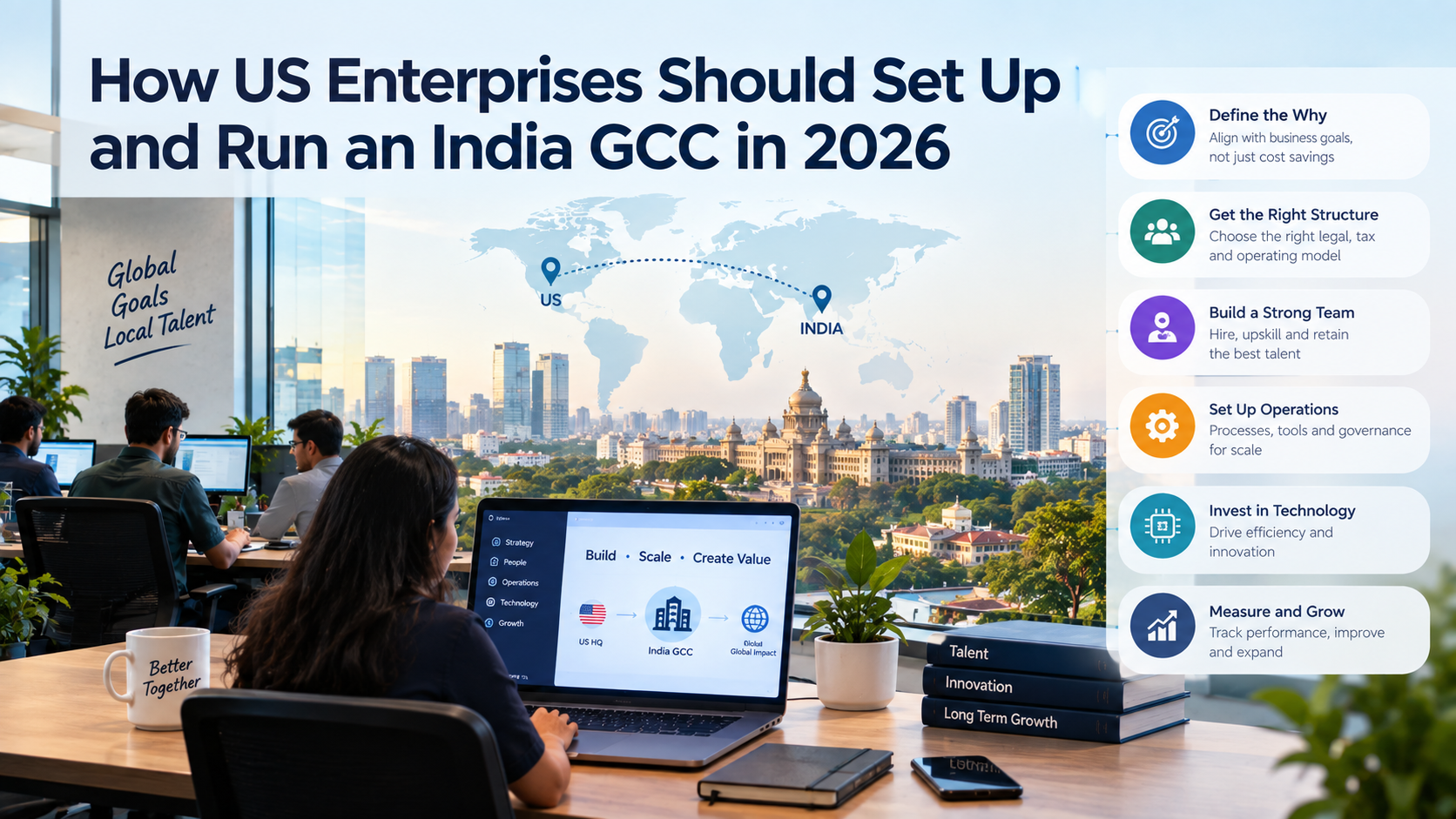
More US enterprises are setting up India GCCs in 2026 than at any point in the previous decade. The combination of a deep engineering and analytics talent pool, a 20 to 30% cost advantage on fully loaded employee costs, and a maturing GCC ecosystem that has simplified the legal, operational, and cultural challenges of running a captive center makes India the default choice for US enterprises building offshore capability at scale. This guide is written for the US-based GCC sponsor: the CFO, COO, or Chief People Officer who owns the decision and needs a practical roadmap, not a theoretical overview.
Setting up an India GCC is a 12 to 24 month journey to full operational maturity. The legal setup takes 6 to 12 weeks. The first cohort of talent takes 3 to 6 months to hire and onboard. The cultural integration between the India team and the US parent takes 12 to 18 months of deliberate effort. The firms that succeed treat the GCC as a business unit from day one, not as a staffing exercise. The firms that struggle treat it as a remote hiring program and wonder why the team does not feel integrated.
Before You Start: The Strategic Clarity Checklist
The most expensive GCC mistakes happen before the entity is formed. US leadership teams that have not resolved the following questions at the strategic level before beginning setup consistently encounter operational problems that require expensive course corrections later.
-
Define the functions and outputs, not just the headcount target
A GCC setup mandate of "100 engineers in India by end of year" is not a strategy. The functions the GCC will deliver, the outputs it will be accountable for, and the internal clients it will serve must be defined before hiring begins. Without this clarity, the India leadership team cannot hire against the right skill profiles, and the parent organization cannot build the demand pipeline to keep the GCC productive from day one.
-
Decide on the delivery model: pure captive, BOT, or hybrid
A pure captive GCC is wholly owned from day one: your entity, your employees, your infrastructure. A Build-Operate-Transfer (BOT) model uses a local operator to build and run the GCC under their entity for 12 to 24 months, then transfers ownership to you. A hybrid model (GCC core plus outsourced flex capacity) gives you captive depth on strategic functions with variable capacity on peripheral work. The choice depends on your appetite for setup risk, your timeline, and how quickly you need operational capability.
-
Align the intercompany billing model before operations begin
Cost-plus, fixed-fee, or T&M: the billing model governs how the GCC charges the parent for services and how the GCC's financial performance is measured. This decision requires alignment between the GCC finance team, the parent CFO, and external transfer pricing counsel before the first intercompany invoice is raised. Changing it after operations begin creates retroactive accounting complexity.
-
Define success metrics for Year 1, Year 2, and Year 3
What does success look like at the end of Year 1? Headcount achieved, operational baseline established, initial delivery quality metrics met. Year 2? Utilization targets hit, bench rate below 15%, intercompany billing running cleanly. Year 3? GCC leading at least one global program, talent pipeline self-sustaining, strategic value demonstrated beyond cost savings. Without this roadmap, the GCC will be evaluated against implicit and changing expectations that no leadership team can consistently meet.
Entity Setup and Legal Structure
| Entity Type | Best For | Setup Timeline | Key Consideration |
|---|---|---|---|
| Private Limited Company (Pvt Ltd) | Most GCCs; the standard structure for wholly owned India subsidiaries | 6 to 10 weeks | Requires minimum two directors; one must be Indian resident. Regulated by the Companies Act 2013. |
| Liaison Office | Market exploration before full GCC commitment; cannot conduct operational delivery | 4 to 8 weeks (RBI approval) | Cannot generate revenue or deliver services; limited use for operational GCCs |
| Branch Office | Specific operational activities with RBI approval | 6 to 12 weeks (RBI approval) | More restrictive than Pvt Ltd; not recommended for most GCCs |
| SEZ Unit | GCCs with significant export revenue qualifying for SEZ tax benefits | 10 to 16 weeks (additional SEZ approval) | 25% corporate tax exemption on export income; requires separate SEZ compliance |
For the vast majority of US enterprises establishing a GCC in India, the Private Limited Company structure under the Companies Act 2013 is the right choice. It provides full operational flexibility, a clean legal structure for employment contracts and IP ownership, and a straightforward path to repatriation of earnings to the US parent. Engage a Big 4 or top-tier India law firm for entity formation: the process is well-understood, but the documentation requirements are specific and errors cause material delays.
Choosing Your India City: The 2026 Decision Framework
| City | Talent Strength | Cost Relative | Best For |
|---|---|---|---|
| Bangalore | Deepest technology and engineering talent pool; highest density of senior engineers and AI/ML specialists | Highest (20-30% above Hyderabad/Pune) | Product engineering, AI/ML, platform development, top-tier technology talent |
| Hyderabad | Strong technology, finance, and analytics talent; rapidly growing GCC ecosystem | Mid-range | Technology, BFSI functions, analytics, pharma; excellent infrastructure |
| Pune | Strong engineering and manufacturing technology talent; growing analytics and BFSI presence | Mid-range | Automotive technology, manufacturing engineering, IT services, financial services |
| Chennai | Strong in manufacturing technology, automotive, and finance functions; lower attrition historically | Below mid-range | Manufacturing tech, BFSI operations, supply chain; strong work culture |
| Gurugram/NCR | Strong in BFSI, consulting, and technology; access to IIT/IIM talent pool | Mid-range | BFSI, consulting support, sales and GTM functions, technology |
| Tier 2 Cities (Coimbatore, Jaipur, Indore) | Growing talent availability; lower competition for talent vs Tier 1 | Lowest (30-40% below Bangalore) | Specific function delivery where talent pipeline is adequate; lower cost priority |
Hiring India Leadership First: The Non-Negotiable Sequence
The single most consistently cited success factor in GCC establishment is the quality of the India site leader hired before any other position. The India site leader is responsible for entity compliance, initial talent acquisition, workspace setup, US-India operating rhythm, and representing the GCC in the India market. A poor hire at this level sets back the entire GCC program by 12 to 18 months. This hire deserves US C-suite attention, a competitive compensation package, and a minimum 3-month search process.
15+ years of India IT industry experience, preferably including a prior GCC or captive center leadership role. Demonstrated ability to build teams from scratch. Strong network in the relevant talent market (city and function). Track record of managing relationships with US or European parent organizations. Comfort with ambiguity: the first 12 months of a GCC involves constant problem-solving without established playbooks.
Promoting the most senior available India employee into a role they have not been prepared for. Hiring a site leader from an outsourcing background who has never managed a captive model. Hiring primarily on technical credentials without assessing leadership, communication, and parent-organization management skills. Underinvesting in the compensation for this role relative to market: the best India GCC leaders have multiple options.
Building the Talent Pool: Hiring for GCC Fit
GCC talent acquisition is different from both outsourcing vendor staffing and direct US hiring. The GCC competes for talent against IT services firms (Infosys, Wipro, TCS), other GCCs (Google, JPMorgan, Walmart), and emerging startups. The winning talent proposition combines the stability of a large enterprise employer with the career growth story of a company-shaping role, global exposure, and above-market compensation.
GCCs that price compensation at the 50th percentile of the India market struggle to attract the talent that makes them competitive. The target is the 65th to 75th percentile for initial hires, with a total compensation structure (base, variable, ESOP or phantom equity where available) that creates retention value over a 2 to 3 year horizon.
The strongest GCC talent proposition is genuine global career path: leading programs that affect the parent's global operations, building relationships with US leadership, and being recognized for the quality of output rather than just geographic location. GCCs that offer this genuinely retain their best talent. GCCs that promise it but deliver a remote execution role do not.
Senior India engineers and analysts expect access to the same technology stack as their global counterparts. GCCs that restrict access to enterprise tools, constrain cloud spend, or lag on adopting current technology lose talent to competitors who do not impose these constraints.
Setting Up Operations: The First 90 Days
-
Establish the operating rhythm before the first hire joins
Define the weekly stand-up cadence, the monthly performance review format, the escalation path for blockers, and the communication channels between the India team and US stakeholders before the first employee joins. Teams that join an undefined operating structure build ad hoc habits that are hard to change later.
-
Send a US founder or senior leader to India for the first 60 days
The single fastest way to build cultural integration between the India team and the US parent is physical presence. A US leader embedded in India for the first 60 days after the GCC opens communicates priority, accelerates decision-making, and builds the personal relationships that sustain collaboration through the inevitable challenges of the first 12 months.
-
Deploy the PSA platform before delivery begins
The operational systems that track resource allocation, time, output, and intercompany billing must be live before the GCC begins delivering work. GCCs that try to install operational infrastructure after delivery has begun are always catching up: time data is missing, billing is delayed, and the parent's first view of GCC performance is incomplete. Infrastructure first, delivery second.
-
Set up the compliance function from day one
Indian labor law (POSH, PF, ESIC, gratuity, professional tax, shops and establishment registration), GST registration, transfer pricing documentation, and FEMA compliance for foreign exchange transactions are all active from the date the entity begins operations. Engaging a Big 4 or specialized India advisory firm for ongoing compliance is not optional: it is the infrastructure that keeps the entity legally clean.
Parent-GCC Governance: The Operating Model That Works
| Governance Element | What It Covers | Cadence |
|---|---|---|
| Weekly Operating Sync | Delivery status, blockers, hiring updates, operational issues | Weekly; India lead + US business unit leads |
| Monthly Performance Review | Utilization, output metrics, hiring vs plan, cost vs budget, SLA attainment | Monthly; India GCC head + US COO/CFO |
| Quarterly Business Review | Strategic progress, capacity outlook, talent health, program updates | Quarterly; India GCC head + US C-suite |
| Annual Planning Session | Next year headcount plan, function expansion, budget, strategic priorities | Annual; India leadership team + US leadership team, ideally in person |
| Transfer Pricing Review | Intercompany pricing compliance, benchmark update, documentation review | Annual; GCC finance + US finance + external TP counsel |
The 5 Most Common GCC Setup Mistakes
GCCs set up as "India hiring programs" consistently underperform. The GCC must have a defined service scope, internal clients with demand plans, performance metrics, and a leadership team with genuine authority. Without these, the team becomes a loosely connected group of remote employees without organizational identity or strategic purpose.
The India GCC head and the first 5 to 10 functional leads are the people who will build everything else. Compensating them at the 50th percentile of the India market guarantees that you are not hiring the people who will make the GCC succeed. This is the most expensive saving most US companies make in GCC setup.
GCCs that begin delivery without a connected PSA for time tracking, resource management, and intercompany billing spend the first 6 months catching up on data they did not capture. The recovery cost in retrospective time allocation, billing disputes, and management time is always higher than the cost of deploying the platform before go-live.
Delivery culture, communication norms, escalation expectations, and meeting practices differ significantly between US and India professional environments. GCCs that do not invest deliberately in cross-cultural integration training, US-India working visit programs, and intentional communication protocol development accumulate misalignment that shows up as delivery friction, talent attrition, and relationship breakdown at 12 to 18 months.
KEBS is the PSA platform that runs GCC operations with the same rigor that world-class professional services firms apply to their client delivery. Resource management handles skills-based allocation across the India talent pool with real-time bench visibility and AI-driven staffing recommendations. Daily timesheet capture ensures that US parent leadership can see GCC utilization in real time rather than waiting for monthly reports. Multi-entity billing with INR/USD settlement automation handles intercompany chargeback without manual reconciliation.
Native integration with Keka (the dominant India HRIS) ensures that employee data, leave balances, and cost rates flow into the PSA delivery model automatically. Integration with Jira, Azure DevOps, and Microsoft 365 connects the India engineering team's delivery tools to the GCC's financial and resource management operation without requiring engineers to log time in two systems. The parent organization's governance function gets real-time GCC performance dashboards without requiring the India team to produce manual reports.
For US enterprises setting up India GCCs in 2026, KEBS eliminates the operational infrastructure gap that causes most new GCCs to spend their first 6 to 12 months catching up on data they did not capture. The platform is deployed before the first cohort joins, so day-one operations run on clean data from the start. The result is a GCC that can demonstrate P&L accountability to the US parent within the first quarter rather than the first year.
Frequently Asked Questions
Setting Up an India GCC? Start with the Right Operational Platform.
KEBS gives your India GCC real-time utilization visibility, skills-based resource management, automated intercompany billing, and native Keka integration from day one. Deploy before your first cohort joins. Rated 4.7/5 on G2.
Book a Free Demo →