AI Readiness for Professional Services: Why Your Data Foundation Decides Your AI ROI
7 PM tools ranked for professional services. Features, comparison table, and verdict.
Date Posted:
September 22, 2026
Share This:
AI Readiness for Professional Services: Why Your Data Foundation Decides Your AI ROI
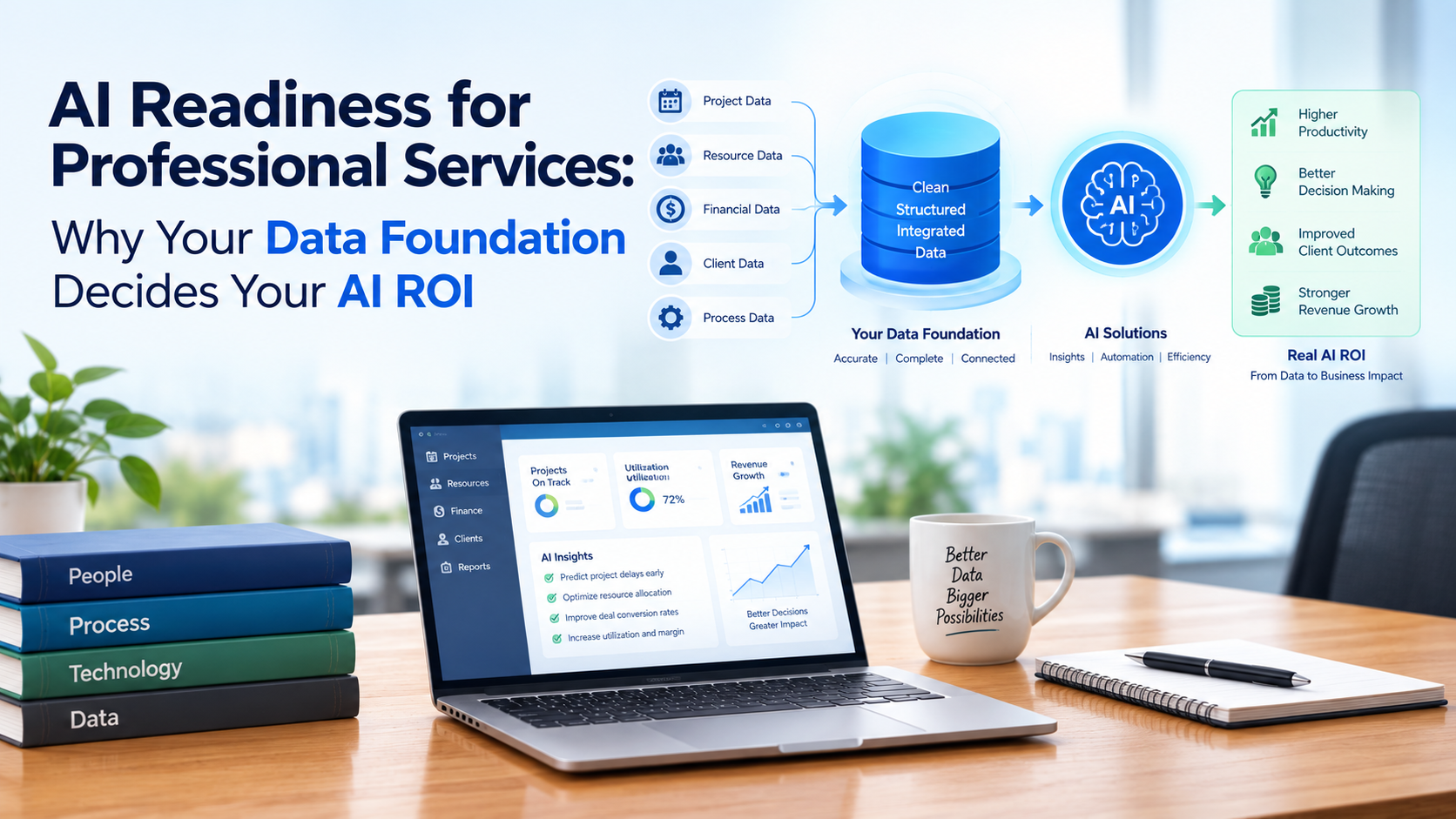
The professional services firms getting real AI ROI in 2026 and the ones that are not share one visible difference: the quality of their operational data. It is not the sophistication of their AI strategy. It is not the size of their AI budget. It is not even which AI platform they chose. The firms delivering 30x to 40x returns on AI investment have clean, connected, timely operational data across their delivery lifecycle. The firms disappointed by their AI results have the same platforms but fragmented, stale, or disconnected data that prevents AI from working as intended. This guide explains what AI readiness actually means for professional services, how to assess where you are, and how to close the gaps.
AI is a reasoning engine. It reasons on data. If your data is incomplete, delayed, or disconnected, your AI will be wrong in proportion to those gaps. Data foundation is not a prerequisite to starting with AI: it is an ongoing investment that determines the ceiling of your AI ROI. The ceiling rises as data quality improves.
The Real Barrier to AI ROI in Professional Services
Every PSA vendor is adding AI features. Every consulting firm is developing an AI strategy. The conversation in the market is almost entirely about which AI to deploy and how quickly. The conversation that rarely happens is the one that would actually determine the outcome: what does the data that AI will reason on look like right now?
AI agents in professional services rely on four categories of operational data: pipeline data to forecast demand, resource data to allocate supply, delivery data to monitor and optimize projects, and financial data to connect activity to revenue. When any of these domains is incomplete, delayed, or disconnected from the others, the AI's recommendations in that domain will be wrong in proportion to the gap. A resource recommendation engine operating on skills data that was last updated 18 months ago will surface candidates who are no longer available, no longer skilled as described, or no longer with the organization. The AI is not broken. The data is.
An AI agent with poor data is not an AI problem. It is a data problem with an expensive wrapper. Fix the data first, then accelerate with AI.
What AI Actually Needs from Your Data
AI recommendations are only as good as the recency of the data they reason on. Timesheets entered weekly instead of daily mean utilization data is always 3 to 5 days behind reality. Pipeline data updated monthly means resource demand forecasts are built on stale opportunity data. Freshness is the first and most impactful data quality dimension to improve.
An AI agent that can see pipeline data but not resource availability cannot make staffing recommendations. An agent that can see project hours but not contract terms cannot calculate billing realization. Data domains that exist in separate systems without integration create reasoning gaps that produce wrong answers even when the underlying data in each system is accurate.
Missing skills records mean certain resources never appear in AI recommendations. Projects without budget data cannot be monitored for margin risk. Clients without payment history produce uninformative AR aging signals. Completeness gaps create blind spots in AI coverage that tend to concentrate around the most complex and highest-risk delivery situations.
If "utilization" means billable hours in one practice and logged hours in another, the AI cannot produce a consistent firm-wide utilization analysis. If project stages are named differently across teams, pipeline-to-delivery data cannot be aggregated. Consistency of definitions and taxonomy is the unglamorous data quality dimension that most firms underinvest in.
The Professional Services Data Maturity Model
| Level | Data State | AI Capability Ceiling | Primary Gap to Fix |
|---|---|---|---|
| Level 1: Fragmented | Data lives in spreadsheets, email, and multiple disconnected tools with no single source of truth | No meaningful AI automation possible. AI produces unreliable outputs. | Implement a connected PSA that consolidates data into one model |
| Level 2: Collected | Data exists in a PSA but is entered inconsistently, often late, with significant gaps in skills, billing, and pipeline data | Basic reporting and descriptive analytics. AI alerts are unreliable. | Enforce data entry discipline, complete skills taxonomy, connect CRM |
| Level 3: Connected | Core data domains are linked (pipeline, resource, delivery, finance) with consistent definitions and daily update cadence | Reliable AI alerts and recommendations. Utilization and billing automation. | Improve data freshness, historical depth, and coverage completeness |
| Level 4: Predictive | 12+ months of clean historical data, real-time updates, full lifecycle connectivity, and consistent taxonomy | Full agentic PSA: predict, recommend, and act autonomously. High-confidence forecasting. | Extend AI scope, tune models on historical outcomes, expand autonomous action boundaries |
Most professional services firms operate at Level 1 or Level 2 when they begin their AI journey. The path from Level 2 to Level 3 is the most impactful transition: it is where AI moves from producing interesting reports to generating actionable recommendations that managers trust and act on. The good news is that this transition typically takes 2 to 4 months with the right platform and the right data discipline, not years.
The Four Data Domains That Determine AI Readiness
-
Pipeline and Deal Data
What AI needs: deal stage, estimated contract value, scope assumptions, required roles and skills, expected start date, probability weighting, and client history. Common gaps: pipeline living in a CRM that does not connect to the PSA, probability estimates that are sales rep opinions rather than historically calibrated win rates, and resource requirements defined at the account level rather than the project level. Without pipeline data, AI cannot forecast resource demand more than 30 days forward, which makes proactive hiring and bench management impossible.
-
Resource and Skills Data
What AI needs: current skill tags with proficiency levels and validation dates, availability by date, cost rate, historical project performance, and location or delivery preference. Common gaps: skills records that were entered at onboarding and never updated, cost rates that are incorrect for current compensation, and availability data that does not reflect approved leave. A resource recommendation engine with stale skills data will surface wrong candidates every time, destroying trust in AI recommendations quickly.
-
Delivery and Timesheet Data
What AI needs: daily timesheet entries by project and task category, milestone completion status, actual vs. planned hours by phase, and client approval events. Common gaps: weekly batch timesheet entry (creates a 3 to 5 day data lag), timesheets attributed to wrong projects, and milestone data that is not updated until billing runs. Daily timesheet capture is the single highest-impact data discipline improvement for AI readiness, because it directly determines the freshness of utilization, margin, and billing data.
-
Financial and Billing Data
What AI needs: rate cards by role, client, and engagement type; invoice status and collection dates; revenue recognition schedule by contract; and budget vs. actual cost by project. Common gaps: rate cards that are not maintained in the PSA (kept in spreadsheets instead), invoices that are raised manually without connecting to timesheet and milestone data, and revenue recognition that is calculated at month end rather than continuously. Without financial data connectivity, AI can monitor delivery health but cannot connect it to financial impact.
How to Audit Your Data Readiness in 5 Questions
If your answer is "it is available at the end of the week" or "we run it monthly," you are at Level 1 or 2 data maturity. Real-time utilization is the baseline for AI-driven bench management.
If fewer than 80% of your billable resources have skill records updated in the last 6 months, resource recommendation AI will be unreliable for a significant portion of your team.
If the answer is more than 5 business days, your financial data is not fresh enough for real-time AI revenue monitoring. The target is automated recognition that updates continuously, not a period-end close exercise.
If resource managers check the CRM separately from the PSA to understand upcoming demand, you have a data connectivity gap that prevents AI from proactive demand forecasting.
If the answer is below 60%, your utilization and delivery data is always stale. Improving daily timesheet compliance is the fastest-impact data quality intervention available to most PS firms.
If you answered positively to 5 of 5, you are at Level 3 to 4 and ready to accelerate AI deployment. 3 to 4: you are at Level 2 to 3 with clear improvement priorities. Fewer than 3: start with data foundation before significant AI investment.
KEBS is designed around the data requirements of the AI agents that run on top of it. Daily timesheet capture with automated reminders reduces data latency from weekly batch to same-day. The skills taxonomy in KEBS RMG includes validation dates and proficiency levels that auto-flag stale records for review. CRM integration with Salesforce and HubSpot connects pipeline data to the resource planning model so that demand forecasting does not require manual data transfer between systems.
Rate card management in KEBS ensures that billing data is always calculated from the current system rate card rather than a manually assembled invoice. Revenue recognition updates continuously from delivery events rather than at period close. The result is that KEBS customers typically reach Level 3 data maturity within 8 to 12 weeks of full deployment, which is when KAIS AI recommendations become reliable enough that managers trust and act on them consistently.
For firms coming from a fragmented data environment, KEBS provides a structured onboarding process specifically designed to build data quality progressively: starting with the highest-impact domains (timesheet freshness and skills completeness) and extending to pipeline connectivity and financial integration as the team develops data discipline. The 11-week average time to AI readiness is not a system constraint: it is the time required to build the operational habits that keep data fresh and complete enough for AI to work as intended.
Frequently Asked Questions
Your AI Is Only as Good as Your Data. KEBS Builds the Foundation.
KEBS connects pipeline, resource, delivery, and financial data in one model with daily freshness, native CRM integration, and automated financial connections. Reach AI-ready data maturity in 8 to 12 weeks. Rated 4.7/5 on G2.
Book a Free Demo →