Best Certinia Alternatives in 2026: A Complete PSA Comparison for Services Leaders
7 PM tools ranked for professional services. Features, comparison table, and verdict.
Date Posted:
October 21, 2026
Share This:
Best Certinia Alternatives in 2026: A Complete PSA Comparison for Services Leaders
Certinia (formerly FinancialForce) built its reputation on one powerful proposition: a Salesforce-native PSA that unifies services delivery, project accounting, and revenue management inside the CRM your sales team already lives in. For large enterprises already committed to the Salesforce ecosystem, that proposition still holds. For everyone else, the cost and dependency are hard to justify.
The pattern that pushes services leaders to look for alternatives is consistent: finance teams love Certinia, delivery teams quietly build workarounds in spreadsheets and Monday.com just to manage their day-to-day work. When that gap opens, the PSA is serving the back office but failing the people actually delivering projects. This guide evaluates 10 Certinia alternatives in 2026 across pricing, AI maturity, Salesforce dependency, and fit for IT services, consulting, and growing delivery teams.
If your firm does not run Salesforce as its CRM backbone, or if delivery teams are working around Certinia rather than with it, KEBS is the top alternative in 2026. It covers the full Quote-to-Cash lifecycle natively, with KAIS AI that observes, predicts, and acts across delivery operations, at role-based pricing from $5 to $49 per user per month. No Salesforce dependency. No $100K+ implementation floor. For mid-market agencies and consultancies, Scoro and Productive offer clean, accessible platforms. For delivery-first teams, Rocketlane leads on client collaboration. But none covers the full IT services and GCC lifecycle like KEBS.
Why Services Leaders Are Rethinking Certinia in 2026
Certinia is a capable platform for the right buyer. But as independent reviews, G2 data, and migration conversations make clear, it is the wrong fit for a significant portion of the organizations that buy it. The reasons cluster into four patterns.
Salesforce dependency inflates total cost of ownership. Certinia requires Salesforce as its infrastructure. For firms not already on Salesforce, that means paying for Salesforce Sales Cloud or Platform licenses in addition to Certinia itself. A 50-person services firm will typically spend $80,000 to $120,000 in year one across both platforms before implementation and training costs are factored in. Even for firms already on Salesforce, every Certinia change requires Salesforce admin involvement, slowing every configuration, integration, and workflow update.
Delivery teams build workarounds. The most consistent pattern in Certinia deployments is that finance owns the system and delivery teams work around it. Project managers track milestones in Smartsheet or Jira. Resource managers maintain capacity in spreadsheets. Time gets batch-entered at the end of the week. The result is a PSA with clean financial outputs but unreliable operational data, which undermines every utilization report and margin forecast built on top of it.
Limited purpose-built AI. Certinia relies on Salesforce Einstein and AgentForce for AI capabilities. These are general-purpose tools built for CRM workflows, not purpose-built PSA intelligence. They can surface pipeline insights but cannot predict staffing gaps, auto-recommend resource assignments based on delivery history, or forecast revenue risk across the delivery lifecycle the way a native AI engine can.
Implementation is a project in itself. Typical Certinia implementations take 4 to 9 months and require a certified Salesforce partner. For growing services firms that need to be operational in weeks rather than quarters, this is a structural barrier.
"Finance loves Certinia. Delivery teams use something else. That gap is where utilization leaks, where margin disappears, and where the PSA investment fails to pay back."
What to Look For in a Certinia Alternative
Your PSA should integrate with your CRM, not depend on it. Look for platforms that connect to Salesforce, HubSpot, or other CRMs via API without requiring that CRM as underlying infrastructure.
A 6-month implementation is a 6-month delay before ROI. Prioritize platforms with guided onboarding, live data within 4 to 8 weeks, and no mandatory SI partner requirement.
General-purpose AI bolted onto a CRM is not the same as an AI engine embedded in the PSA core. Look for platforms where AI predicts staffing gaps, forecasts revenue, and acts on delivery data.
A PSA that only finance loves is a liability. The right alternative must be intuitive enough for project managers, resource managers, and consultants to use daily without training overhead.
Platforms that require a full sales cycle just to quote a price are a warning sign. Published per-user pricing with role-based tiers lets you model real TCO from day one.
Growing services firms cannot afford gaps between their CRM, PSA, HR platform, and finance system. Look for native coverage from deal management through revenue recognition in one data model.
Lifecycle Coverage: Where Certinia Operates vs. Full-Lifecycle Platforms
Certinia covers resource management, project delivery, billing, and financial reporting well, but only within the Salesforce ecosystem. The diagram below shows where each platform category typically operates across the full professional services lifecycle.
Coverage is indicative based on published features and independent PSA reviews 2026. KEBS is the only platform covering all seven stages natively without CRM infrastructure dependency.
The 10 Best Certinia Alternatives in 2026

KEBS is the standout Certinia alternative for 2026 because it solves the core problem that Certinia creates for most services firms: a PSA that works for finance but not for delivery. KEBS covers the complete Quote-to-Cash lifecycle natively, from deal management and resource allocation through project delivery, billing, and revenue recognition, without requiring Salesforce as its underlying infrastructure. It connects to Salesforce, HubSpot, and 36+ other platforms as an integration partner, not a dependency.
KAIS (KEBS AI Suite) is a multi-layer intelligence engine embedded in the operational core of the platform. KII surfaces real-time utilization gaps and margin risk before they become crises. KIR recommends resource assignments based on skill, availability, cost rate, and historical delivery performance. KIA automates staffing actions, billing triggers, project alerts, and three-year revenue forecasts. This is not a CRM AI layer repurposed for PSA use: it was built specifically for the professional services delivery lifecycle.
Backed by KaarTech (SAP Gold Partner, 15+ years), listed on the SAP Store, SOC 2 Type II and ISO 27001 certified. Role-based pricing from $5 to $49 per user per month with no minimum contract floor. Customers include Maveric Systems, Zifo Technologies, Mindsprint, and Agilisium.
- Full lifecycle coverage with zero CRM dependency
- KAIS AI: purpose-built for PS delivery, not repurposed CRM AI
- Role-based pricing from $5/user, no minimum contract floor
- 36+ integrations: Salesforce, SAP, Jira, Keka, HubSpot, NetSuite
- SOC 2 Type II, ISO 27001, SAP Gold Partner backing
- Operational in weeks, not quarters
- Primarily optimized for IT/ITeS, GCC, and consulting verticals
- Full KAIS AI depth requires structured onboarding investment
- Very small firms (under 10 users) may not need all lifecycle modules
Certinia requires Salesforce as infrastructure, adding $40,000 to $80,000+ in platform costs for firms not already on it, plus 4 to 9 months implementation. KEBS starts at $5 per user, deploys in weeks, integrates with Salesforce without depending on it, and includes a purpose-built AI engine that Certinia cannot match. For IT services firms, GCCs, and consulting organizations, KEBS replaces Certinia and eliminates the Salesforce overhead entirely.

Kantata is a strong Certinia alternative for large enterprise professional services organizations, particularly those that want deep resource management and financial forecasting without mandatory Salesforce infrastructure. Kantata offers both a Salesforce-native version (for firms already on Salesforce) and an open infrastructure option (for those that are not), giving enterprise buyers flexibility that Certinia does not.
The trade-offs are significant: custom contracts typically start at $25,000 to $60,000 per year minimum, implementation timelines run 3 to 6 months, and the interface consistently draws complaints for being dated. For growing firms under 50 users, Kantata is rarely accessible or appropriate. But for large organizations evaluating Certinia, Kantata is the most structurally comparable alternative.
- Salesforce-native or open deployment options
- Enterprise-grade resource forecasting and capacity planning
- Strong financial governance and project accounting
- No mandatory Salesforce dependency in open version
- Custom pricing, minimum $25K+ annual contract
- 3 to 6 month implementation typical
- Interface is dated vs. modern alternatives
- Not accessible for firms under 50 users
Kantata is the closest structural alternative to Certinia for large enterprises: similar depth, similar cost, similar complexity. The key advantage over Certinia is the open deployment option that removes Salesforce dependency. For firms that want enterprise PSA capability without mandatory CRM lock-in, Kantata is a stronger choice than Certinia.

Scoro is a compelling Certinia alternative for mid-market agencies, IT consultancies, and professional services firms that want a single platform covering CRM, project management, time tracking, billing, and financial reporting without Salesforce dependency. Its clean UI, strong financial dashboards, and 1,000+ integrations make it accessible and practical for firms in the 10 to 200 user range.
Scoro covers the quote-to-cash workflow with genuine depth for agency-style delivery models: proposal creation, project planning, utilization tracking, invoicing, and profitability reporting all in one data model. The gap vs. Certinia is in enterprise resource management depth, AI maturity, and multi-entity financial governance at scale. For most mid-market firms that do not need those enterprise capabilities, Scoro offers better ROI and faster deployment than Certinia.
- No Salesforce dependency, CRM included natively
- Accessible pricing from $26/user/month
- Strong financial dashboards and profitability simulation
- 1,000+ integrations, fast setup (4 to 8 weeks typical)
- AI features are emerging, not mature
- Enterprise resource management less deep than Certinia
- Complex billing or multi-entity scenarios need workarounds
- Better for agencies than large IT delivery orgs
Scoro removes the Salesforce dependency entirely and delivers the PSA workflow most mid-market firms actually need at a fraction of Certinia's cost. Certinia wins on enterprise revenue recognition depth and Salesforce ecosystem integration. For firms not committed to Salesforce, Scoro delivers better usability and TCO in the mid-market.

BigTime is a well-established PSA with strong time capture, expense management, and billing automation workflows. It is a practical Certinia alternative for mid-market professional services firms that primarily need time-to-invoice automation without the Salesforce overhead. Pricing is transparent, implementation is typically complete within 60 days, and the billing workflow depth for accounting and engineering firms is solid.
As a Certinia alternative, BigTime covers billing and project tracking well but does not match Certinia on enterprise resource management, revenue recognition complexity, or financial governance at scale. For firms that need the latter, BigTime will require supplementary tools. For firms that primarily need better billing automation at a lower cost, BigTime delivers strong ROI.
- Transparent pricing from $20/user, no Salesforce dependency
- Strong billing workflow for accounting and engineering firms
- Fast implementation, typically 60 days to go live
- Good integration with QuickBooks, Sage, and accounting platforms
- No AI-driven resource forecasting or revenue recognition
- Reporting customization is limited vs. enterprise PSA
- Not suited for complex multi-entity or GCC operations
- Mobile experience weaker than desktop
BigTime is a significantly more accessible alternative to Certinia for mid-market firms: lower price, faster deployment, no Salesforce requirement. Certinia leads on enterprise financial governance and revenue recognition at scale. BigTime leads on billing workflow simplicity and accounting firm fit. Neither matches KEBS on full lifecycle AI automation.

Rocketlane is the strongest Certinia alternative for teams where delivery experience and client collaboration are the primary priority. Its client portal, shared project workspaces, and real-time delivery visibility are among the best in the PSA category. For SaaS implementation teams and professional services organizations that need delivery teams and clients to work in the same system, Rocketlane is a compelling choice.
Rocketlane covers projects, time tracking, resource management, billing, and financial operations in a unified platform. Its pricing starts at $19 per user per month, implementation takes weeks rather than months, and adoption rates among delivery teams are consistently higher than enterprise alternatives. The gap vs. Certinia is in multi-entity financial governance and deep revenue recognition at enterprise scale.
- Best-in-class client portal and delivery collaboration
- No Salesforce dependency, fast deployment in weeks
- Accessible entry pricing from $19/user/month
- High delivery team adoption vs. enterprise PSA alternatives
- Multi-entity financial governance less mature than Certinia
- Advanced AI features gated to Premium tier ($69/user)
- Less suited for large-scale IT delivery or GCC operations
- Minimum 5 seats on all plans
Rocketlane solves the Certinia adoption problem directly: delivery teams actually use it. Client collaboration and project experience are significantly better. Certinia wins on Salesforce-native financial depth and enterprise revenue recognition. For delivery-led firms where client experience matters more than back-office financial governance, Rocketlane is a more practical alternative.

Productive is a high-satisfaction PSA platform widely used by creative agencies, digital consultancies, and smaller professional services teams. It covers the full agency PSA lifecycle from quote to invoice with an intuitive interface, fast setup, and competitive pricing starting at $10 per user per month. The platform earns consistently strong G2 scores for usability and value, particularly among teams that want financial visibility without enterprise PSA complexity.
As a Certinia alternative, Productive is most relevant for firms where Certinia is overkill: small to mid-market agency-style delivery organizations that do not need Salesforce integration depth or complex revenue recognition governance. For IT services firms, GCCs, or large consulting organizations with complex billing models, Productive's scope is more limited.
- Accessible pricing from $10/user, no Salesforce dependency
- Excellent UI and fast onboarding (1 to 3 weeks typical)
- Strong quote-to-invoice visibility for agency delivery
- High G2 satisfaction (4.7/5)
- Advanced forecasting gated to highest pricing tier
- Not suited for complex IT delivery or multi-entity operations
- AI maturity limited vs. AI-native platforms
- Enterprise financial governance depth is below Certinia
Productive is only a direct Certinia alternative for smaller, agency-style firms. For those firms, Productive is a dramatically better choice: lower cost, faster implementation, higher adoption, no Salesforce dependency. For enterprise professional services organizations, Productive does not match Certinia's financial governance depth or resource management scale.

Accelo is a quote-to-cash automation platform that links sales, project delivery, time tracking, retainers, and invoicing in a single system for small and mid-size service businesses. It emphasizes operational consistency and automation of administrative overhead, which makes it a practical alternative to Certinia for firms that primarily need to connect sales and delivery in one platform without enterprise complexity or cost.
Accelo's modular structure lets smaller firms start with specific components and expand over time. The full platform at $79 per user per month can become costly at scale. Resource management and AI forecasting depth are more limited than enterprise PSA alternatives, and the reporting layer is less robust than Scoro or KEBS for firms that need executive-level margin visibility.
- No Salesforce dependency, modular pricing for SMBs
- Strong process automation from sales through invoicing
- Good retainer management for recurring services
- Faster setup than enterprise PSA alternatives
- Full platform at $79/user adds up quickly at scale
- Limited AI and forecasting depth
- Not designed for large IT delivery or GCC operations
- Reporting less mature than Scoro or KEBS
Accelo and Certinia serve entirely different market segments. Certinia targets large enterprises with complex Salesforce ecosystems; Accelo targets SMBs that want fast deployment and process automation. For small service firms where Certinia is a mismatch on price and complexity, Accelo is a practical alternative. For firms at scale, neither Accelo nor Certinia provides the AI-native automation that KEBS delivers.

Projectworks is a purpose-built consulting PSA that connects time tracking, resource planning, expense management, invoicing, and live financial reporting in a single platform. Built by practitioners with consulting firm backgrounds, it has a practical, finance-oriented approach to project profitability that resonates with engineering, architecture, and management consulting firms that need margin visibility without enterprise complexity.
Projectworks integrates natively with Xero, QuickBooks, MYOB, Jira, Azure DevOps, and Salesforce. Strong user satisfaction (4.6/5 on G2) and a focus on real-time project financial visibility make it a strong mid-market alternative for consulting firms where Certinia is either too expensive or too Salesforce-dependent.
- Built specifically for consulting firm financial workflows
- Real-time project profitability and margin visibility
- Native Xero, QuickBooks, Jira, Salesforce integrations
- High G2 satisfaction (4.6/5)
- Less suited to large IT delivery or multi-entity GCC operations
- AI features limited vs. AI-native platforms
- Narrower vertical focus than full-suite PSA platforms
- Implementation support varies by region
Projectworks is a more accessible, faster-to-deploy alternative to Certinia for engineering and consulting firms. It removes the Salesforce dependency entirely and delivers strong financial visibility at a lower TCO. Certinia leads on enterprise revenue recognition complexity and Salesforce ecosystem depth. For mid-market consulting firms, Projectworks typically delivers better ROI.

Birdview PSA is known for its visual approach to resource management, workload planning, and project portfolio visibility. Gantt charts, capacity heatmaps, and real-time project status dashboards make it easy for operations managers to see team availability and project health at a glance. The platform is popular with mid-size professional services teams that want better delivery visibility without enterprise PSA complexity.
Birdview's financial management depth and AI capabilities are more limited than top-tier PSA alternatives. It is a strong operational planning tool for delivery-first teams, but not a comprehensive replacement for Certinia's financial governance capabilities at enterprise scale.
- Strong visual resource planning and Gantt views
- Intuitive workload management interface
- No Salesforce dependency
- Good for mid-size delivery team visibility
- Financial management depth is limited vs. enterprise PSA
- AI features are minimal
- Not a full Quote-to-Cash platform
- Custom pricing only, no published rate card
Birdview PSA and Certinia serve different needs. Certinia is a financial governance platform with delivery capabilities; Birdview is a delivery visibility platform with limited financial depth. As a Certinia alternative, Birdview is only relevant for firms that primarily need better resource planning and workload visibility rather than financial governance.

Teamwork is a project and client work platform with a strong focus on agency delivery, client portals, and time tracking. It is accessible, well-designed, and popular with marketing agencies, creative studios, and smaller consulting firms that need structured delivery visibility and client communication in one platform. Pricing from $13.99 per user per month makes it one of the most cost-effective options in this guide.
As a Certinia alternative, Teamwork is only relevant for firms with significantly simpler needs than Certinia addresses. It does not match Certinia on financial governance, revenue recognition, or enterprise resource management. For firms moving down-market from Certinia to a simpler, lower-cost delivery tool, Teamwork is worth considering. For firms that need full PSA capability, it is a point tool rather than a platform replacement.
- Accessible pricing from $13.99/user, no Salesforce dependency
- Strong client portal and delivery collaboration
- Fast onboarding (1 to 4 weeks typical)
- Not a full PSA platform, limited financial depth
- AI capabilities are minimal
- Not suited for complex billing or GCC operations
Teamwork is a project delivery and collaboration tool, not a PSA replacement for Certinia. For small agencies moving away from Certinia due to cost and complexity, Teamwork provides a practical simplification. For any organization that needed Certinia's financial depth, Teamwork is not a viable replacement.
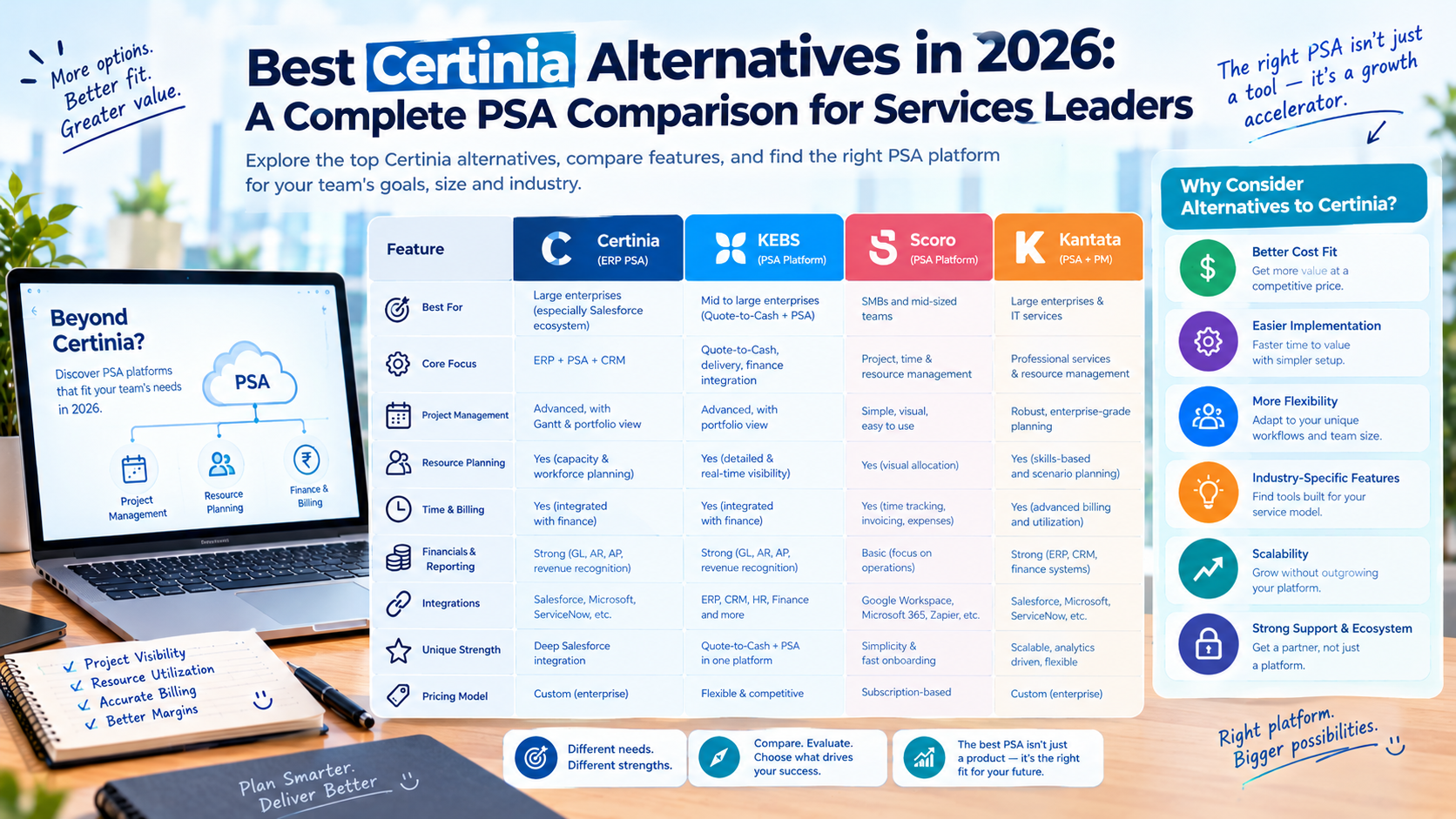
Side-by-Side Comparison: Certinia Alternatives in 2026
| Platform | Starting Price | Salesforce Dependency | AI Depth | Full Lifecycle | Impl. Speed | Best Fit |
|---|---|---|---|---|---|---|
| KEBS | $5 to $49/user | None (integrates) | Multi-layer KAIS AI | Yes | Weeks | IT/ITeS, GCC, Consulting |
| Certinia PSA | Custom enterprise | Required | Einstein/AgentForce (CRM AI) | Partial (Salesforce only) | 4 to 9 months | Salesforce enterprise |
| Kantata | $60+/user (custom) | Optional (open version) | Emerging | Partial | 3 to 6 months | Large enterprise PS |
| Scoro | From $26/user | None | Emerging | Broad, agency-focused | 4 to 8 weeks | Agencies, consultancies |
| BigTime | From $20/user | None | Limited | Partial (billing focus) | 60 days | Mid-market billing-first |
| Rocketlane | From $19/user | None | Growing | Partial (delivery focus) | Weeks | SaaS onboarding, PS teams |
| Productive | From $10/user | None | Limited | Agency-focused | 1 to 3 weeks | Creative agencies |
| Accelo | $39 to $79/user | None | Minimal | Partial | 4 to 8 weeks | SMB service firms |
| Projectworks | From $37/user | None | Minimal | Partial | 4 to 8 weeks | Consulting, engineering |
| Birdview PSA | Custom | None | Minimal | No (delivery only) | Weeks | Mid-size delivery teams |
| Teamwork | From $13.99/user | None | Minimal | No | 1 to 4 weeks | Agencies, client services |
How to Choose the Right Certinia Alternative
Frequently Asked Questions
Move Beyond Salesforce Dependency. Run Your Full Services Lifecycle on KEBS.
KEBS is the AI-native Quote-to-Cash PSA built for IT/ITeS firms, GCCs, BPOs, and consulting teams. No CRM lock-in. Full lifecycle coverage. Transparent pricing from $5 per user. Rated 4.7/5 on G2.
Book a Free Demo →