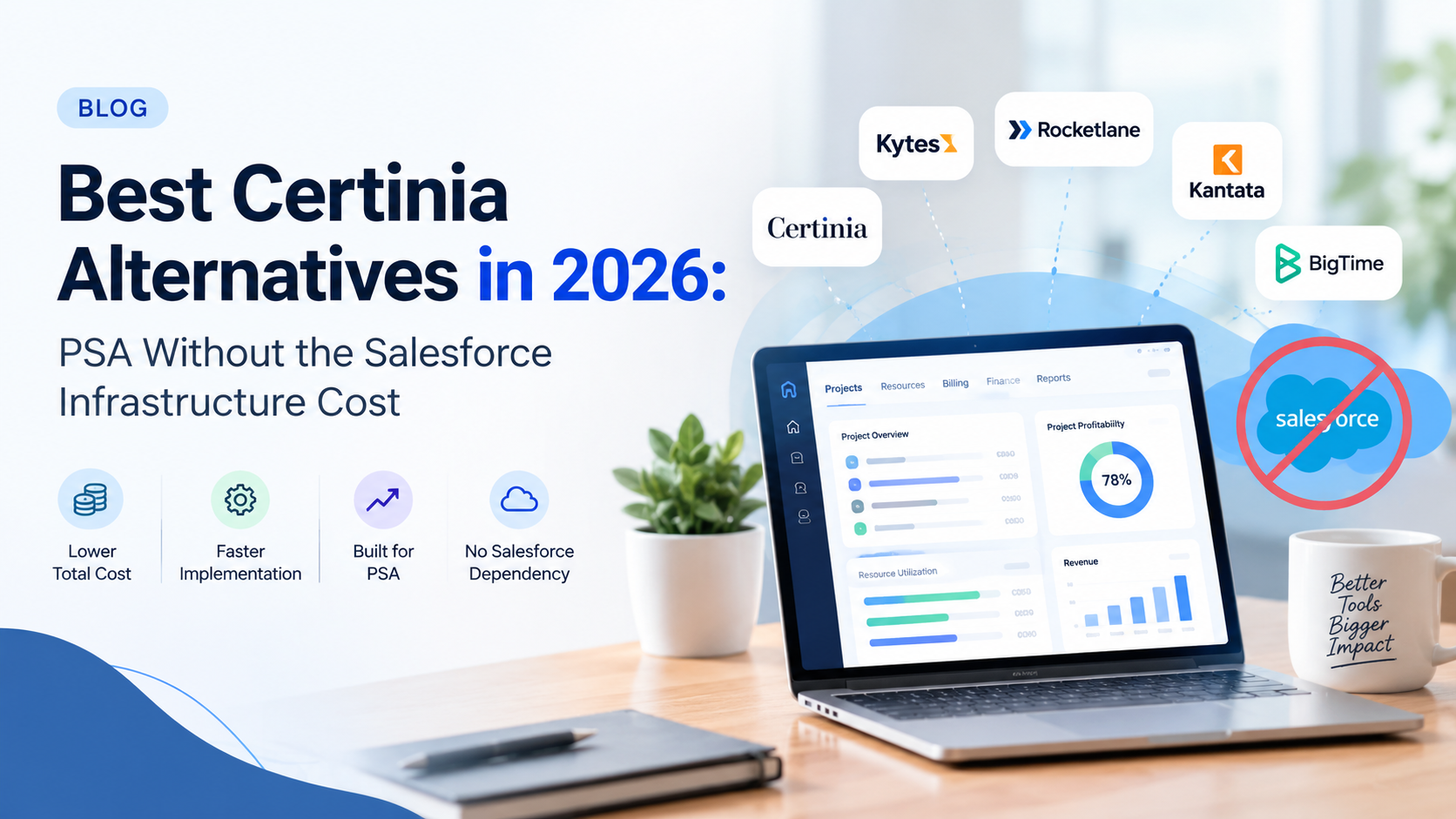
Best Certinia Alternatives in 2026: PSA Without the Salesforce Infrastructure Cost
7 PM tools ranked for professional services. Features, comparison table, and verdict.
Date Posted:
September 11, 2026
Share This:
Best Certinia Alternatives in 2026: PSA Without the Salesforce Infrastructure Cost
Certinia (formerly FinancialForce) is the incumbent choice for professional services firms that are already deeply committed to Salesforce and need a PSA that runs in the same data model. Its revenue recognition capabilities are genuinely strong, and for Salesforce-native organizations, the integration depth is real. But Certinia is consistently cited for two problems that drive firms to alternatives: the Salesforce infrastructure cost ($40,000 to $80,000-plus annually in Salesforce licensing for firms not already on the platform) and the implementation timeline (4 to 9 months requiring SI partner involvement). Add that Certinia has no native Keka, Darwinbox, or SAP integration, no support for the India-US multi-entity billing model, and no ITSM coverage, and the field of Certinia alternatives grows quickly. This guide covers who the right alternatives are and what each one is actually better at.
For IT/ITeS firms, GCCs, and MSPs that want Certinia's financial governance without the Salesforce overhead: KEBS with ASC 606 automation, native Keka/SAP/Darwinbox integration, multi-entity INR/USD billing, and KAIS AI at $5 to $49/user. For large enterprise PS firmly on Salesforce: stay on Certinia or evaluate Kantata. For mid-market all-in-one: Scoro. For billing-first US teams: BigTime.
Why Firms Look Beyond Certinia
What Certinia Does Well
| Capability | Certinia Strength | When It Is the Right Choice |
|---|---|---|
| Revenue recognition | Best-in-class ASC 606 and IFRS 15 revenue recognition within the Salesforce data model, with deep support for complex contract modifications and variable consideration | Enterprise PS firms with complex multi-element arrangements and strict external audit requirements, already on Salesforce |
| Salesforce-native operation | Full native integration with Salesforce CRM, Sales Cloud, and Service Cloud; single data model across sales, delivery, and finance for Salesforce-committed organizations | Firms where Salesforce is the system of record and eliminating the CRM-PSA integration gap is the primary driver |
| Project accounting | Deep project accounting with budget management, cost allocation, and financial reporting that meets enterprise audit requirements | Large PS firms with complex project cost structures and multi-entity financial consolidation requirements |
| Established ecosystem | Large SI partner ecosystem, extensive AppExchange integration library, and long track record in enterprise professional services | Organizations that prioritize vendor stability, partner availability, and ecosystem depth over implementation speed |
Top 6 Certinia Alternatives in 2026
1. KEBS
Best for: IT/ITeS firms, GCCs, MSPs needing financial governance without Salesforce overhead | G2: 4.7/5 | From $5/user
KEBS delivers the capabilities that drive Certinia evaluations (ASC 606 revenue recognition, project financial governance, multi-entity billing) without requiring Salesforce infrastructure. ASC 606-compliant revenue recognition for all contract types (T&M, fixed-price, milestone, retainer, variable) is automated from billing events without manual journal entries. Multi-entity INR/USD billing with GST compliance and transfer pricing support is native for the India-US delivery model. KAIS AI (KII, KIR, KIA) operates at three agentic layers that exceed Salesforce Einstein's PSA capabilities in bench management and billing automation. Native Keka, Darwinbox, and SAP integration eliminates the custom development Certinia requires for the Indian IT ecosystem. Role-based pricing from $5 to $49/user. No Salesforce license required. 4 to 8 week implementation. G2: 4.7/5.
2. Kantata
Best for: Large enterprise PS firms seeking enterprise resource management without Salesforce dependency | G2: 4.1/5 | Custom ($25K+ minimum)
Kantata is available in a Salesforce-native and a standalone variant. For firms evaluating Certinia and wanting to avoid Salesforce infrastructure dependency, Kantata standalone is the enterprise alternative. Deep resource forecasting and financial governance at enterprise scale. Trade-offs: $25,000-plus annual minimum, 3 to 6 month implementation, no native Keka or SAP integration. G2 satisfaction is lower than KEBS and mid-market alternatives.
3. Scoro
Best for: Mid-market consultancies wanting CRM + PSA + billing without Salesforce | G2: 4.5/5 | From $26/user
Scoro covers the commercial lifecycle from quoting through billing with its own built-in CRM, eliminating the need for Salesforce to power the pipeline-to-delivery connection. A practical alternative for mid-market consultancies that evaluated Certinia and found the Salesforce infrastructure requirement unjustifiable. No ITSM, no Keka or SAP integration, no multi-entity INR/USD billing, but strong for UK and European mid-market delivery operations.
4. BigTime
Best for: US professional services firms needing financial management without Salesforce overhead | G2: 4.5/5 | From $20/user
BigTime delivers reliable billing automation and deep QuickBooks, Sage, and NetSuite integration at accessible pricing without the Salesforce infrastructure requirement. For PS firms evaluating Certinia primarily for billing and accounting integration, BigTime covers the billing requirements at a fraction of the cost. No ASC 606 automated recognition, no multi-entity billing, no resource management AI. Best for billing-first requirements.
5. Projectworks
Best for: Consulting firms needing project financial visibility without Salesforce | G2: 4.6/5 | From $37/user
Projectworks delivers strong real-time project profitability, resource scheduling, and billing without requiring Salesforce infrastructure. Higher usability scores than Certinia and a faster implementation timeline. Limited for IT services-specific requirements: no ITSM, no Keka or SAP integration, no multi-entity INR/USD billing. Suited for consulting and engineering firms, not for Indian IT/ITeS or GCC delivery.
6. Rocketlane
Best for: IT implementation teams needing delivery management without Salesforce | G2: 4.5/5 | From $19/user
Rocketlane covers the project delivery phase with best-in-class client portal and onboarding automation, without requiring Salesforce infrastructure. For firms evaluating Certinia for delivery management rather than financial governance, Rocketlane is a faster, cheaper, and better-UX alternative for the delivery phase. Limited for resource management at scale, financial governance, and IT/ITeS-specific requirements.
Full Comparison Table: Certinia vs Alternatives 2026
| Capability | Certinia | KEBS | Kantata | Scoro | BigTime | Projectworks |
|---|---|---|---|---|---|---|
| Revenue recognition | Best-in-class (ASC 606) | ASC 606 automated | Strong | Basic | Basic | Standard |
| Salesforce dependency | Required ($40K-80K+/yr) | Not required | Optional (standalone) | Not required | Not required | Not required |
| Keka / SAP (native) | Custom API | Native | Custom API | None | None | None |
| AI bench management | Einstein (basic) | Agentic (KII/KIR/KIA) | Emerging | None | None | None |
| Multi-entity INR/USD | Salesforce multi-org only | Native | Limited | Limited | No | No |
| Native ITSM | No | Native | No | No | No | No |
| GCC operations | No | Built for it | Partial | No | No | No |
| G2 Rating | 4.2 | 4.7 | 4.1 | 4.5 | 4.5 | 4.6 |
| Implementation speed | 4 to 9 months + SI | 4 to 8 weeks | 3 to 6 months + SI | 6 to 10 weeks | 4 to 6 weeks | 4 to 6 weeks |
TCO: The Salesforce Infrastructure Cost in Context
The most decisive number in any Certinia evaluation for a firm not already on Salesforce is the Salesforce infrastructure cost. Here is what it means in total 3-year TCO for a 50-user deployment:
| Cost Component | Certinia (non-Salesforce firm) | KEBS Equivalent |
|---|---|---|
| Year 1 PSA licensing | $35,000 to $50,000 | $12,000 to $18,000 |
| Salesforce infrastructure (Year 1) | $40,000 to $80,000 (additional) | Not required ($0) |
| Implementation + SI partner | $70,000 to $130,000 | $5,000 to $8,000 |
| Integration development (Keka, SAP) | $20,000 to $40,000 | Included in licensing |
| Year 2 to 3 licensing (PSA + Salesforce) | $150,000 to $260,000 | $24,000 to $36,000 |
| 3-Year Total TCO | $315,000 to $560,000 | $41,000 to $62,000 |
For a firm already on Salesforce Enterprise, the Salesforce infrastructure cost drops to zero (incremental licensing only), making the Certinia comparison much more competitive. The TCO analysis above applies specifically to firms not already running Salesforce, which is the majority of Indian IT services firms, GCCs, and mid-market PS organizations evaluating PSA software in 2026.
Which Certinia Alternative for Which Profile
| Your Profile | Best Alternative | Primary Reason |
|---|---|---|
| IT/ITeS or GCC firm not on Salesforce, needing financial governance and India delivery billing | KEBS | ASC 606 automated recognition + native Keka/SAP + multi-entity INR/USD + KAIS AI, no Salesforce required |
| Large enterprise PS firm already on Salesforce, needing enterprise PSA in Salesforce data model | Stay on Certinia | If Salesforce infrastructure cost is already sunk, Certinia's integration depth is genuinely valuable |
| Large enterprise PS not on Salesforce, needing enterprise resource management | Kantata (standalone) | Enterprise resource forecasting without Salesforce dependency; accept the implementation cost and timeline |
| Mid-market consultancy needing CRM + delivery + billing without Salesforce | Scoro | Built-in CRM eliminates Salesforce dependency; strong mid-market coverage at published pricing |
| US PS firm needing billing and accounting integration primarily | BigTime | Billing automation without Salesforce or SI partner; QuickBooks/Sage/NetSuite native |
The case for Certinia is fundamentally a case for the Salesforce data model: if your organisation is already committed to Salesforce and the single-system data model is worth the infrastructure cost, Certinia's revenue recognition and project accounting depth is real. For organizations not already on Salesforce, the $40,000 to $80,000 annual infrastructure cost is a tax on using Certinia that makes every other aspect of the comparison secondary.
KEBS provides ASC 606-compliant revenue recognition for all PS contract types (T&M, fixed-price, milestone, retainer, variable consideration) as a native platform capability, not as a Salesforce extension. Revenue recognition runs automatically from billing events without manual journal entries, with exception routing for complex treatments (contract modifications, variable consideration probability reassessment). The KEBS finance module handles multi-entity consolidation, intercompany elimination entries, and entity-level financial reporting for organizations with India-plus-global structures.
For the Indian IT services market specifically, KEBS adds capabilities that Certinia structurally cannot provide: native Keka and Darwinbox HRIS integration, native SAP ERP connectivity (KaarTech is an SAP Gold Partner), INR/USD multi-entity billing with GST compliance, and KAIS AI operating at three agentic layers across bench management, resource matching, and billing automation. The total 3-year cost for a 50-user IT services firm is $41,000 to $62,000 for KEBS vs $315,000 to $560,000 for Certinia without existing Salesforce infrastructure. That difference funds years of operational improvement from the PSA itself. KEBS rated 4.7/5 on G2 vs Certinia 4.2/5. Role-based pricing from $5 to $49/user. No minimum contract floor.
Frequently Asked Questions
ASC 606. Multi-Entity Billing. KAIS AI. No Salesforce License Required.
KEBS delivers enterprise financial governance for IT services firms at $5 to $49/user, in 4 to 8 weeks, without the Salesforce infrastructure cost. Native Keka, SAP, and Darwinbox integration included. Rated 4.7/5 on G2 vs Certinia 4.2/5.
Book a Free Demo →