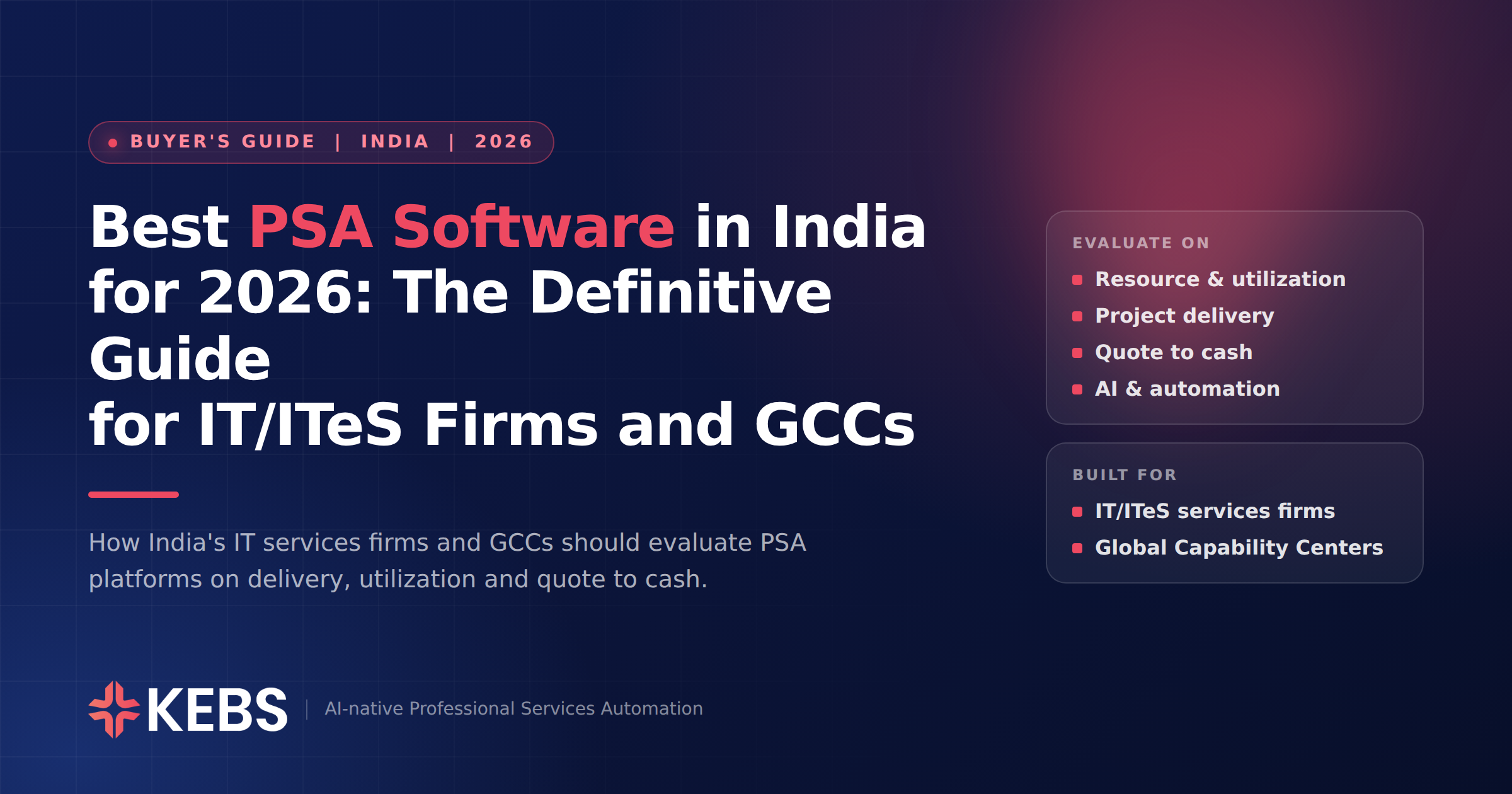
Best PSA Software in India for 2026
7 PM tools ranked for professional services. Features, comparison table, and verdict.
Date Posted:
September 16, 2026
Share This:
Best PSA Software in India for 2026: The Definitive Guide for IT/ITeS Firms and GCCs
The PSA software market in India is growing rapidly but remains dominated by platforms designed for US and European professional services firms. The operational reality of Indian IT services delivery, the HRIS stack (Keka, Darwinbox, greytHR), the ERP landscape (SAP, Oracle), the multi-entity billing structure for India-to-global delivery, the GCC intercompany chargeback model, and the scale of bench management challenges in large delivery pools, none of these are the primary use cases for which most PSA vendors built their platforms. This guide evaluates the PSA options available to Indian IT/ITeS firms and GCCs in 2026, and identifies where the operational requirements of Indian delivery organizations are and are not covered by each platform.
KEBS is the only PSA built specifically for Indian IT/ITeS firms, GCCs, and managed service providers, with native Keka, Darwinbox, and SAP integration, multi-entity INR/USD billing with GST compliance, KAIS AI for bench management at Indian delivery pool scale, and ITSM for managed services alongside project delivery. It is also the only India-headquartered PSA in this review. All other platforms reviewed are designed for non-Indian primary markets and require significant customisation or workarounds for Indian operational requirements.
India's Professional Services Landscape in 2026
India's professional services delivery operates at a scale and with a structural complexity that most Western PSA platforms were not designed for. Understanding the specific characteristics of Indian IT services delivery is the prerequisite for a meaningful PSA evaluation:
| Characteristic | Indian IT Services Reality | PSA Implication |
|---|---|---|
| Delivery pool scale | 50 to 10,000+ billable resources in a single delivery organisation, managed across practices by technology stack | AI-native bench management that monitors continuously, not weekly dashboard reviews by human resource managers |
| HRIS stack | Keka, Darwinbox, greytHR, and SAP SuccessFactors dominate the Indian IT market. Western HRIS platforms (Workday, BambooHR) have limited penetration below the top 10 firms. | Native HRIS integration for India-dominant platforms, not just Workday and BambooHR |
| ERP landscape | SAP dominates among mid-to-large IT services firms. NetSuite is common among newer mid-market firms. Oracle is prevalent in firms with US parent entities. | Native SAP integration without custom development; KaarTech's SAP Gold Partner status is directly relevant |
| Billing model | India entity billing to US or European clients (T&M in USD from India), or India GCC billing to US parent (intercompany INR/USD), or both simultaneously | Multi-entity INR/USD billing with GST compliance and transfer pricing documentation support |
| Managed services + project delivery | Most mid-to-large IT services firms manage support contracts (SLA-governed) alongside project delivery engagements | Native ITSM with ticket-to-invoice automation in the same platform as project management |
| Time zones | India team delivers to US and European clients across 5 to 12 hour time zone differences, with 3 to 5 hours daily overlap | Time-zone-aware operations: India day-end timesheet cut-off, US-side approval workflows |
What Indian IT Firms Need That Western PSA Platforms Often Lack
Top PSA Tools for Indian IT/ITeS Firms and GCCs in 2026
1. KEBS
Best for: Indian IT/ITeS firms, GCCs, MSPs of all sizes | G2: 4.7/5 | From $5/user | India-headquartered
KEBS is the only PSA in this list built specifically for Indian IT services delivery, by KaarTech, an SAP Gold Partner based in India with 20-plus years of IT services delivery experience. The platform reflects the actual operational reality of Indian IT firms: a skills taxonomy organised by technology stack (not generic roles), KAIS AI operating at three agentic layers (KII inform, KIR recommend, KIA act) for bench management at Indian delivery pool scale, native Keka, Darwinbox, and greytHR HRIS integration, native SAP and Oracle ERP integration, multi-entity INR/USD billing with GST compliance and transfer pricing support, native ITSM for managed services alongside project delivery, and time-zone-aware operations for India-US delivery. SOC 2 Type II and ISO 27001 certified. Role-based pricing from $5 to $49/user with no minimum contract floor. 4 to 8 week implementation. Customers: Maveric Systems, Zifo Technologies, Mindsprint, Agilisium.
2. Kantata
Best for: Very large Indian IT enterprises (500+ users) with enterprise resource management requirements | G2: 4.1/5 | Custom ($25K+ minimum)
Kantata offers deep enterprise resource forecasting for very large organizations. No native Keka, Darwinbox, or SAP integration (custom API required at $10,000 to $30,000 per connection). Limited multi-entity INR/USD billing support. No native ITSM. Implementation takes 3 to 6 months with mandatory SI partner. Appropriate only for the largest Indian IT organizations where resource management complexity justifies the enterprise cost, and where IT teams can absorb the integration development overhead for Indian ecosystem tools.
3. Certinia
Best for: Indian subsidiaries of US companies already committed to Salesforce | G2: 4.2/5 | Custom + Salesforce cost
Certinia runs on Salesforce, requiring $40,000 to $80,000-plus in annual Salesforce infrastructure for firms not already on the platform. No native Keka, Darwinbox, or SAP integration. Limited support for INR invoicing and GST compliance. Implementation 4 to 9 months. The right choice only for Indian organizations whose US parent entity mandates Salesforce infrastructure, making the incremental Certinia cost justifiable against the already-sunk Salesforce investment.
4. BigTime
Best for: Indian consulting subsidiaries of US firms with USD-only billing and QuickBooks/Sage integration requirements | G2: 4.5/5 | From $20/user
BigTime is a practical billing-first PSA for small Indian IT consulting teams with US-only billing and no HRIS integration requirement. No INR invoicing, no GST support, no Keka or SAP integration, no multi-entity billing, no bench management AI. Appropriate for very small Indian consulting operations (under 20 users) with straightforward USD T&M billing as the sole requirement.
5. Scoro
Best for: Indian boutique consultancies with European or UK client portfolios | G2: 4.5/5 | From $26/user
Scoro is a mid-market all-in-one platform with CRM, project management, and billing. No INR invoicing with GST, no Keka or SAP integration, no multi-entity INR/USD billing, no ITSM. Better suited for boutique Indian consultancies with European delivery than for Indian IT services firms with domestic billing or GCC operations.
Full Comparison: PSA Software for Indian IT Firms 2026
| Capability | KEBS | Kantata | Certinia | BigTime | Scoro |
|---|---|---|---|---|---|
| India-headquartered | Yes (KaarTech) | No (US) | No (US) | No (US) | No (EU) |
| Keka / Darwinbox (native) | Native | Custom API | Custom API | None | None |
| SAP ERP (native) | Native (Gold Partner) | None | None | None | None |
| INR invoicing + GST | Native | No | Limited (Salesforce) | No | No |
| Multi-entity INR/USD billing | Native | Limited | Salesforce multi-org | No | Limited |
| AI bench management | Agentic (KII/KIR/KIA) | Emerging | Einstein (basic) | None | None |
| Native ITSM | Native | No | No | No | No |
| GCC intercompany billing | Built for it | Partial | No | No | No |
| Transfer pricing docs | Native | Partial | No | No | No |
| G2 Rating | 4.7 | 4.1 | 4.2 | 4.5 | 4.5 |
| Indian support (IST) | India-based CS team | US hours only | US hours primarily | US hours only | EU hours primarily |
The Keka and SAP Integration Gap: Why It Matters More Than Vendors Acknowledge
Keka is the HRIS platform for the majority of India's mid-to-large IT services firms. SAP is the ERP for most of the same firms. A PSA without native connectors for both creates three operational problems that compound over time:
| Data Type | Without Native Integration | With Native Integration (KEBS) |
|---|---|---|
| Employee cost rates | Manually entered and updated in PSA; lag of 1 to 4 weeks when Keka records change due to increment or promotion; cost rate errors flow directly into billing and margin calculations | Cost rates pulled from Keka daily; any salary change in Keka updates PSA cost rates automatically; billing and margin calculations always reflect current cost |
| Leave and availability | Leave taken in Keka is not reflected in PSA availability calendar until manually entered; resource managers allocate against resources who are on leave, producing allocation errors and billing disputes | Leave approved in Keka updates PSA availability in real time; resource matching and capacity forecasting reflect actual availability without manual sync |
| New hire onboarding | New employees in Keka do not appear in PSA until HR manually creates their profile; resources are invisible to allocation for weeks after joining | New hire in Keka triggers automatic profile creation in KEBS; skills completion prompt sent within 30 days; resource available for matching from joining date |
| Financial consolidation (SAP) | PSA billing data must be manually exported and re-entered in SAP for financial consolidation at period end; month-end close takes 3 to 5 additional working days for reconciliation | PSA billing data flows to SAP automatically; period-end close does not require manual PSA-to-SAP reconciliation; financial consolidation data available from day 1 of the new period |
The GCC Factor: Why GCC Operations Require a Different PSA Conversation
With over 1,700 GCCs operating in India in 2026 and a combined headcount exceeding 1.9 million professionals, GCC operations represent a distinct and growing segment of India's IT delivery market. GCCs have three PSA requirements that IT services firms do not:
-
Intercompany billing replaces client billingGCCs bill one internal client (the parent) at a transfer price rather than multiple external clients at market rates. The PSA must generate intercompany invoices with INR amounts (India entity cost) and USD amounts (parent entity chargeback) simultaneously, with GST classification for the India entity and compatible format for the parent's ERP. No generic PSA and no Western PSA was designed for this billing model natively.
-
Parent visibility is a trust and accountability requirementGCC leadership must demonstrate utilization and productivity to a parent organization that is making a multi-million-dollar annual investment in India headcount. Parent finance leaders need real-time utilization data by practice in USD terms, accessible without requiring access to the India PSA. A parent dashboard that shows bench by skill category, cost per deliverable, and utilization vs target is the data that justifies GCC budget expansion in annual planning cycles.
-
Transfer pricing documentation is a compliance requirementBoth the Indian Income Tax Act and the tax laws of the parent entity's jurisdiction require that intercompany service charges be at arm's length. Documentation requires service-level time and cost records that can demonstrate the basis for the transfer price. A PSA that captures daily delivery records against parent work categories generates this documentation as a byproduct of normal operations without a separate documentation exercise at audit time.
KEBS was built by KaarTech in India for the Indian IT services market. KaarTech is an SAP Gold Partner with 20-plus years of IT services delivery experience across Indian IT firms, GCCs, and managed service providers. The platform's design decisions reflect the operational reality of this market in ways that no Western PSA platform has replicated: Keka and Darwinbox are native connectors because those are the HRIS platforms Indian IT firms use; SAP integration is enterprise-grade because SAP is the ERP of choice across the Indian IT services segment; multi-entity INR/USD billing is native because Indian IT firms and GCCs both bill across currencies; ITSM is included because Indian IT services firms manage support contracts alongside projects; KAIS AI operates at three agentic layers because Indian delivery pool bench management at 100 to 1,000 resources cannot be managed by human monitoring alone.
Customer support is India-based and operates in IST business hours, unlike US and European PSA vendors whose support operates primarily in US or EU time zones, creating the 5 to 12 hour lag that makes urgent operational questions difficult to resolve promptly. Implementation is delivered by the KEBS Customer Success team directly, without requiring a third-party SI partner, and completes in 4 to 8 weeks for standard deployments.
KEBS customers in India include Maveric Systems, Zifo Technologies, Mindsprint, and Agilisium. These are not pilot deployments; they are production-scale operations across IT services delivery pools ranging from 50 to 1,000-plus billable resources, using KEBS for daily bench management, billing, and delivery operations. Role-based pricing from $5 to $49/user. No minimum contract floor. SOC 2 Type II and ISO 27001 certified for enterprise security requirements.
Frequently Asked Questions
The Only PSA Built for Indian IT Services. Trusted by Maveric, Zifo, Mindsprint, and Agilisium.
Native Keka, Darwinbox, and SAP integration. INR billing with GST compliance. Multi-entity INR/USD. KAIS AI bench management. Native ITSM. India-based customer success. From $5/user. Rated 4.7/5 on G2.
Book a Free Demo →