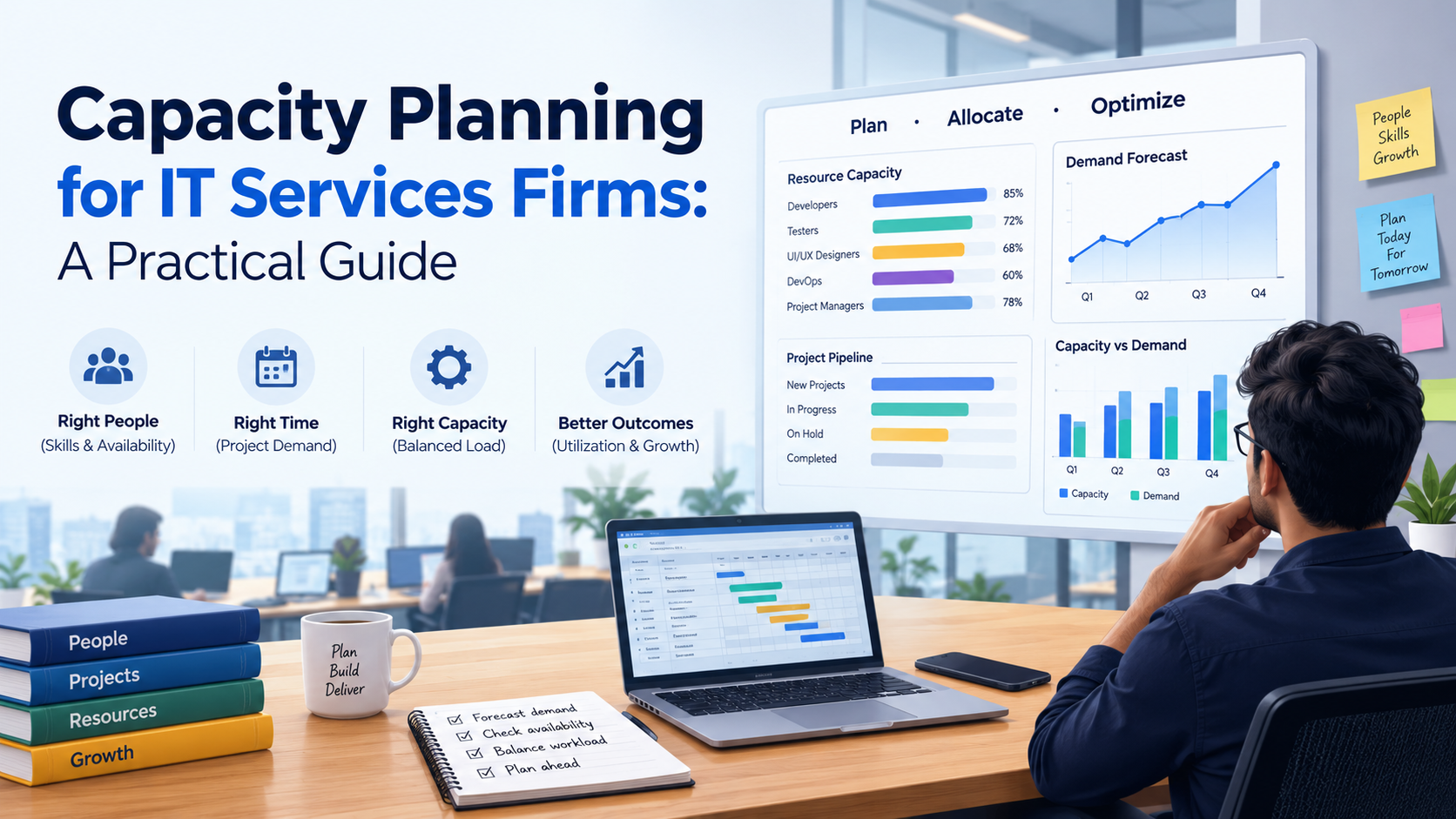
Capacity Planning for IT Services Firms: A Practical Guide
7 PM tools ranked for professional services. Features, comparison table, and verdict.
Date Posted:
September 22, 2026
Share This:
Capacity Planning for IT Services Firms: A Practical Guide
Capacity planning is the operational discipline that prevents two equally expensive problems: too little capacity (turning away revenue or delivering at below-standard quality because the team is overcommitted) and too much capacity (paying for bench that does not generate revenue). For IT services firms managing a delivery pool across multiple practices, technologies, and geographies, capacity planning requires connecting demand signals from the pipeline, supply data from the delivery pool, and time-zone and availability constraints from the workforce, all in a single view that is updated continuously rather than assembled monthly. This guide gives you the framework to build that view.
Capacity planning in IT services is supply minus demand equals gap. Supply is available billable hours from your delivery pool by skill and availability. Demand is the hours required by active projects plus pipeline-weighted upcoming demand. The gap tells you whether to hire, bench, or reallocate. The planning horizon determines how much lead time you have to act on each gap before it costs you revenue or margin.
What Capacity Planning Actually Means for IT Services
Capacity planning in IT services is not headcount planning. Headcount planning asks "how many people do we need?" Capacity planning asks "do we have the right skills, available at the right time, in the right location, at the right cost, to meet the demand we expect in the next 30, 60, and 90 days?"
That distinction matters because a firm can be at full headcount and still have a capacity gap. If all 200 engineers are allocated to long-running projects and a high-value new opportunity requires 10 SAP consultants starting in 6 weeks, the firm has a capacity gap in the SAP practice that no amount of headcount in the cloud or data practice can fill. Capacity planning is skill-specific, time-specific, and location-specific. Generic headcount targets address none of these dimensions.
A 200-person IT services firm with 95% overall utilization can still be turning away revenue because the 5% available capacity is in the wrong practice for the demand it is facing.
Why Most IT Services Firms Get Capacity Planning Wrong
The 4 Data Inputs That Make Capacity Planning Work
| Input | What It Provides | Data Source | Update Frequency Needed |
|---|---|---|---|
| Current allocation data | Which resources are deployed on which projects, at what allocation percentage, through what end date | PSA allocation records | Real-time (updated when allocation changes) |
| Skills availability | Which resources with which skills are available (fully or partially) in each planning window | PSA skills taxonomy + allocation calendar | Daily (updated with timesheet and allocation changes) |
| Pipeline demand | Resource requirements (skills, headcount, start date, duration) from pipeline opportunities weighted by close probability | CRM with resource requirement fields | On stage change (triggered by pipeline updates) |
| Committed demand | Resource requirements from confirmed projects not yet fully staffed, plus known contract renewals | PSA project records | Real-time (updated when projects are created or modified) |
Planning Horizons: What to Do at 30, 60, and 90 Days
| Horizon | Primary Focus | Decision Type | Data Quality Required |
|---|---|---|---|
| 0 to 30 days | Current allocation gaps and immediate bench management. What resources are rolling off and where are they going? | Tactical: reallocation, bench activation, short-term contractor engagement | High: must be based on confirmed allocations and approved leave |
| 30 to 60 days | Near-term supply-demand alignment. Which pipeline opportunities at 70%+ probability need resourcing? Which practice has a capacity constraint? | Operational: pre-allocation from pipeline, internal mobility, subcontracting decisions | Medium-High: pipeline probability weighting critical at this horizon |
| 60 to 90 days | Strategic capacity gaps. Where will the firm be short on specific skills? What hiring is required to meet demand that cannot be filled from the current pool? | Strategic: hiring plans, partner capacity agreements, L&D investment to close skill gaps | Medium: probability weighting essential; scenario planning for high-uncertainty pipeline |
The Supply-Demand Gap: How to Calculate and Act on It
-
Calculate available supply by skill and time windowFor each skill category in your taxonomy (e.g., AWS Solutions Architect), calculate total available hours in each planning window: headcount with that skill, minus allocated hours already committed, minus approved leave and holidays. This is your supply figure. It must be calculated at skill level, not at total headcount level.
-
Calculate probability-weighted demand by skill and time windowFor each open pipeline opportunity, capture the resource requirements (skills needed, hours per week, start date range). Multiply hours by deal probability. Sum across all opportunities to get probability-weighted demand by skill category in each planning window. Add committed project demand (probability = 100%) to get total demand.
-
Identify the gaps and surpluses by skillFor each skill category, subtract demand from supply. A positive number is surplus capacity (bench risk at that skill level). A negative number is a capacity gap (revenue risk, delivery risk, or margin risk from subcontracting). Gaps and surpluses must be visible at skill level to be actionable.
-
Take the right action for each gap type0 to 30 day gap: reallocate from surplus skills, engage preferred contractors, or reduce scope with client. 30 to 60 day gap: accelerate pipeline closure for opportunities using surplus skills; negotiate start date flexibility for gapped skills. 60 to 90 day gap: initiate hiring for persistent skill gaps; invest in L&D to convert surplus skills to gapped skills; evaluate partner capacity agreements for peak coverage.
Skills-Level Capacity Planning: The Matrix That Works
The capacity planning output that is most useful to IT services operations is a skills capacity matrix: a grid that shows available capacity by skill category against demand by time window, with gaps and surpluses clearly flagged. Here is a simplified example for a 100-person IT services firm:
| Skill Category | Available (0-30d) | Demand (0-30d) | Gap | Available (31-60d) | Demand (31-60d) | Gap |
|---|---|---|---|---|---|---|
| AWS / Cloud Infra | 320 hrs | 280 hrs | +40 hrs | 290 hrs | 410 hrs | -120 hrs |
| SAP S/4HANA | 160 hrs | 200 hrs | -40 hrs | 120 hrs | 240 hrs | -120 hrs |
| Data Engineering | 480 hrs | 360 hrs | +120 hrs | 440 hrs | 280 hrs | +160 hrs |
| Salesforce | 80 hrs | 80 hrs | 0 | 80 hrs | 120 hrs | -40 hrs |
| DevOps / Kubernetes | 240 hrs | 200 hrs | +40 hrs | 200 hrs | 320 hrs | -120 hrs |
This matrix immediately shows the operations leadership team three things: where they can confidently pursue new demand (Data Engineering surplus), where they have an immediate constraint to address (SAP gap in 0 to 30 days), and where a looming constraint requires hiring or L&D action now (AWS, SAP, DevOps all gapped in 31 to 60 days).
How AI Improves Capacity Planning Accuracy
AI updates the capacity plan every time a pipeline stage changes, an allocation is modified, or a timesheet is submitted, rather than on a weekly or monthly review cycle. The capacity picture is always current, not 7 to 30 days stale.
AI models trained on historical pipeline conversion rates by deal type, client segment, and practice produce more accurate probability weights than standard CRM stage percentages, which are often set by salespeople rather than calibrated to actual win rates.
AI fires capacity gap alerts when the model detects a supply-demand imbalance forming in the 30 to 60 day horizon, giving operations leadership lead time to act on hiring, L&D, or contractor engagement decisions before the gap becomes a delivery crisis or a lost opportunity.
AI-powered capacity planning can model scenarios: "what happens to our capacity plan if the three largest pipeline deals all close in the same week?" or "what does our utilization look like if we lose the Acme renewal?" Scenario modelling converts capacity planning from a single-forecast exercise into a risk management tool.
The 5 Most Common Capacity Planning Mistakes
| Mistake | What It Looks Like | Consequence | Fix |
|---|---|---|---|
| Planning at headcount not skill level | "We have 15 available engineers" with no skill breakdown | Engineers available in the wrong practice; demand goes unmet despite surplus headcount | Capacity matrix by skill category, not headcount total |
| Not weighting pipeline by probability | Treating all opportunities as confirmed demand | Over-hiring for pipeline that does not close; bench accumulates | Probability-weighted demand from CRM stage, calibrated to historical win rates |
| Monthly planning cadence | Capacity review happens in the monthly ops meeting | Gaps discovered after they have cost revenue or margin | Continuous AI-driven recalculation triggered by pipeline and allocation changes |
| Not including rolloffs | Capacity plan shows current allocation but not who rolls off when | Future available supply is unknown; hiring decisions are made on current utilization | Allocation end dates tracked in PSA; capacity plan projects forward based on confirmed project timelines |
| No action owner for gap alerts | Capacity gap identified in plan but no clear owner or deadline for resolution | Gaps identified but not addressed until they become delivery crises | Gap alerts assigned to specific owners with resolution deadlines; escalation if not addressed within SLA |
KEBS connects pipeline demand from Salesforce and HubSpot to resource supply from the PSA delivery pool in real time. When an opportunity moves to 60% probability in the CRM, KEBS automatically surfaces the resource requirements for that opportunity and compares them against available capacity by skill category. The capacity plan updates continuously, not on a review cycle.
KAIS KII monitors the capacity matrix by skill continuously and fires gap alerts when the model detects a supply-demand imbalance forming in the 30 to 60 or 60 to 90 day horizon. The alert includes the specific skill category, the magnitude of the gap, the pipeline opportunities driving the demand, and the current delivery pool resources closest to matching the gap. Operations leadership receives actionable intelligence, not a raw data report.
KIR models probability-weighted demand from historical win rates by deal type and practice, producing more accurate capacity forecasts than CRM stage-based estimates. The capacity dashboard shows the skills capacity matrix for all three planning horizons simultaneously, with surplus capacity highlighted as potential pre-sales resources and gaps flagged with recommended actions (hire, upskill, partner, or client timeline negotiation). For IT services firms managing multi-practice delivery across India and global locations, KEBS provides the continuous, skills-level capacity intelligence that spreadsheet-based planning cannot deliver at scale.
Frequently Asked Questions
See Your Capacity Gap 90 Days Before It Costs You. KEBS Makes It Visible Today.
Skills-level capacity planning connected to your CRM pipeline. AI gap alerts 60 to 90 days in advance. Continuous recalculation from live allocation and pipeline data. From $5/user. Rated 4.7/5 on G2.
Book a Free Demo →