GCC vs Outsourcing vs BOT: Which Delivery Model Fits Your Services Strategy
7 PM tools ranked for professional services. Features, comparison table, and verdict.
Date Posted:
September 24, 2026
Share This:
GCC vs Outsourcing vs BOT: Which Delivery Model Fits Your Services Strategy
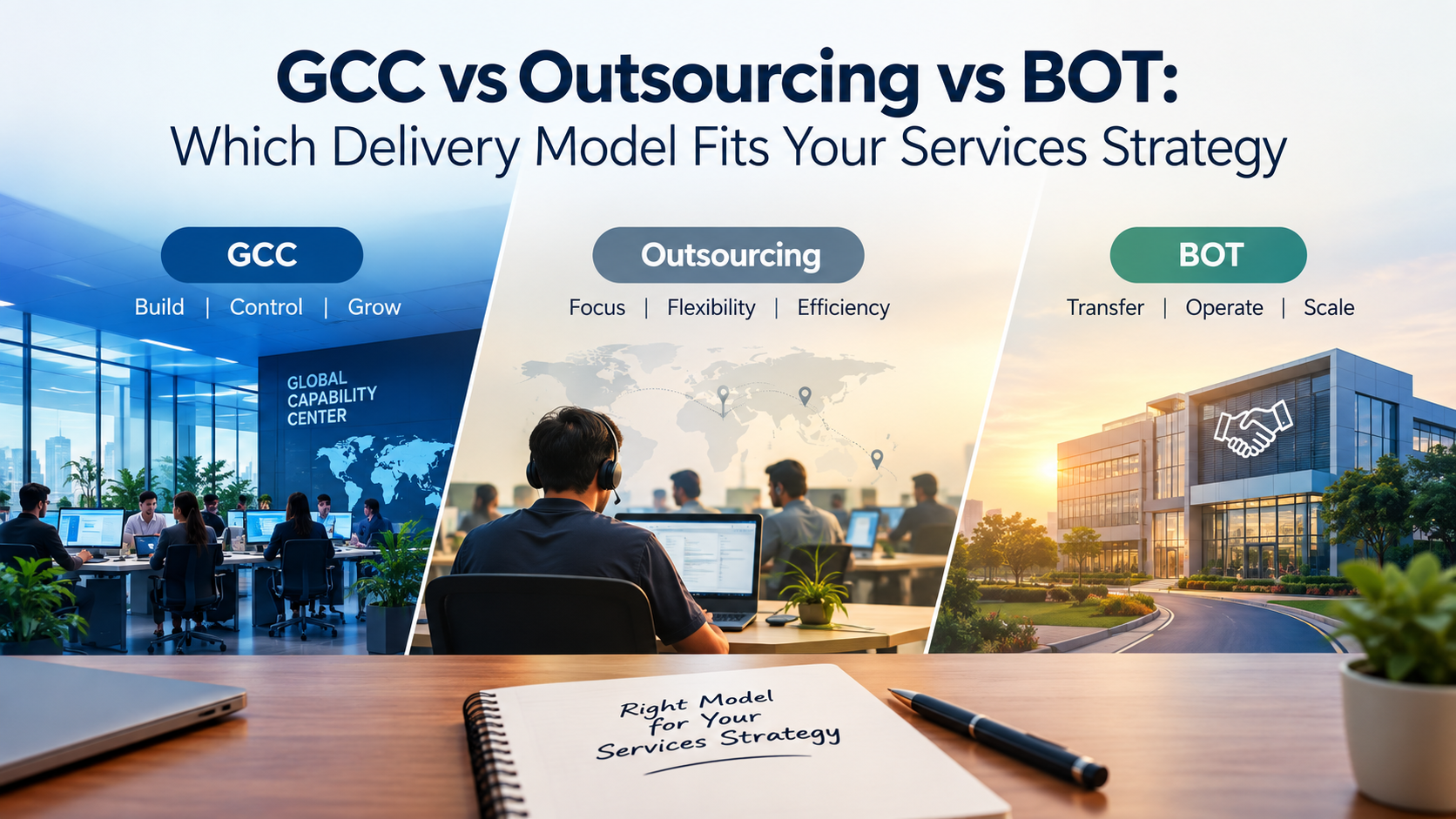
Every US enterprise building global delivery capability in 2026 faces the same strategic question: do we own the capability (GCC), buy it from a vendor (outsourcing), or start with a managed transition to ownership (BOT)? Each model has a different risk profile, cost structure, timeline to operational capability, and long-term strategic value. Each has also failed spectacularly for organizations that chose it for the wrong reasons or executed it without the right operational infrastructure. This guide gives you the framework to make the right choice for your specific situation rather than defaulting to the model your peer companies are using.
Choose GCC when the work is strategic, IP-sensitive, or requires deep cultural integration with your organization. Choose outsourcing when the work is commodity, demand is variable, or speed to capability is the primary requirement. Choose BOT when you want GCC ownership long-term but lack the operational experience to build it directly. In practice, the best-performing enterprises use all three simultaneously for different function categories.
The Three Models Explained
GCC: Global Capability Center (Captive)
A GCC is a wholly owned subsidiary of the parent enterprise. The people are the parent's employees. The infrastructure is the parent's infrastructure. The IP generated belongs to the parent permanently. The GCC is a business unit, not a vendor. Setup takes 6 to 12 months, requires significant upfront investment, and produces a delivery capability that the parent organization owns indefinitely. It is the highest-commitment, highest-control, and highest-long-term-value model.
Outsourcing: Third-Party Vendor Delivery
Outsourcing engages a third-party vendor (Infosys, Wipro, Accenture, a specialist MSP) to deliver a defined scope of work for a contracted price. The vendor's employees deliver the work. The vendor owns the delivery infrastructure. The parent organization manages the relationship through an SLA and a contract. Outsourcing can be operational within weeks for well-defined work, requires no entity setup, and carries no fixed overhead. It is the lowest-commitment, lowest-control model, with the highest vendor margin embedded in the rate.
BOT: Build-Operate-Transfer
BOT is a hybrid transition model. A local operator (often a specialized GCC setup firm or an IT services company) builds the India team under their entity, operates it for a defined period (typically 12 to 36 months), and then transfers the employees, infrastructure, and entity to the parent organization. The parent gets a running operation without managing the setup complexity directly, but pays a premium rate during the operate phase and manages the complexity of the transition event.
Side-by-Side Comparison
| Dimension | GCC (Captive) | Outsourcing | BOT |
|---|---|---|---|
| IP ownership | Parent owns all | Contract-dependent; risk of vendor retention | Parent owns at transfer; operator risk during operate phase |
| Talent ownership | Parent employees; parent culture | Vendor employees; divided loyalty | Operator employees transitioning to parent |
| Cost structure | No vendor margin long-term; higher setup cost | Vendor margin (typically 25-45%) embedded in all rates | Operator margin during operate phase; none post-transfer |
| Time to operational | 6 to 12 months | 4 to 12 weeks | 3 to 6 months with operator |
| Setup complexity | High: entity, compliance, talent, infrastructure | Low: vendor manages all setup | Moderate: shared with operator |
| Flexibility to scale down | Low: India labor law constrains rapid reduction | High: contract notice period only | Moderate: operator flexibility during operate phase |
| Long-term value | Highest: builds permanent enterprise capability | Lowest: capability leaves with the contract | High: GCC value post-transfer |
| Best timeline commitment | 5+ years | 1 to 3 years typical engagement | 3 to 5 years (including transfer) |
GCC: When It Wins
When the work involves proprietary algorithms, product architecture decisions, customer data at scale, or competitive differentiation in the technology stack, a GCC is the only model that provides genuine IP security. Outsourcing vendors have multiple clients; your IP investment is only as secure as the contract.
If the function you are building offshore is central to your competitive advantage (product engineering, AI/ML, financial modeling, customer strategy), the people doing it should be your employees who build deep organizational knowledge over time, not vendor employees who rotate across client engagements every 18 months.
GCC economics improve with scale and stability. The fixed cost of entity, leadership, and infrastructure is spread across a larger workforce. For 100+ person engagements with stable demand, the fully loaded GCC cost is typically 15 to 25% lower than equivalent outsourced delivery once the GCC reaches steady state and setup costs are amortized.
If the 5-year vision is a strategic India center that leads global programs, drives innovation, and develops the next generation of enterprise leadership, the GCC model is the only path. Outsourcing can deliver work; it cannot build an enterprise capability that compounds in value over time.
Outsourcing: When It Wins
When you need 30 engineers operational in 8 weeks, outsourcing is the only viable model. A greenfield GCC cannot hire, onboard, and deploy 30 people in that timeline. For time-critical programs, outsourcing buys the time needed to build the GCC alongside the delivery work.
When demand is project-based, seasonal, or uncertain in volume, outsourcing provides flexibility that a captive GCC cannot. Adding and removing vendor capacity through contract amendments is operationally and legally simpler than managing headcount changes in an India subsidiary under the Indian labor law framework.
Niche skills that you need occasionally (a specific SAP module, a regulatory compliance specialty, an emerging technology you are evaluating) are better sourced from a specialist vendor than built into a captive team that may not sustain utilization of those skills long-term.
Using an outsourcing vendor to deliver a function for 12 to 18 months while evaluating whether it is right for GCC internalization is a legitimate and low-risk sequencing strategy. The vendor engagement provides operational insight into the function's complexity and the India talent market before a GCC investment is committed.
BOT: When It Wins
The BOT model is most valuable in three specific scenarios:
-
First-time India market entry with limited local knowledge
For US enterprises establishing their first India operation, the BOT model transfers the entity registration, statutory compliance, initial talent acquisition, and operational setup complexity to a local operator with established infrastructure. The parent benefits from the operator's India expertise without needing to hire that expertise internally before the GCC is running.
-
Need for GCC-quality ownership without the 12-month setup delay
The BOT model can be operational in 3 to 4 months vs. 6 to 12 months for a greenfield captive. For programs where the parent needs people working within a quarter, BOT provides a path to GCC ownership without the full captive setup timeline.
-
Risk mitigation for uncertain long-term commitment
When the parent organization has strategic intent to own a GCC but board-level uncertainty about the 5-year commitment, BOT allows the organization to begin building the team and the operational model under the operator's entity. If the commitment is confirmed at 18 months, transfer proceeds. If circumstances change, the parent can exit the BOT agreement more cleanly than unwinding a captive entity.
Hybrid Models: How Leading Enterprises Structure Global Delivery
The most sophisticated global delivery strategies in 2026 combine all three models deliberately, assigning each function category to the model that best fits its characteristics:
| Function Category | Recommended Model | Rationale |
|---|---|---|
| Core product engineering and AI/ML | GCC | IP-sensitive, requires deep organizational integration, builds long-term competitive capability |
| Steady-state IT operations and support | GCC or Outsourcing | GCC if scale justifies, outsourcing if demand is variable or below GCC viability threshold |
| Peak capacity and niche skills | Outsourcing | Variable demand; specialized skills not sustainable in captive model |
| New function evaluation | Outsourcing then BOT or GCC | Validate function before committing to captive investment |
| Transitional functions during GCC setup | BOT or Outsourcing | Bridge capacity while GCC is being built |
The Decision Framework: 5 Questions
Yes: GCC or BOT. No: outsourcing is viable. This is the highest-weight question in the framework. If the answer is yes, the case for a vendor relationship requires very strong compensating factors.
Yes: GCC economics are favorable. No: outsourcing flexibility is more valuable than GCC ownership. The fixed cost of a captive entity requires sufficient scale to amortize efficiently.
Yes: pure captive. No: BOT with a trusted operator. The GCC setup process requires dedicated leadership attention for 6 to 12 months. If that attention is not available, BOT transfers the operational complexity to the operator.
Under 3 months: outsourcing only. 3 to 6 months: BOT or outsourcing bridge to GCC. 6 to 12 months: pure captive. Timeline is often the constraint that forces a hybrid approach.
High confidence: pure captive GCC. Moderate confidence: BOT with transfer option. Low confidence: outsourcing. The GCC model compounds in value over time but requires sustained organizational commitment to deliver that value.
Mostly GCC indicators: build the captive. Mostly outsourcing indicators: vendor first, with a defined review point at 18 months. Mixed: hybrid model with GCC for core and outsourcing for periphery. BOT if setup complexity is the barrier.
KEBS supports all three delivery models within a single operational platform. For GCC operations, KEBS provides the full PSA capability: resource management, skills-based staffing, daily timesheet capture, intercompany billing, and KAIS AI utilization intelligence. For outsourcing oversight, KEBS tracks vendor-delivered work against SLAs, monitors costs vs. budget, and provides the data needed to evaluate vendor performance against GCC internalization thresholds. For BOT transitions, KEBS can be deployed in the operator environment during the operate phase and transferred with the entity, ensuring that operational data continuity is maintained through the transition event.
Multi-entity billing in KEBS handles the complexity of hybrid delivery models where some functions are delivered through the GCC entity (INR billing) and others through outsourcing vendors (USD billing). Parent-facing dashboards consolidate performance data across delivery models so global leadership sees one unified view of total delivery performance regardless of which model each function is using. For enterprises managing the full spectrum from captive to vendor to BOT simultaneously, KEBS provides the connective tissue that makes the hybrid model operationally coherent rather than fragmented across systems.
Frequently Asked Questions
GCC, Outsourcing, or BOT: KEBS Gives You the Operational Clarity to Run Any Model.
Resource management, intercompany billing, vendor performance tracking, and KAIS AI utilization intelligence across your full global delivery footprint. One platform, any delivery model. Rated 4.7/5 on G2.
Book a Free Demo →