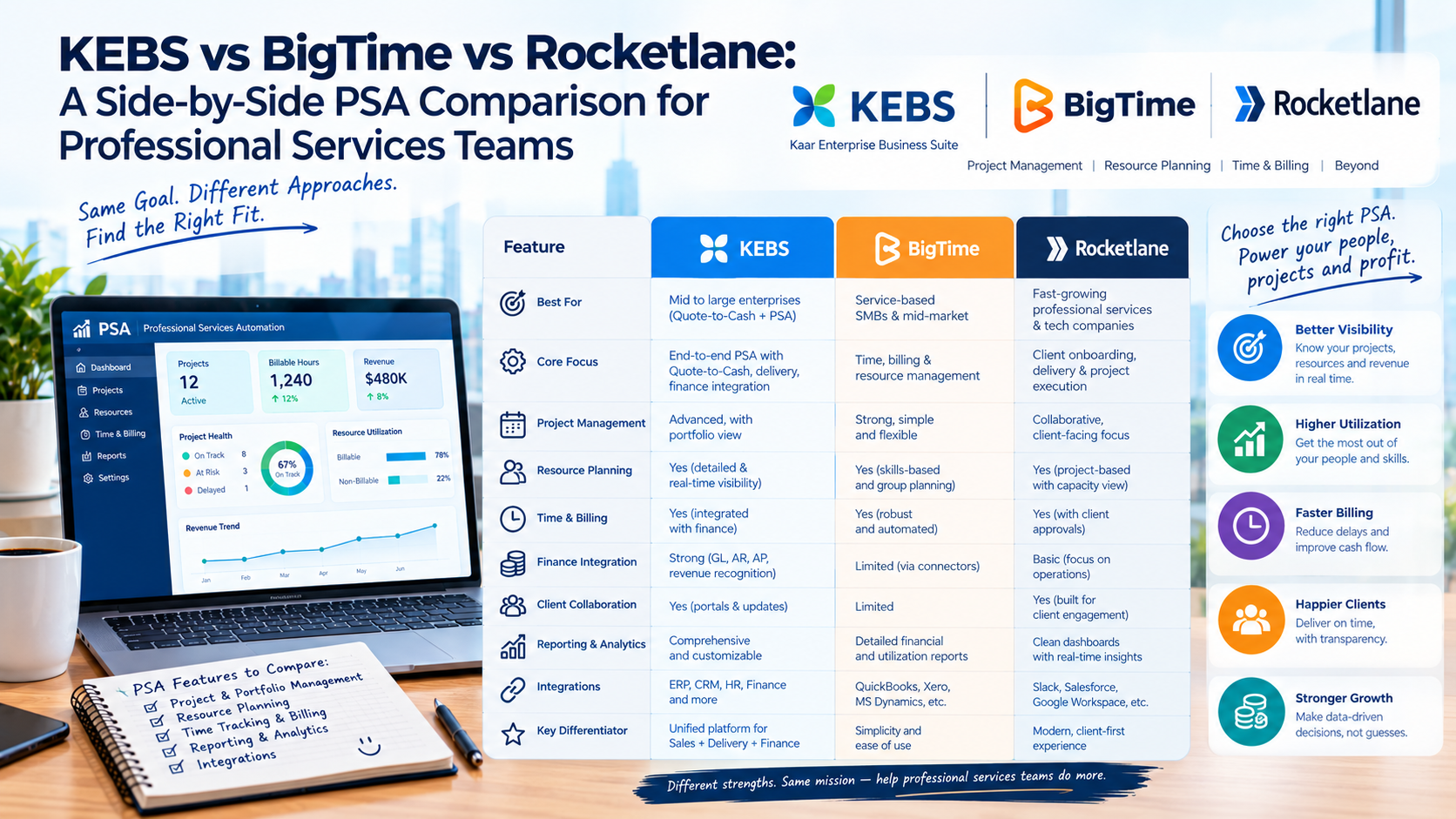
KEBS vs BigTime vs Rocketlane: A Side-by-Side PSA Comparison for Professional Services Teams
7 PM tools ranked for professional services. Features, comparison table, and verdict.
Date Posted:
October 15, 2026
Share This:
KEBS vs BigTime vs Rocketlane: A Side-by-Side PSA Comparison for Professional Services Teams
Three distinct philosophies compete for the professional services automation budget in 2026. BigTime takes a billing-first approach: time capture, expense management, and invoicing done reliably for accounting and engineering firms. Rocketlane takes a delivery-first approach: client collaboration, shared project workspaces, and onboarding experience designed for SaaS and implementation teams. KEBS takes a lifecycle-first approach: AI-native automation across the full Quote-to-Cash arc for IT services, GCC, BPO, and consulting delivery. This comparison shows exactly where each philosophy wins and which team it actually fits.
KEBS wins on full lifecycle coverage, AI depth, pricing at scale, and fit for IT services and GCC delivery models. BigTime wins on billing workflow depth for accounting and engineering firms that primarily need reliable time-to-invoice automation. Rocketlane wins on client-facing delivery experience for SaaS implementation and onboarding teams where client collaboration is a first-class requirement. The right choice depends on whether your primary PSA need is billing automation, client delivery, or full lifecycle intelligence.

IT/ITeS, GCC, Consulting

Accounting, engineering, IT consulting

SaaS onboarding, implementation teams
Platform Overview: Three Different Philosophies
KEBS is an AI-native PSA built by KaarTech (SAP Gold Partner) for IT services firms, GCCs, BPOs, and consulting organizations. It covers the complete Quote-to-Cash lifecycle: deal management, skills-based resource allocation, project delivery, multi-entity billing, and revenue recognition in a single platform. KAIS (KEBS AI Suite) is a three-layer intelligence engine: KII surfaces delivery risk, KIR recommends resource assignments, and KIA automates staffing, billing, and forecasting actions. Pricing: $5 to $49 per user per month, role-based. G2: 4.7/5.
BigTime is a time-and-billing PSA for mid-market professional services firms, with particular depth for accounting, engineering, and IT consulting firms. Its core strength is reliable time capture, expense management, and invoicing automation with strong integration to accounting platforms (QuickBooks, Sage, NetSuite). Pricing from $20 per user per month. G2: 4.5/5. Established in 2002, BigTime has a large customer base among US mid-market professional services firms.
Rocketlane is a delivery-first PSA focused on client collaboration, shared project workspaces, and onboarding experience for SaaS and professional services implementation teams. It covers projects, time tracking, resource management, billing, and financial operations with a client portal that is among the best in the category. Pricing from $19 per user per month (Standard) to $69 per user per month (Premium). G2: 4.5/5.
At-a-Glance Scorecard
Pricing and Total Cost of Ownership
Role-based pricing: $5 (Resource) up to $49 (Executive) per user per month. A typical 50-person IT services team with a mix of project resources, managers, and executives typically pays $15,000 to $35,000 per year. Implementation with KaarTech support does not require a separate SI partner. All lifecycle modules (resource management, project delivery, billing, revenue recognition) are included without additional tier costs. Estimated 3-year TCO: $60,000 to $120,000 including implementation.
Pricing from $20 per user per month (Essentials) to $55+ per user per month (Premier). A 50-person team on a mid-tier plan typically pays $15,000 to $30,000 per year in licensing. Implementation is typically complete within 60 days, no mandatory SI partner. If billing is your primary PSA need, BigTime delivers strong ROI. If you need resource management, project governance, or AI automation at depth, additional tools will be required, adding to the real TCO. Estimated 3-year TCO for billing-primary use: $55,000 to $100,000.
Pricing from $19 (Standard) to $49 (Business) to $69 (Premium) per user per month. AI capabilities and advanced revenue recognition are gated to the Premium tier. A 50-person team needing full feature access at Premium pays $41,400 per year in licensing, which is competitive at that depth. Implementation takes 2 to 6 weeks. Minimum 5 seats on all plans. Estimated 3-year TCO at Business tier: $90,000 to $130,000; at Premium: $130,000 to $180,000.
KEBS wins on pricing at scale for full lifecycle coverage. BigTime is competitive if billing is your only PSA need. Rocketlane's Premium tier becomes costly at scale, particularly when AI and financial features that KEBS includes in base pricing require the highest tier.
AI and Automation Depth
KAIS is a three-layer intelligence system embedded in PSA operations. KII proactively surfaces utilization risk, bench gaps, budget burn, and margin alerts before they require human investigation. KIR recommends specific resource-project matches based on skill taxonomy, availability, cost rate, and delivery history. KIA automates staffing actions, billing triggers, project escalations, and three-year revenue forecasting without manual steps. This is operational AI: it does not wait for a manager to pull a report. It detects problems and acts on them.
BigTime's AI features are limited in 2026. The platform focuses on reliable billing workflow execution rather than intelligence. Some basic automation for time entry reminders, invoice triggers, and budget alerts is available. There is no resource recommendation engine, no proactive delivery health monitoring, and no revenue forecasting automation. For teams that primarily need billing reliability rather than operational intelligence, this is not a barrier. For teams that need PSA AI, BigTime is not the platform.
Rocketlane has introduced AI features including AI-generated project plans, automated status updates, and delivery health summaries. These are useful productivity features that reduce manual work within the delivery workflow. At the Premium tier, more advanced analytics and financial forecasting are available. Rocketlane's AI roadmap is active and improving, but in 2026 it remains below the depth of KAIS for operational automation: it assists delivery managers rather than acting autonomously on delivery data.
KEBS wins decisively on AI depth. KAIS operates three layers above what BigTime or Rocketlane currently offer. For teams where operational AI automation is a buying criterion, KEBS is the clear choice. For teams that primarily need billing reliability (BigTime) or client delivery collaboration (Rocketlane), the AI gap is less important than those platforms' specific strengths.
Resource Management
KEBS RMG handles skills taxonomy, bench management, capacity forecasting, and AI-driven resource recommendations natively. KIR recommends the right resource for the right project based on skill profile, availability, cost rate, and historical delivery performance. Real-time bench visibility shows who is available, when, and at what cost. Multi-geography and multi-entity resource allocation is fully supported. This is purpose-built for IT services delivery where bench utilization directly impacts margin and EBITDA.
BigTime offers resource scheduling through a visual scheduling view, showing team availability and project assignments across time. It handles basic time-based resource planning well for mid-market accounting and engineering firms with stable teams. Skills-based matching, bench management, and capacity forecasting at IT services scale are not first-class features. For firms primarily managing 5 to 30 billable professionals on structured project engagements, BigTime's resource scheduling is adequate.
Rocketlane covers resource management through workload views, capacity planning, and time-based scheduling. It handles resource allocation for project-based delivery teams well and has improved its resource management capabilities with each release cycle. Skills-based bench management at IT services scale, multi-entity allocation, and AI-driven resource recommendations are not current strengths. For SaaS implementation teams where resource pools are smaller and more stable, Rocketlane's resource management is sufficient.
KEBS wins on resource management for IT services, GCC, and consulting delivery models where skills-based bench management and AI-driven allocation are operational requirements. BigTime and Rocketlane both cover resource scheduling adequately for their core use cases (billing-first and delivery-first respectively) but do not match KEBS at IT services scale.
Billing and Financial Management
KEBS covers multi-entity billing (INR and USD), T&M, milestone, retainer, and hybrid billing models natively. Revenue recognition is automated through KIA. Three-year financial forecasting is built into the KAIS engine. Integration with SAP, NetSuite, QuickBooks, and Tally is native. For IT services firms managing multi-currency invoicing across India and global entities, KEBS handles it without supplementary tools. Finance teams get clean, automated revenue reporting from the same data model that delivery operations run on.
BigTime's billing workflow is the strongest in this comparison for accounting and engineering firm billing models. Time capture to invoice generation is fast, reliable, and highly automated. Multiple billing rates per client, retainer billing, milestone invoicing, and expense reimbursement workflows are all well supported. QuickBooks, Sage, and NetSuite integration is deep and bidirectional. For firms where billing reliability is the primary PSA requirement, BigTime has best-in-class workflow execution. Multi-entity and multi-currency billing at enterprise scale is more limited.
Rocketlane covers standard billing models: T&M, fixed price, and milestone invoicing. Financial reporting and project profitability are available at all tiers. Advanced revenue recognition and financial forecasting are gated to the Premium tier ($69/user). For SaaS implementation teams with standard billing models, Rocketlane's billing coverage is sufficient. For firms with complex multi-entity billing structures or enterprise revenue recognition requirements, Rocketlane requires supplementary tools or the highest pricing tier.
BigTime wins on billing workflow depth for accounting and engineering billing models. KEBS wins for multi-entity, multi-currency IT services billing and automated revenue recognition. Rocketlane covers standard billing adequately but is not the choice if financial depth is a primary requirement. The right answer depends on whether you need billing specialization (BigTime), full financial lifecycle automation (KEBS), or standard billing bundled with excellent delivery (Rocketlane).
Project Delivery and Client Collaboration
KEBS handles project delivery with task management, milestone tracking, Gantt views, and real-time health dashboards. KII proactively surfaces delivery risks before managers need to check dashboards. Budget burn, schedule drift, resource gaps, and margin risk are flagged automatically. Strong Jira integration means IT delivery teams stay in their agile tooling while KEBS aggregates the operational picture. Delivery health is monitored by AI, not by a manager running reports.
BigTime covers project management through task lists, Gantt charts, and budget tracking against time entries. It is adequate for the delivery workflows of accounting and engineering firms where projects are structured around defined deliverables and tracked by hours. Client portals and collaborative delivery workspaces are not a BigTime strength. Delivery visibility is primarily internal: it shows PMs and billing managers what was captured, not clients what is happening. For firms where client transparency is a requirement, BigTime requires a supplementary collaboration tool.
Rocketlane's project delivery and client collaboration are best-in-class in this comparison. Shared project workspaces, client portals, real-time progress visibility, mutual action plans, and stakeholder communication tools are all built-in first-class features. Clients see what is happening without being asked for a status update. Delivery teams and clients work in the same system. For SaaS onboarding and implementation teams where client experience during delivery is a competitive differentiator, Rocketlane wins this dimension outright.
Rocketlane wins on client collaboration, no competition. KEBS wins on AI-monitored internal delivery health for IT services teams. BigTime is adequate for structured internal project tracking but is not a delivery-experience platform. The choice here depends entirely on whether client-facing delivery experience is a priority (Rocketlane) or internal operational intelligence is (KEBS).
Integrations
CRM: Salesforce, HubSpot. ERP and Finance: SAP, NetSuite, QuickBooks, Tally. HRIS: Keka, Darwinbox, Workday. Project tools: Jira, Azure DevOps. Collaboration: Microsoft 365, Teams, Slack, Google Workspace. The SAP Gold Partner backing means enterprise-grade connectivity is a core competency, not an afterthought. For Indian IT services firms specifically, Keka integration is a deciding factor that neither BigTime nor Rocketlane natively supports.
BigTime's integration strength is accounting platforms: QuickBooks (deep, bidirectional), Sage, NetSuite, and Intacct. Salesforce CRM integration is available. Jira integration is available for project tracking. HRIS integrations are limited: Keka, Darwinbox, and India-specific HRIS platforms are not natively supported. For US-based mid-market accounting and engineering firms, BigTime's integration set covers the core requirements well. For IT services firms in India or GCCs with enterprise HRIS requirements, BigTime's integration coverage is insufficient.
Rocketlane integrates natively with Salesforce (CRM), HubSpot, Jira, Slack, Microsoft Teams, and standard accounting platforms at the project level. Dedicated HRIS integrations and enterprise SAP connectivity are not current strengths. For SaaS and technology services implementation teams with Salesforce or HubSpot as their CRM, Rocketlane's integration set covers the core requirements. For IT services firms needing Keka, SAP, or enterprise HRIS integration, Rocketlane requires custom API work.
KEBS wins for IT services and enterprise tool stacks, particularly for Indian firms needing Keka and SAP integration natively. BigTime wins for US-based accounting and engineering firms where QuickBooks and Sage are the core integration requirement. Rocketlane wins for SaaS teams on Salesforce or HubSpot CRM stacks.
Implementation Speed
Structured onboarding with KaarTech support brings IT services teams live in 4 to 8 weeks. No mandatory SI partner. Workflow changes, rate card updates, and reporting configurations are manageable by operations teams without IT tickets. KaarTech's SAP Gold Partner background provides enterprise-grade implementation knowledge built into the support model. Post go-live, teams run the platform without ongoing consultant dependency.
BigTime implementations typically complete within 60 days without an SI partner. The platform's focused scope (time, billing, project tracking) means setup decisions are straightforward. Guided onboarding, template libraries, and an accessible configuration interface make initial setup manageable for operations teams. Ongoing admin is minimal: the platform is designed to run without constant configuration changes.
Rocketlane deploys quickly, typically 2 to 6 weeks for a standard implementation team. The platform's design is intuitive and template-driven, making onboarding for delivery teams fast. No mandatory SI partner. Post go-live admin is minimal for delivery teams. Finance and revenue recognition setup at the Premium tier adds configuration complexity, but the base delivery platform is among the fastest to operational in this comparison.
All three platforms deploy significantly faster than enterprise PSA alternatives. Rocketlane is marginally fastest for delivery-focused implementations. KEBS and BigTime are comparable at 4 to 8 weeks and 60 days respectively. None requires a mandatory SI partner, which is a shared advantage over Kantata and Certinia.
Who Should Choose Which Platform
Final Verdict
KEBS is the overall winner for IT services, GCC, and consulting teams that need AI-native automation, full lifecycle coverage, and scalable pricing with enterprise-grade integrations. BigTime is the winner for accounting and engineering firms that primarily need reliable, deep billing workflow automation with strong QuickBooks and Sage connectivity. Rocketlane is the winner for SaaS implementation and onboarding teams where client-facing delivery experience is the primary competitive differentiator. The three platforms serve different primary needs, and the right choice is determined by your delivery model and what you most need your PSA to do: bill reliably, deliver collaboratively, or automate intelligently across the full lifecycle.
Frequently Asked Questions
Ready to Move Beyond Point Solutions? Run Your Full IT Services Lifecycle on KEBS.
KEBS covers what BigTime stops at (billing) and what Rocketlane misses (operational AI). Full Quote-to-Cash lifecycle. KAIS AI that observes, predicts, and acts. 36+ integrations including SAP and Keka. Role-based pricing from $5 per user. Rated 4.7/5 on G2.
Book a Free Demo →