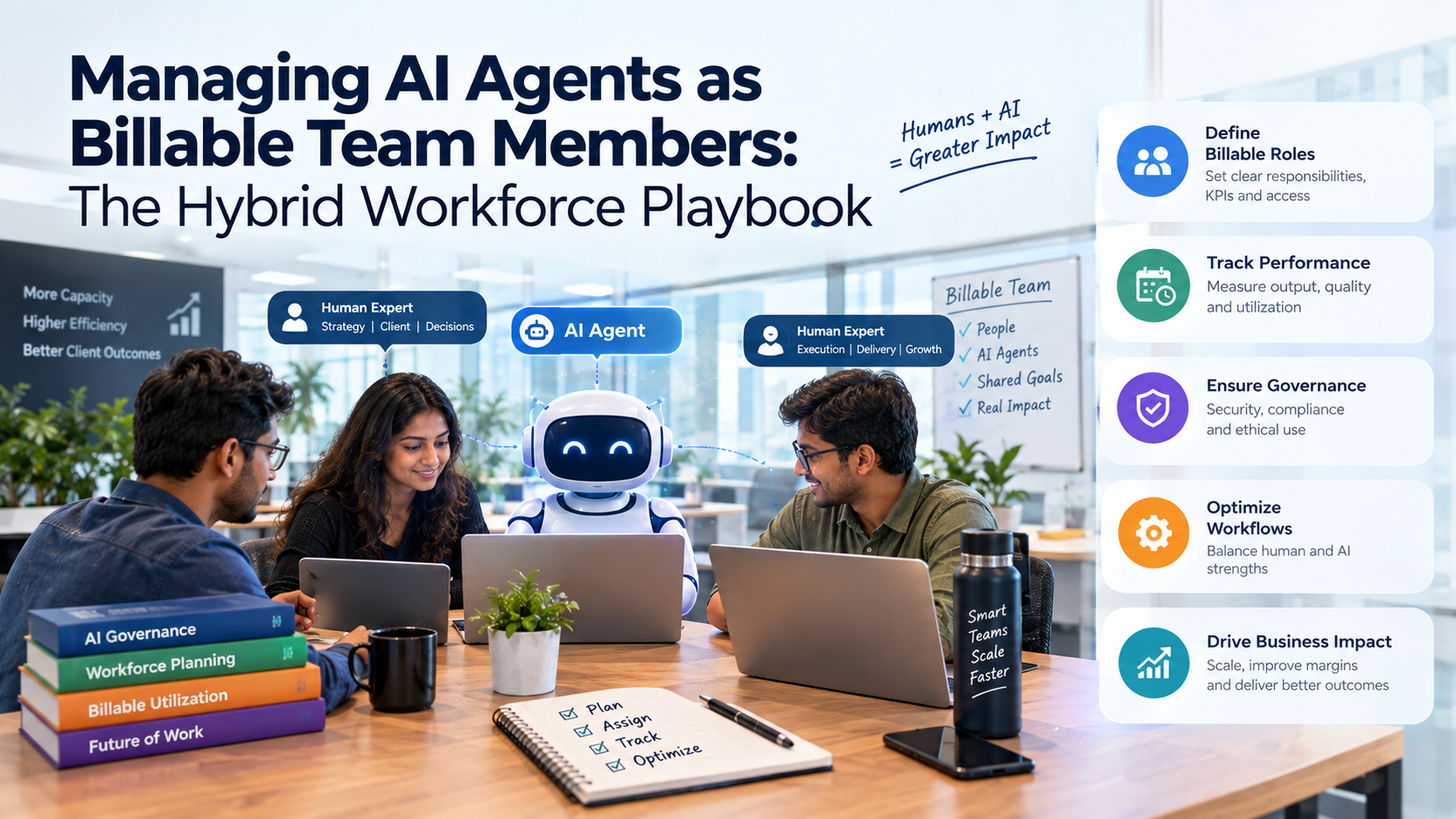
Managing AI Agents as Billable Team Members: The Hybrid Workforce Playbook
7 PM tools ranked for professional services. Features, comparison table, and verdict.
Date Posted:
September 25, 2026
Share This:
Managing AI Agents as Billable Team Members: The Hybrid Workforce Playbook
The professional services workforce is changing faster than the management frameworks designed to run it. In 2026, growing numbers of IT services firms, consulting organizations, and managed service providers are deploying AI agents that perform real delivery work: drafting documents, running analyses, reviewing code, generating test cases, producing first-draft proposals. When an AI agent does work that a human consultant would have billed for, three operational questions become urgent: who owns the output, how do you account for the cost and value of AI work, and how do you maintain quality and client trust in a hybrid team? This is the playbook.
An AI agent that does billable work is a team member with a cost structure, a utilization rate, a quality record, and a governance requirement. Treating it as a tool rather than a team member creates accounting blind spots, quality gaps, and client relationship risks. The firms that manage AI agents as accountable delivery participants will outperform those that treat AI output as a background efficiency gain.
The AI-as-Team-Member Concept
When we describe an AI agent as a team member, we are not speaking metaphorically. We mean that the agent performs discrete, accountable work tasks within a delivery engagement, that its work is tracked and reviewed, that its output quality is measurable, and that its cost and productivity are factored into the engagement economics. The management challenge is that none of the frameworks professional services firms currently use for resource management, utilization tracking, billing, and quality assurance were designed with a non-human delivery participant in mind.
The firms that navigate this transition well are not treating AI as a magic productivity multiplier they quietly pocket. They are treating it as a new class of delivery resource with different cost economics, different quality characteristics, different governance requirements, and different implications for client pricing and disclosure.
Why This Matters More Than Most Firms Realize
AI platform costs, including API fees, model licensing, and infrastructure, are real delivery costs. If they are not allocated to engagements, they sit as unallocated overhead that distorts project profitability calculations. A project that looks like it delivered at 32% margin may have consumed $8,000 of AI platform cost that was never allocated to the engagement.
If a human consultant completes a task in 4 hours that previously took 20 hours because an AI agent did the first draft, the consultant's billed hours are 4, not 20. Utilization falls for that consultant on that task. If this pattern is widespread and not accounted for, utilization dashboards become misleading about actual delivery capacity.
When a human produces a deliverable, accountability is clear. When an AI agent produces the first draft and a human reviews and approves it, the quality accountability chain is less obvious. If the output is wrong, who owns the error? Firms without explicit AI quality governance answer this question badly in front of clients.
Enterprise clients increasingly know that their PS partners are using AI. Some expect transparency and disclosure as a contractual requirement. Others expect the efficiency gains to show up in pricing. Firms that have not defined their AI disclosure and pricing policy are making these decisions reactively under client pressure rather than proactively as a strategic choice.
How to Bill for AI Agent Work: Three Approaches
| Billing Approach | How It Works | Margin Impact | Client Transparency | Best For |
|---|---|---|---|---|
| Efficiency Retention | Bill at the same rate for the deliverable. AI efficiency is captured as margin improvement. Client pays for the outcome, not the hours. | High: AI cost is low vs. full billing rate | Implied in outcome pricing; full disclosure optional | Fixed-price and outcome-based contracts |
| Pass-Through Pricing | AI platform cost allocated to the engagement as a line item, similar to software or data costs. Human review hours billed at standard rate. | Moderate: depends on AI cost vs. human rate delta | Full: AI cost is explicit on the invoice | T&M contracts where client expects cost transparency |
| Hybrid Rate Card | Define an "AI-assisted" delivery tier with a lower hourly rate that reflects AI contribution to the work. Human review billed at standard rate, AI-assisted execution at the lower tier. | Moderate: lower rate reduces margin vs. efficiency retention but creates a sustainable client conversation | Full: client sees rate differentiation explicitly | Firms with transparent T&M models and progressive clients |
The efficiency retention approach generates the highest margin but requires a move away from T&M billing to outcome or fixed-price models. The pass-through and hybrid rate card approaches are compatible with T&M billing but require explicit client conversations about AI use. The right approach depends on your existing billing model, client sophistication, and the degree to which AI is integrated into your standard delivery process.
Tracking AI Agent Utilization
A human resource's utilization is measured as billable hours divided by available hours. An AI agent's utilization is measured differently but the underlying logic is the same: how much of the agent's potential productive capacity is being deployed on billable work vs. non-billable or idle time.
For a human, the productive unit is an hour. For an AI agent, it depends on what the agent does: tasks completed, documents processed, code reviews executed, analyses run. Define the unit of productivity for each agent type deployed in your delivery operation and track it consistently.
Every AI agent task performed on a client engagement should be logged to that project, just as human hours are logged. This creates the data needed to calculate per-project AI cost allocation and to build historical data on AI work volume by engagement type.
Human review should log whether AI-generated output was accepted, modified, or rejected before submission. This quality rate by agent type and task category is the quality analog of human utilization and is essential for identifying where AI deployment is generating value vs. creating rework.
AI platform cost allocated per task divided by the human hours saved gives you the effective cost per hour of AI work. Compare this to the loaded cost of the human who would have done the same work to calculate the cost efficiency of the AI deployment by task category.
Staffing a Hybrid Team: What Changes
When AI agents handle first-draft production, analysts, and junior consultants shift toward review, refinement, and client communication roles. The skills profile of a "junior consultant" in a hybrid team is different from that of a traditional junior consultant. Roles must be redefined to reflect what humans do in a team where AI handles certain task categories.
If an AI agent handles the equivalent of 1.5 junior consultant outputs per day, the staffing ratio for the delivery team changes. Senior consultants can oversee more work, the team produces more per head, and the billable headcount required per engagement can decrease. Staffing models must account for this.
In a traditional team, quality is distributed across every human contributor. In a hybrid team, quality is concentrated at the human review gate. A single reviewer who approves AI output without genuine scrutiny can pass poor work to clients at a volume that no traditional team would produce. Quality gate discipline is the most important operational change in hybrid staffing.
The most valuable skill in a hybrid delivery team in 2026 is the ability to direct AI agents effectively: to frame tasks precisely, evaluate outputs critically, and integrate AI work into a coherent client deliverable. This skill must be explicitly trained and valued in performance management, not assumed to exist.
Governance and Quality Control for AI Team Members
| Governance Dimension | For Human Team Members | For AI Agent Team Members |
|---|---|---|
| Output quality review | Peer review or manager sign-off before client delivery | Mandatory human review before any AI output is submitted to a client; review quality logged |
| Error accountability | Individual and team accountability chain is clear | Reviewing human owns accountability for approved AI output |
| Data access controls | Role-based access to client data enforced in systems | AI agents must operate within same data access boundaries as the human role they support |
| Performance tracking | Utilization, quality scores, client feedback | Task completion rate, output acceptance rate, cost per task, human hours saved |
| Client disclosure | N/A | Formal policy required: what to disclose, when, and in what format |
Having the Client Conversation About AI
The client conversation about AI in your delivery team is unavoidable in 2026. The question is whether you have it proactively and on your terms, or reactively when a client notices something they did not expect. Three frameworks for approaching this conversation:
Disclose all AI use in the engagement upfront, define the AI governance policy, and invite client input on acceptable AI use scope. Creates trust and differentiation for clients who value it. Requires a mature AI governance framework to back up the disclosure.
Include an AI use clause in the standard engagement contract that defines what AI tools are used, how output is reviewed before delivery, and what client data is and is not used in AI systems. Disclosure is built into the contract rather than treated as a separate conversation.
Frame AI use as a quality and speed advantage for the client rather than a cost reduction for the firm. AI-assisted research is faster. AI-assisted analysis covers more scenarios. AI-assisted drafting allows human experts to focus on insight rather than production. Position the hybrid team as a better delivery capability, not a cheaper one.
KEBS is designed for the hybrid workforce reality. Resource management in KEBS RMG can model AI agent capacity alongside human resource capacity, allowing delivery managers to plan engagements that explicitly allocate work between human and AI participants and track the actual utilization of each. AI platform costs are allocatable to projects as delivery costs, ensuring that project profitability calculations reflect the true cost of AI-assisted delivery.
Quality governance is enforced through structured review workflows: AI-generated outputs can be logged as pending human review, with the review step creating an auditable accountability record before the work is submitted to the client. KII monitors the acceptance rate of AI-generated outputs by agent type and delivery category, surfacing quality drift before it reaches the client.
For firms navigating the transition to hybrid delivery models, KEBS provides the operational infrastructure to manage AI agents with the same rigor applied to human team members: tracked, costed, quality-controlled, and accountable. This is not a future roadmap item. It is operational in the current platform for customers including Maveric Systems and Zifo Technologies who are actively managing hybrid delivery teams at scale.
Frequently Asked Questions
Ready to Manage Your AI Agents with the Same Rigor as Your Human Team?
KEBS provides the resource management, cost allocation, quality governance, and utilization tracking infrastructure for hybrid human-AI delivery teams. Built for IT services, consulting, and GCC organizations operating at scale. Rated 4.7/5 on G2.
Book a Free Demo →