Managing Utilization and Billing Across India + US Time Zones
7 PM tools ranked for professional services. Features, comparison table, and verdict.
Date Posted:
September 28, 2026
Share This:
Managing Utilization and Billing Across India + US Time Zones
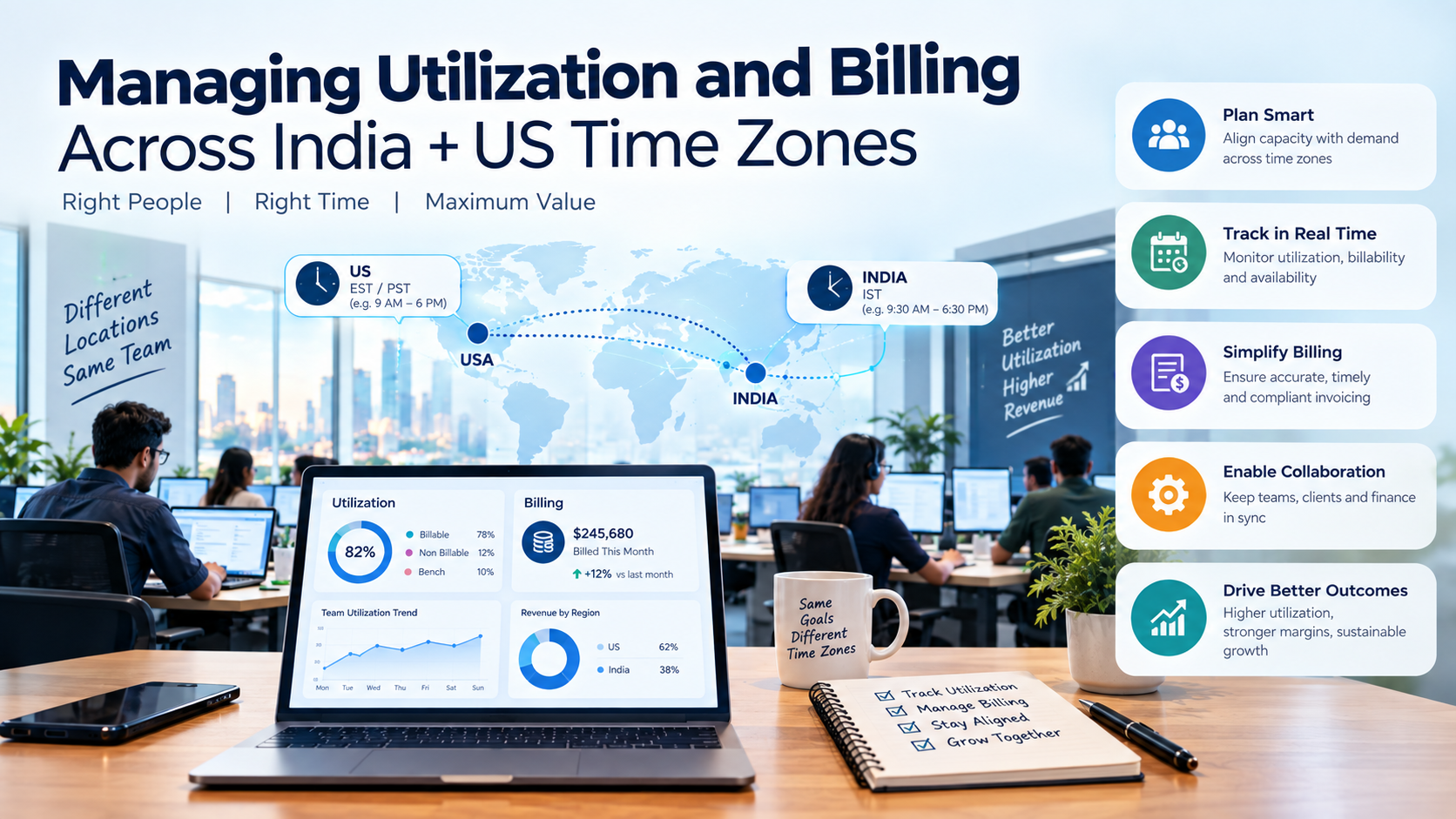
The India-US time zone gap is 9.5 to 12.5 hours depending on US daylight saving time and the specific US time zone. This gap is simultaneously one of the most valuable aspects of the India delivery model (follow-the-sun coverage, overnight turnaround) and one of its most persistent operational challenges. Utilization data that crosses time zones is never perfectly synchronized. Billing that spans two working days in different countries introduces timing questions that manual processes consistently mishandle. Client escalations that arrive in India at 10pm need to be handled without the US team being available. This guide addresses the specific operational challenges of managing utilization and billing across the India-US time zone gap and provides the framework to turn the gap from a friction point into a competitive advantage.
Time zones create two distinct operational problems in India-US delivery: utilization visibility gaps (the US team cannot see India utilization in real time, and India cannot get resourcing decisions approved fast enough) and billing timing gaps (hours worked in India on a US business day may or may not align to the same billing period, creating reconciliation complexity). Both are solved by the same underlying fix: a connected PSA that operates on a unified data model across both entities, so time zone does not create a data boundary.
The Time Zone Challenge in India-US Delivery
The India-US time zone relationship creates a structural asymmetry in every operational workflow that requires coordination between the two sides. When India engineers start their day at 9am IST, their US counterparts are asleep (EST) or finishing their previous day (PST is 10:30pm the night before). When the US team starts their day at 9am EST, India is at 6:30pm and ending their workday. The overlap window of 1.5 to 4 hours (depending on US time zone and whether daylight saving is active) is the only period where both teams can collaborate synchronously.
This creates two categories of operational impact: decisions that should happen in real time are delayed by a full working day because they cannot be resolved in the overlap window, and data that should be visible to both sides simultaneously (utilization, project status, billing hours) is always slightly out of sync because one side is always offline when the other is updating it.
The Overlap Reality by US Time Zone
| US Time Zone | IST Equivalent of 9am-5pm US | Actual Overlap Window | Effective Collaboration Hours |
|---|---|---|---|
| Eastern (EST/EDT) | EST: 7:30pm-3:30am IST / EDT: 6:30pm-2:30am IST | EST: 6:30-8pm IST / EDT: 5:30-7pm IST | 1.5 to 2 hours |
| Central (CST/CDT) | CST: 8:30pm-4:30am IST / CDT: 7:30pm-3:30am IST | CST: 6:30-8pm IST / CDT: 5:30-7:30pm IST | 2 to 2.5 hours |
| Mountain (MST/MDT) | MST: 9:30pm-5:30am IST / MDT: 8:30pm-4:30am IST | MST: 6:30-8pm IST (India leaving) / MDT: 5:30-7:30pm IST | 2.5 to 3 hours |
| Pacific (PST/PDT) | PST: 10:30pm-6:30am IST / PDT: 9:30pm-5:30am IST | PST: 6:30-8pm IST (only if India extends) / PDT: 5:30-7:30pm IST | 0 to 1.5 hours |
The practical implication: India-US delivery teams working with US Pacific time zone clients have essentially zero natural overlap and must deliberately structure their operating rhythm around asynchronous communication with infrequent synchronous touchpoints. Teams working with US East Coast clients have 1.5 to 2 hours of overlap, which is enough for one structured daily standup if both sides adjust their working hours slightly (India extends 30 minutes; US joins 30 minutes early).
How Time Zones Distort Utilization Data
Utilization data in a cross-time-zone delivery model is always partially stale for one side of the equation. When the US resource management team reviews GCC utilization at 9am EST, the India team has already been working for 7 to 8 hours. The utilization snapshot the US team sees reflects yesterday's India data plus whatever has been logged in the first 7 hours of India's current day, which may or may not be captured in real time depending on the timesheet tool.
A firm with weekly timesheet submission has utilization data that is 3 to 5 business days behind. In a cross-time-zone model, this lag means the US team is making resource allocation decisions based on India utilization data that reflects last week's reality. By the time the US team acts on a bench alert, India resources have already been sitting unallocated for 5 to 7 days.
When resource allocation changes require US approval, a request raised at end of India's day (4pm IST) sits unprocessed until the US team starts 9 to 12 hours later (depending on US time zone). The India resource is effectively unallocated during the approval window. At scale, approval delays of 24 to 48 hours per resource allocation decision represent significant bench accumulation.
Monthly utilization reports built from the data available at a specific timestamp (typically US close of month) may not reflect the final India hours for that month if India's final business day data has not been submitted and approved before the US reporting timestamp. The reported utilization is technically accurate at the timestamp but misrepresents the actual India delivery for the period.
Resources that are working on handover tasks, documentation, and transition activities between India day end and US day start appear as "non-billable" in most timesheet systems even though the work is directly supporting client delivery. This phantom bench distorts utilization downward and creates inaccurate cost-per-billable-hour calculations.
How Time Zones Complicate Billing
| Billing Complication | How It Happens | Financial Impact |
|---|---|---|
| Period-end timing mismatch | India's last business day of the month may end 9 to 12 hours before the US billing period closes. Hours worked in India on the last India business day may be attributed to the next US billing period. | Revenue timing distortion; incorrect period-level margin calculations |
| Approval delay pushing hours to next cycle | Hours worked in India require US manager approval. If US approval is not given before the billing run, the hours miss the current cycle and appear on the next invoice. | DSO extension; cash flow delay; client invoices that do not reflect current period delivery |
| INR/USD rate application timing | Intercompany billing from the India entity to the US parent requires a currency conversion. The exchange rate applied depends on whether it is determined at the time of work (India day), at the time of billing (US billing date), or at an agreed fixed rate. | Currency variance in intercompany billing; transfer pricing documentation complexity |
| SLA billing across midnight | Incidents raised at end of US business day (5pm ET) are received by India at 3:30am IST. Resolution time spans a US business day and an India business day, creating ambiguity about which billing period and SLA clock the effort belongs to. | Potential under-billing of overnight effort; SLA compliance reporting complexity |
Building a Cross-TZ Operating Rhythm That Works
-
Define the overlap window and protect it for decisions, not status updates
The 1.5 to 4 hour overlap window is too short to waste on status reporting that could be async. Use the overlap exclusively for decisions, escalations, and relationship-building interactions that genuinely require synchronous communication. Move all status updates, reports, and informational communication to async formats delivered before the overlap so the overlap time is available for the conversations that cannot happen any other way.
-
Establish India-side authority for routine resource allocation decisions
Any resource allocation decision that requires US approval and falls below a defined threshold (for example, allocations under 50% or shifts within the same project) should be delegated to the India resource management function with next-day US ratification rather than same-day US approval. This eliminates the 24-hour approval delay for routine decisions while maintaining US oversight for significant allocation changes.
-
Enforce daily timesheet submission at India day end
Time entered by the India team before the end of their business day gives the US team access to current utilization data when they start their day 9 to 12 hours later. This simple discipline closes most of the utilization visibility gap. The PSA should auto-lock timesheets at India day end so that submissions are timely and the US team can rely on the data they see when they open the dashboard.
-
Create a written daily handover standard
Every India team should produce a written end-of-day handover note for the US team before the India day closes. Format: what was completed today, what is in progress and where it stands, what is blocked and what unblocking action is needed from the US side, and what is expected to be delivered before the next India day start. This note lands in the US team's inbox as they start their day and eliminates the information vacuum that makes cross-TZ collaboration inefficient.
The Handover Protocol: What Good Looks Like
The handover note should follow the same format every day so US readers know exactly where to find the information they need without reading narrative prose. Use a consistent structure: Completed / In Progress / Blocked / Needs US Action. Predictability reduces the cognitive load of handover consumption on the US side and makes omissions immediately obvious.
A handover note delivered at exactly end of India day leaves no time for the India team to respond to US questions before going offline. A note delivered 30 minutes early creates a window for the US team (who have been online for 4 to 8 hours by this point depending on US time zone) to ask clarifying questions while the India team can still respond.
Every item that requires US action should be explicitly flagged in the handover (NEEDS US ACTION: approve resource allocation for Project X before 11am EST so India team can assign tomorrow). Buried requests in narrative handover notes are missed. Explicit flags with deadlines are acted on.
Handover notes that reference ticket numbers, project codes, and resource names that link directly to the PSA system give the US team the ability to verify status, check utilization, and take action in the system rather than relying on the note alone. The handover is the summary; the PSA is the source of truth.
Intercompany Billing Across Time Zones: The Timing Rules
Intercompany billing between the India GCC entity and the US parent requires a consistent set of timing rules that resolve the ambiguities created by the time zone gap. Define these rules in the intercompany service agreement before billing begins:
| Timing Question | Recommended Rule | Rationale |
|---|---|---|
| When does a billing period start and end? | Calendar month end in IST (India Standard Time) is the billing period close for the India entity | Avoids ambiguity about which hours belong to which period; India entity closes its books in its local time |
| Which exchange rate applies? | Monthly average USD/INR rate published by RBI for the billing month | Aligns with RBI regulatory guidance; defensible for transfer pricing; eliminates daily rate volatility |
| When must US approval be given for hours to appear on current month invoice? | US approval must be completed by the 3rd business day of the following month | Allows India to close the month; US has time to review and approve without delaying billing significantly |
| How are overnight SLA hours attributed? | Hours are attributed to the India business day during which they were worked, regardless of US business day alignment | Clean India-side records; avoids split-period attribution complexity |
How AI Reduces Time Zone Friction
An AI agent that monitors utilization continuously fires alerts when bench thresholds are crossed or demand gaps appear, regardless of whether US or India managers are online. The alert is waiting in the US team's inbox when they start their day, and the India team has an action item before they start theirs. The AI eliminates the human monitoring gap that makes time zones operationally costly.
AI systems that can generate structured handover summaries from project data, ticket status, and timesheet submissions reduce the manual effort of handover note writing and ensure that format consistency is maintained even when team members are under delivery pressure. The AI generates the draft; the India lead reviews and sends.
When a demand request arrives during the India-US gap period (India has signed off; US has not yet started), an AI resource matching agent can surface the top 3 candidate resources from the talent pool and queue them for US approval. By the time the US team starts, the recommendation is ready to approve rather than requiring the resource manager to start the matching process from scratch.
Automated billing triggers that fire when time is approved do not wait for a billing coordinator to be online. If India approves time at 5pm IST and the billing trigger fires automatically, the hours are staged in the billing queue before the US team starts their day. The US finance team reviews a pre-staged invoice rather than building one from scratch, shortening the billing cycle by 2 to 3 days across the month-end close.
KEBS operates on a unified data model that is time-zone-aware without being time-zone-dependent. When the India team submits timesheets at 5pm IST, those hours are immediately visible to the US resource management team when they start at 9am EST, along with a utilization dashboard that shows current GCC bench status, active project health, and pending approval items. No manual export, no morning report, no email summary: the PSA is the source of truth for both teams simultaneously.
KAIS KII (Inform) monitors utilization and billing status continuously across both time zones and fires alerts when thresholds are crossed, regardless of whether the relevant manager is online. Bench alerts that fire at 11pm IST (as India day ends and US team is offline) are waiting in the US resource manager's notification queue when they start their day. Resource allocation decisions that India leadership can approve independently are processed in the system without waiting for US input. Decisions that require US sign-off are queued with full context so the US team can approve in one click rather than starting an investigation.
Multi-entity billing with INR/USD settlement automation handles the intercompany billing timing complexity: billing periods close at IST month end, exchange rates are applied from the configured rate source (monthly average or fixed), and invoice staging is triggered from approved timesheets automatically. The US finance team receives a draft invoice with full hour-level backup on the 2nd business day of the following month rather than assembling it from exports. For IT services firms, GCCs, and managed service providers managing India-US delivery at scale, KEBS eliminates the time zone gap as an operational friction point by ensuring that data, alerts, and billing actions are always current regardless of which timezone triggered them.
Frequently Asked Questions
Stop Losing Utilization and Billing Data to the India-US Time Zone Gap. KEBS Closes It.
Real-time utilization visibility across both time zones. Automated handover reporting. AI alerts that fire while both teams sleep. INR/USD billing automation. One connected platform for your India-US delivery operation. Rated 4.7/5 on G2.
Book a Free Demo →