PSA Software for Global Capability Centers
7 PM tools ranked for professional services. Features, comparison table, and verdict.
Date Posted:
September 16, 2026
Share This:
PSA Software for Global Capability Centers: Running a GCC Like a Profit Center
Global Capability Centers are the fastest-growing delivery model in Indian IT services, with over 1,700 GCCs operating in India in 2026 and over 500 new centers established in the past two years. A GCC is no longer just a cost center with cheap engineers; it is a delivery organization that the US or European parent expects to operate with the financial discipline, utilization visibility, and billing accountability of a profit center. That requires a PSA built for the GCC operating model, not a generic PSA adapted for it. The specific requirements are non-trivial: intercompany billing with INR/USD settlement, parent-facing utilization dashboards by practice, transfer pricing documentation, GST compliance on India entity invoices, time-zone-aware operations for India-US delivery, and HRIS integration with the Indian platforms the GCC actually runs. Most PSA platforms were not designed for any of these. This guide explains what GCC operations actually require from a PSA and which platforms in 2026 deliver it.
KEBS is the only purpose-built PSA for the GCC operating model in 2026: native intercompany billing with INR/USD settlement and GST compliance, parent-facing dashboards by practice, native Keka and Darwinbox HRIS integration, native SAP ERP connectivity, time-zone-aware operations, and KAIS AI monitoring the full India delivery pool continuously. No other platform covers all seven GCC-specific requirements natively.
What a GCC Is Operationally
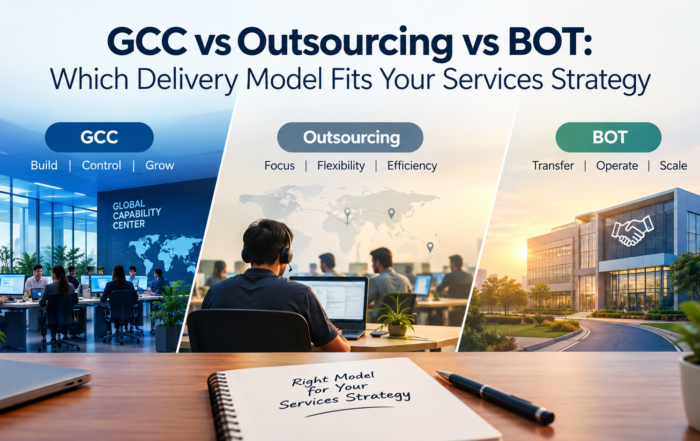
A Global Capability Center is a wholly-owned subsidiary of a US, European, or APAC parent company, set up in India to deliver technology, analytics, finance, or operations services back to the parent. Unlike an outsourcing arrangement where a third-party vendor is involved, a GCC is the parent's own organization operating in India, with the parent entity as the sole client.
The operational model creates specific financial and management requirements that neither traditional enterprise PSA (designed for third-party client billing) nor generic HRIS platforms cover adequately:
| GCC Dimension | Operational Reality | PSA Requirement |
|---|---|---|
| Billing model | India entity bills parent entity via intercompany invoices at a transfer price (cost-plus, market rate, or negotiated rate) | Multi-entity billing with intercompany invoice generation, INR/USD settlement, and transfer pricing documentation support |
| Financial reporting | India entity must report profitability, utilization, and cost to the parent in a format compatible with the parent's financial systems | Parent-facing dashboards and reports in USD showing utilization by practice, cost by function, and delivery productivity metrics |
| Tax compliance | India entity issues GST-compliant invoices; parent entity receives USD invoices with appropriate tax treatment | GST calculation and filing data for India entity; USD invoicing from India entity to parent with correct currency and tax treatment |
| HRIS | India GCC employees are managed in Keka, Darwinbox, or similar India-native HRIS platforms | Native HRIS integration to pull employee cost rates, leave balances, skills data, and org structure without manual sync |
| Delivery management | India team delivers to US or European stakeholders; time zones overlap for 3 to 4 hours daily at most | Time-zone-aware operations: India day-end timesheet submission, US-side approval workflows, and daily reporting that accounts for the 9 to 12 hour offset |
| Accountability to parent | GCC leadership must demonstrate utilization, productivity, and cost efficiency to justify headcount and budget in parent planning cycles | Practice-level utilization benchmarks, productivity by team, and cost-per-deliverable data that GCC leadership can present to the parent in business review meetings |
Why GCCs Need Different PSA Capabilities Than IT Services Firms
The 7 Non-Negotiable GCC PSA Requirements
| # | Requirement | What "Native" Means | Cost of Not Having It Natively |
|---|---|---|---|
| 1 | Intercompany billing (INR to USD) | System generates intercompany invoice from India entity to parent entity at agreed transfer price, in INR and USD simultaneously, without manual calculation | Manual Excel reconciliation at month end; rate card errors; FX conversion inconsistency |
| 2 | GST compliance for India entity | System calculates and records GST on India entity intercompany invoices; generates filing data for India GST returns without manual extraction | Manual GST calculation; filing errors; compliance risk |
| 3 | Transfer pricing documentation data | System maintains the service-level time and cost records by entity that support the transfer pricing policy and are available for tax authority review | Manual assembly of TP documentation; audit risk; inability to demonstrate arm's-length pricing |
| 4 | Keka / Darwinbox HRIS integration | Employee data, cost rates, leave balances, and org structure pulled natively from the HRIS without manual data entry or spreadsheet sync | Manual cost rate maintenance; leave data lag producing availability errors; $10,000 to $30,000 custom API development |
| 5 | Parent-facing utilization dashboards | Practice-level and function-level utilization visible to parent stakeholders in USD terms without requiring the parent to access India PSA directly | Manual monthly utilization reports assembled in PowerPoint; data always 2 to 4 weeks stale when presented in business reviews |
| 6 | Time-zone-aware operations | Timesheet deadlines, approval workflows, and reporting periods configured for India day-end submission and US-side review without manual scheduling adjustment | India timesheets submitted but not reviewed before US billing period close; approval lag creates billing cycle delay |
| 7 | Bench visibility before parent sees it | AI-driven pre-bench alerts that surface undeployed capacity to GCC leadership 7 to 14 days before bench becomes visible in parent cost reporting | Parent discovers bench in monthly cost report; GCC leadership is in reactive mode; trust in GCC efficiency eroded |
PSA Tools Evaluated for GCC Operations in 2026
1. KEBS
Best for: GCCs of all sizes | G2: 4.7/5 | From $5/user
KEBS is the only PSA in this review purpose-built for the GCC operating model. All seven non-negotiable requirements above are native capabilities: intercompany INR/USD billing, GST compliance, transfer pricing documentation data, native Keka and Darwinbox HRIS integration, parent-facing utilization dashboards, time-zone-aware operations, and KAIS KII pre-bench alerts before bench appears in parent cost reporting. KaarTech's history as an SAP Gold Partner means the SAP ERP connector (used by many GCC parent entities) is enterprise-grade. Role-based pricing from $5 to $49/user with no minimum contract floor. SOC 2 Type II and ISO 27001 certified. 4 to 8 week implementation.
2. Kantata
Best for: Large GCCs (200+ users) needing enterprise resource forecasting depth | G2: 4.1/5 | Custom ($25K+ minimum)
Kantata covers resource management and financial governance at enterprise depth. Limited multi-entity support for India-US intercompany billing; no native Keka or Darwinbox integration (custom API required). Best for very large GCCs where resource management complexity justifies the enterprise cost and implementation timeline, and where the India-specific billing requirements can be handled through custom configuration. Trade-off: $25,000-plus annual minimum and 3 to 6 month implementation.
3. Generic Enterprise PSA (SAP Project System, Oracle PS Cloud)
Best for: GCCs already running SAP or Oracle infrastructure at the parent level | Pricing: Custom
Some GCCs deploy SAP Project System or Oracle PS Cloud as extensions of the parent's ERP because the parent already runs these platforms. The integration with parent financial systems is the primary advantage. The operational complexity for GCC-specific delivery management (skills-based bench management, daily timesheet workflows for India teams, practice-level utilization reporting for GCC leadership) is a significant implementation challenge; these are ERP modules, not purpose-built PSA platforms. Best for GCCs where the parent mandate is ERP consolidation rather than operational delivery management.
4. Mid-Market PSA (BigTime, Scoro, Productive)
Best for: Small GCCs (under 30 users) with straightforward billing | Pricing: $10 to $26/user
Mid-market platforms like BigTime, Scoro, and Productive offer accessible pricing and quick implementation for small GCCs where intercompany billing complexity is low and the parent does not require formal transfer pricing documentation. None cover the seven non-negotiable requirements above; they require manual processes for most GCC-specific financial operations. A practical starting point for very early-stage GCCs (10 to 25 people) that will need a purpose-built platform as they scale above 50 users.
Full GCC Capability Comparison
| GCC Requirement | KEBS | Kantata | SAP PS / Oracle | Mid-Market (BigTime, Scoro) |
|---|---|---|---|---|
| Intercompany INR/USD billing | Native | Limited / custom | ERP-native (complex) | Manual |
| GST compliance (India) | Native | Not natively | SAP FI module | Manual |
| Transfer pricing data | Native | Partial | ERP-level | Manual |
| Keka / Darwinbox (native) | Native | Custom API | Custom API | Custom API or manual |
| Parent-facing dashboards | Native, USD | Standard reports | ERP reports | Manual export |
| Time-zone-aware operations | Configured for India-US | Manual configuration | ERP timezone settings | Not designed for it |
| Pre-bench AI alerts | KII (7-14 days lead) | Emerging | None | None |
| Skills-based bench matching | KIR (AI-ranked) | Deep | None | None |
| Implementation speed | 4 to 8 weeks | 3 to 6 months | 6 to 18 months | 4 to 8 weeks |
| G2 Rating | 4.7 | 4.1 | N/A (ERP modules) | 4.4 to 4.6 |
Intercompany Billing Deep Dive: What GCCs Actually Need
Intercompany billing between the India GCC entity and the US parent entity involves five connected requirements that most PSA platforms do not support natively:
-
Transfer price calculation from delivery recordsThe intercompany invoice amount must be calculated from actual delivery records (hours worked by resource, at the agreed transfer price per resource role) rather than from a fixed monthly fee. This requires the PSA to capture India team hours against parent-defined work categories and apply the agreed transfer price schedule automatically, without manual calculation by the GCC finance team.
-
Dual-currency invoice generationThe India entity issues an invoice in INR (the functional currency of the Indian entity) which is simultaneously converted to USD at the agreed contractual exchange rate for the parent entity's recording. Both currency amounts must appear on the invoice, and the exchange rate used must match the transfer pricing agreement. Manual FX conversion introduces errors that create reconciliation disputes in month-end close.
-
GST on the India entity invoiceServices provided by the India GCC entity to the foreign parent entity are typically zero-rated for GST (export of services), but the invoice must include the correct GST classification and filing data. The GCC finance team must generate GST return data from the intercompany billing records without manually reconciling across billing and accounting systems.
-
Parent ERP compatibilityThe intercompany invoice must be in a format that the parent entity's ERP (SAP, Oracle, NetSuite) can process without manual data re-entry. For GCCs whose parent runs SAP, KEBS' native SAP connector generates intercompany billing data in SAP-compatible formats, eliminating the manual AP entry on the parent side.
-
Transfer pricing documentationTax authorities in both the India entity's jurisdiction and the parent entity's jurisdiction may request documentation that the transfer price is at arm's length. This requires the GCC to maintain service-level records showing hours worked, role level, work category, and the basis for the transfer price. The PSA must generate this documentation data from delivery records without requiring a manual reconstruction exercise at audit time.
Utilization Reporting for Parent Visibility: The GCC Business Case
The most common point of tension between a GCC and its parent organization is utilization visibility. Parent finance leaders who approve India headcount budgets need evidence that the investment is productively deployed. When they cannot see utilization data in real time, they rely on end-of-quarter reports that are always stale, and they ask questions that GCC leadership cannot answer confidently because their own visibility is limited.
A GCC that can show its parent "our cloud practice is at 78% utilization, our data engineering practice is at 81%, and we have 14 available engineers in the DevOps practice that can absorb the new platform modernization workstream" wins budget conversations. A GCC that presents a quarterly headcount justification slide without real-time utilization data loses them.
| Utilization Report Type | What It Shows | Parent Use Case |
|---|---|---|
| Practice-level utilization | Billable utilization by practice (Cloud, SAP, Data Engineering, DevOps, etc.) against target for each period | Headcount budget justification by practice; identifies which practices have capacity for additional parent demand |
| Bench by skill category | Resources currently on bench, by skill category, with bench duration and cost accruing in USD | Budget transparency; prevents parent perception of hidden waste; justifies active bench management investment |
| Productivity by function | Deliverables produced per billable hour or per FTE by function, trended over time | Year-over-year productivity improvement narrative; justification for GCC headcount growth vs additional outsourcing |
| Cost per deliverable | Fully loaded cost of India team delivery per unit of output (story points, tickets resolved, reports delivered) in USD | Demonstrates GCC cost efficiency vs alternative delivery models; supports budget reviews and RoI conversations |
KEBS GCC deployment covers all seven non-negotiable requirements natively, without custom development or manual workarounds. Intercompany billing from India entity to parent entity is generated from daily delivery records with INR and USD amounts, the agreed exchange rate, GST classification, and transfer pricing documentation data included in the billing output. The parent entity's finance team receives a single structured billing file compatible with their ERP (SAP, Oracle, NetSuite) for automated processing on their side.
Keka and Darwinbox HRIS integration pulls India team employee records, cost rates, leave balances, and org structure into KEBS daily. Skills profiles are maintained in KEBS from the HRIS foundation, keeping the resource matching taxonomy current without separate data maintenance. When a new hire joins the GCC and is entered in Keka, their KEBS profile is created automatically and flagged for skills completion within 30 days of join.
KAIS KII monitors bench across the India delivery pool continuously. When a resource approaches rolloff without a confirmed next allocation, KII fires a pre-bench alert to the GCC resource management team 7 to 14 days before bench begins. KIR surfaces the top 3 demand requests from the parent's incoming work pipeline that match the resource's skills profile, giving the GCC resource management team a confirmed next allocation before bench appears in the parent's cost reporting. The average time from KII bench alert to confirmed next allocation in KEBS-managed GCC deployments is 1.8 days.
Parent-facing utilization dashboards show practice-level utilization, bench by skill category, productivity by function, and cost per deliverable in USD, updated from daily delivery data. GCC leadership can share a read-only dashboard link with parent stakeholders in the US, eliminating the monthly report assembly exercise and giving parent finance leaders real-time visibility into the investment they are making in India delivery capacity. Role-based pricing from $5 to $49/user. SOC 2 Type II and ISO 27001 certified. 4 to 8 week deployment.
Frequently Asked Questions
Run Your GCC Like a Profit Center. KEBS Is the Only PSA Built for the GCC Operating Model.
Intercompany INR/USD billing. GST compliance. Transfer pricing documentation. Native Keka and Darwinbox integration. Parent-facing utilization dashboards. Pre-bench AI alerts. From $5/user. SOC 2 Type II. ISO 27001. 4 to 8 week deployment.
Book a Free Demo →