
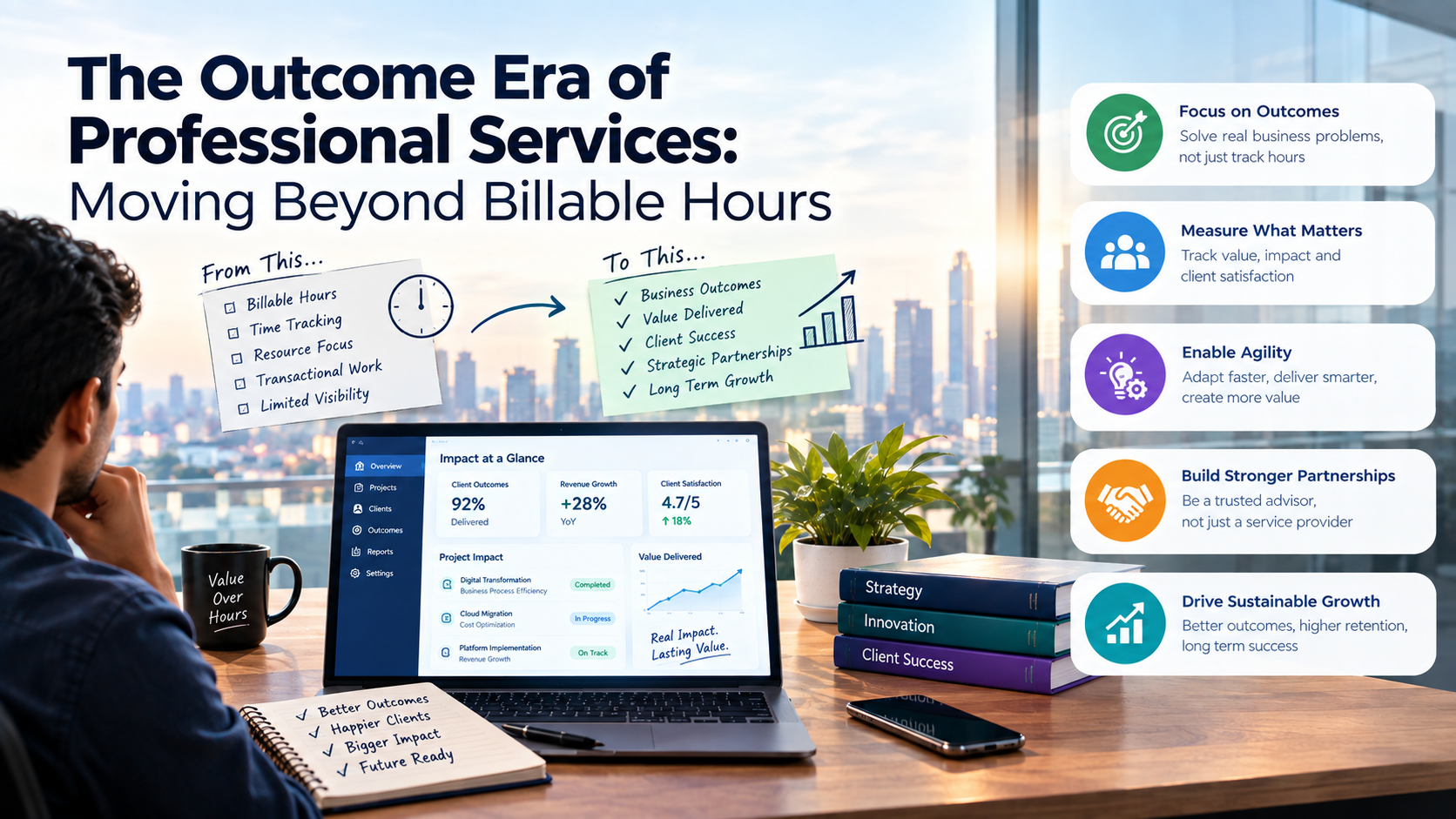
The Outcome Era of Professional Services: Moving Beyond Billable Hours
7 PM tools ranked for professional services. Features, comparison table, and verdict.
Date Posted:
September 30, 2026
Share This:
The Outcome Era of Professional Services: Moving Beyond Billable Hours
Professional services has been sold on hours for a century. The client pays for time; the firm tracks that time; the difference between cost and billing rate is the margin. It is a model that is simple to operate, easy to audit, and deeply familiar to both sides of every engagement. It is also a model that clients are increasingly unwilling to accept, and that AI is making structurally obsolete. The outcome era of professional services is not a trend. It is a structural transition driven by two simultaneous forces: client demand for value-based pricing and AI-driven delivery efficiency that makes the hour-by-hour justification of cost increasingly difficult.
In the billable hours model, the firm is paid for effort. In the outcome model, the firm is paid for results. The transition requires different pricing structures, different delivery metrics, different risk management, and different technology. It also creates the potential for significantly higher margin when delivery efficiency improves.
The Shift That Is Already Happening
The pressure to move beyond billable hours is not coming from professional services firms. It is coming from clients. Enterprise procurement teams in 2026 are significantly more sophisticated about what they are buying when they engage a consulting or IT services firm. They have seen too many T&M engagements that ran over budget and under-delivered to accept the implicit risk transfer that hourly billing represents: "we will bill you for whatever it takes."
The second force is AI. When AI agents can accelerate delivery significantly for certain categories of professional services work, the billable hour model creates a perverse incentive: the more efficient the firm becomes with AI, the less it earns per engagement under T&M pricing. Outcome-based pricing breaks this incentive structure. When the firm is paid for the result rather than the time, delivery efficiency accrues entirely to the firm as margin improvement.
AI makes the billable hour model self-defeating. The more efficiently you deliver with AI, the less you earn per engagement if you are billing by the hour. Outcome pricing is how AI efficiency becomes margin.
Why the Billable Hours Model Is Failing in 2026
When a task that previously required 40 hours of consultant time can be completed in 8 hours with AI assistance, billing the client for 40 hours is dishonest and billing for 8 hours reduces revenue by 80%. Outcome pricing resolves this by decoupling payment from time.
In T&M contracts, all delivery risk sits with the client. Scope grows, hours grow, the invoice grows. Sophisticated enterprise buyers increasingly refuse this risk transfer and insist on fixed-price or outcome-linked contracts.
A senior consultant who solves a client's problem in 2 hours of thinking delivers more value than a junior team that produces the same output in 20 hours. Hourly billing systematically undervalues expertise and over-rewards inefficiency.
Firms that can credibly commit to outcomes and demonstrate a track record of delivery consistently command a 15 to 30% price premium over equivalent T&M work. The risk premium the client pays for a firm that absorbs delivery risk is real and sustainable.
Outcome-Based Billing Models: A Practical Overview
The term "outcome-based pricing" covers a spectrum of models. Understanding the spectrum is essential because the operational requirements, risk profiles, and margin dynamics are different at each point.
| Model | How It Works | Who Bears Delivery Risk | Best For |
|---|---|---|---|
| Fixed Price | Firm agrees to deliver a defined scope for a fixed fee | Firm (if over scope) | Well-defined projects with stable requirements |
| Milestone-Based | Payment tied to achievement of defined delivery milestones | Shared | Multi-phase implementations with clear stage gates |
| Retainer (Outcome SLA) | Monthly fee for a defined service level and set of deliverables | Firm (if SLA is missed) | Ongoing managed services with predictable scope |
| Gain Share | Base fee plus a percentage of measurable client value created | Shared, aligned | Transformation projects with clear financial KPIs |
| Pure Outcome / Success Fee | Fee paid only when a defined outcome is achieved | Firm entirely | High-confidence, narrow-scope projects with binary outcomes |
The Real Risks of Outcome-Based Pricing
In T&M, scope creep inflates the invoice. In fixed-price, it inflates cost without revenue recovery. Every undocumented requirement, every client-requested addition that does not trigger a change order, directly reduces margin. Outcome pricing requires airtight scope management.
Fixed-price contracts are only profitable if the cost estimate was accurate. Firms with poor historical delivery data, inconsistent skills tracking, or no AI-driven cost estimation will systematically under-price fixed engagements until the losses force them back to T&M.
Gain-share and success-fee models create disputes when the firm delivers its commitments but the client fails to implement recommendations or external factors move the KPI. Contracts must clearly define what is in and out of the firm's control.
Under ASC 606 and IFRS 15, outcome-based contracts with variable consideration require careful accounting for revenue recognition. Gain-share and success-fee components may need to be constrained until it is highly probable they will not reverse.
What You Need to Operate on Outcomes
-
Delivery data history that makes cost estimation reliable
Before you can confidently price a fixed-price engagement, you need to know what similar work has actually cost to deliver, by engagement type, by resource profile, by client complexity. This requires years of clean PSA data where actual hours, actual costs, and actual delivery timelines are recorded accurately at the project level.
-
Real-time margin monitoring throughout delivery
On a T&M project, a budget overrun is the client's problem. On a fixed-price project, it is yours. You need real-time visibility into actual cost vs. estimated cost at every stage of delivery so that margin erosion is detected and addressed before it reaches a point of no recovery.
-
Disciplined change order management
Every out-of-scope request must be formally assessed, documented, and either declined or priced as a change order. This is not a documentation preference: on a fixed-price contract, it is the difference between a profitable engagement and a loss-making one. The PSA must enforce a change order workflow that makes ad hoc scope additions impossible to absorb silently.
-
Skills-based resource matching to protect margin
On a fixed-price contract, assigning a more expensive resource than the estimate assumed directly reduces margin. Resource matching must respect the cost assumptions built into the fixed-price proposal, which requires a PSA that tracks cost rates by resource and flags when actual staffing deviates from the proposal's resource assumptions.
-
Revenue recognition that handles variable consideration
Outcome-based contracts with variable components (performance bonuses, gain share, success fees) require revenue recognition that applies the constraint principles of ASC 606: recognizing variable consideration only to the extent it is highly probable it will not reverse. This requires a finance system that can model this complexity, not a spreadsheet that books revenue at contract signing.
KEBS is built for the outcome model as much as for the T&M model. Fixed-price and milestone billing are native billing structures with real-time margin monitoring built in: KII (Inform) tracks actual cost vs. estimated cost at every project stage and surfaces margin risk before it reaches a point where recovery is impossible. When a fixed-price project burns 60% of its budget at 40% completion, the alert fires before the next delivery phase begins, not after the project closes.
Change order management is enforced in the platform: when delivery events are logged that fall outside the contracted scope, KEBS prompts the project manager to create a formal change assessment rather than allowing the work to be absorbed silently. Skills-based resource matching in RMG respects the cost rate assumptions from the proposal so that staffing decisions do not inadvertently destroy fixed-price margin.
Revenue recognition for outcome-based contracts is automated: milestone billing triggers recognition when the milestone is accepted, variable consideration components are tracked separately with constraint flags for ASC 606 compliance, and the three-year revenue forecast from KIA incorporates the probability-weighted value of outstanding outcome-based engagements. For IT services firms and consulting organizations transitioning to outcome-based pricing models, KEBS provides the operational infrastructure that makes the transition safe rather than a margin risk.
Frequently Asked Questions
Ready to Move Beyond Billable Hours? KEBS Provides the Infrastructure to Do It Safely.
Real-time fixed-price margin monitoring. Automated change order workflows. Milestone billing. AI-driven cost estimation. KEBS gives you everything you need to transition to outcome-based pricing without the execution risk. Rated 4.7/5 on G2.
Book a Free Demo →