
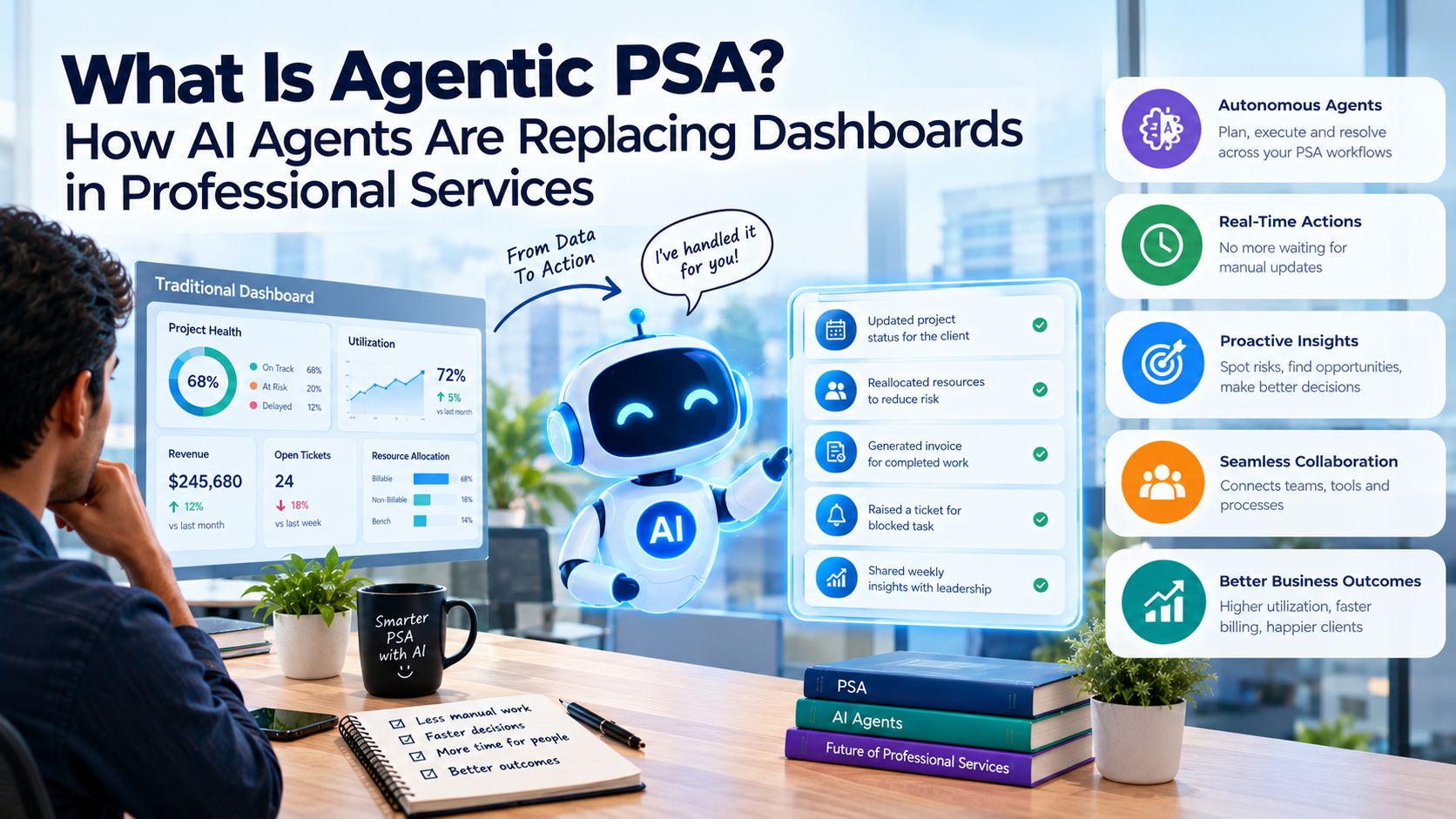
What Is Agentic PSA? How AI Agents Are Replacing Dashboards in Professional Services
7 PM tools ranked for professional services. Features, comparison table, and verdict.
Date Posted:
October 9, 2026
Share This:
What Is Agentic PSA? How AI Agents Are Replacing Dashboards in Professional Services
For the past decade, PSA platforms competed on the richness of their dashboards. More charts, more filters, more real-time data visualizations. The underlying assumption was always the same: a human would look at the data, interpret it, and decide what to do. Agentic PSA flips that assumption. Instead of building better dashboards for humans to watch, it deploys AI agents that watch the operation themselves, interpret what they see, and act on it without waiting for someone to open a report.
Agentic PSA is a professional services automation platform where AI agents actively monitor delivery operations, make decisions within defined parameters, and execute actions automatically, replacing the passive dashboard-and-report model with a system that runs the operation in real time. The agent does not wait to be asked. It observes, reasons, and acts.
The Dashboard Problem in Professional Services
Traditional PSA dashboards are designed on a reactive model. The system records what happened: hours logged, projects updated, invoices raised, resources allocated. A manager opens a report, sees the data, identifies an issue, and takes action. By the time that cycle completes, the project has already burned through margin, the resource gap has already delayed a milestone, or the invoice has already aged past 45 days.
The core limitation is not the quality of the data. Most modern PSA platforms have excellent data. The limitation is the assumption that a human will be monitoring that data continuously across every project, every resource, and every financial metric simultaneously. That assumption has never been true. Delivery managers run portfolios of 10 to 30 projects. They check dashboards when something feels wrong, not continuously, which means they find problems after the fact, not before.
A dashboard that shows you a problem after it has already cost you margin is not intelligence. It is a post-mortem tool with a live feed.
Agentic PSA solves this by replacing the manager-watches-dashboard model with an agent-watches-everything model. The agent is always on. It monitors every data point across the entire portfolio continuously, applies pre-trained reasoning to identify patterns that indicate risk, and acts within its authorization boundary without waiting for a human to notice.
How AI Agents Work Inside a PSA Platform
An AI agent in the context of PSA software is a software system that continuously observes a defined domain of data, applies learned or rule-based reasoning to determine what actions are appropriate, and executes those actions within a defined scope of authority. The key distinction from traditional automation is the reasoning layer: a rules-based automation fires when a condition is met. An agent interprets context, weighs multiple signals, and determines what the right action is given the current state of the system.
The Three Core Capabilities of a PSA AI Agent
The agent monitors all incoming data streams simultaneously: timesheet submissions, resource allocation changes, project milestone updates, billing events, and pipeline movements. It does not rely on batch processing or scheduled report runs.
Rather than firing on single thresholds, the agent weighs multiple signals together. A resource at 95% allocation on a project running 12% over budget in a client with a history of late approvals is a different risk profile than a resource at 95% on a healthy fixed-price project.
Within its authorization boundary, the agent acts without waiting for human approval: sending a utilization alert, flagging a billing discrepancy, escalating a stalled timesheet, or updating a resource allocation recommendation in the demand queue.
The Three Layers of Agentic PSA: Inform, Recommend, Act
The most useful way to understand agentic PSA capability is across three layers of increasing autonomy. Not every platform that claims AI is operating at all three layers. The layer at which a PSA operates determines how much of the delivery operation it genuinely runs vs. how much it still depends on humans to watch, decide, and act.
| Layer | What the Agent Does | Human Role | Example in PSA |
|---|---|---|---|
| Layer 1: Inform | Monitors data, surfaces alerts and anomalies proactively | Receives alert, decides and acts | Flags that Project X margin has dropped below 15% threshold |
| Layer 2: Recommend | Diagnoses the cause, generates ranked recommended actions | Reviews recommendation, approves or modifies, acts | Recommends three specific resources to backfill a gap, ranked by skill fit and cost |
| Layer 3: Act | Executes the action autonomously within defined authorization | Reviews audit log, overrides if needed | Triggers billing, updates allocation, sends client milestone notification automatically |
Most PSA platforms with AI features operate at Layer 1. A smaller number operate meaningfully at Layer 2. True agentic PSA operates at Layer 3 for routine, well-defined actions while escalating ambiguous or high-stakes decisions to human review. The goal is not to remove humans from the loop: it is to ensure humans are only in the loop for decisions that require their judgment, not for actions that are deterministic given the data.
Agentic PSA in Practice: Real-World Use Cases
An agent continuously monitors resource allocation across the portfolio. When a resource rolls off a project 10 days before their next confirmed assignment, the agent identifies the bench gap, matches available demand requests to their skill profile, and queues a staffing recommendation for the resource manager, without anyone running a utilization report.
The agent monitors budget burn rate against delivery progress on every active project. When actual hours exceed planned hours by more than a configurable threshold relative to completion percentage, it surfaces a margin risk alert and generates a change order prompt for the project manager, before the project closes and the damage is done.
When a project milestone is marked complete and approved in the delivery system, the agent automatically triggers invoice generation, populates it from approved timesheet data and the contract rate card, queues it for finance review, and logs the billing event to the revenue recognition schedule, without a billing coordinator manually connecting these steps.
Rather than waiting for a monthly finance review to update the revenue forecast, the agent recalculates expected revenue continuously as pipeline stages change, projects progress, and resource availability shifts. The forecast is always current because the agent is always recalculating it from live operational data.
Agentic PSA vs. Traditional PSA: The Operating Model Difference
| Dimension | Traditional PSA | Agentic PSA |
|---|---|---|
| How problems are found | Manager reviews dashboard, notices deviation | Agent detects deviation, alerts manager immediately |
| Response time to delivery risk | Days to weeks after the problem appears in data | Hours or minutes after the signal threshold is crossed |
| Resource allocation | Resource manager manually reviews availability and skills | Agent recommends ranked matches, manager approves |
| Billing process | Finance coordinator manually connects timesheet to invoice | Agent triggers invoice from approved delivery events |
| Revenue forecasting | Monthly finance exercise based on last period's data | Continuous recalculation from live pipeline and delivery data |
| Manager time on PSA | 4 to 8 hours per week reviewing reports and dashboards | 30 to 60 minutes reviewing agent actions and escalations |
| Primary human role | Data consumer: reads reports, identifies issues, acts | Exception handler: reviews agent decisions, overrides edge cases |
How KEBS Delivers Agentic PSA
KEBS operates across all three agentic layers through KAIS (KEBS AI Suite). KII (Inform) continuously monitors utilization, bench status, project margin, and billing health across the entire delivery portfolio, surfacing alerts when patterns indicate risk without waiting for a manager to run a report. KIR (Recommend) diagnoses the cause of each flagged condition and generates ranked recommended actions: specific resources, specific billing adjustments, specific change order triggers, with reasoning the delivery manager can review and approve or modify.
KIA (Act) is where KEBS moves fully into agentic territory. Within defined authorization parameters, KIA executes actions autonomously: triggering invoices from milestone completions, updating resource allocation queues, sending client notifications, recalculating the three-year revenue forecast when pipeline data changes. Managers review what KIA has done through an audit log, not a dashboard, because the action has already been taken correctly in most cases.
The result is a delivery operation where managers spend their time on exceptions and strategic decisions, not on reading reports and manually connecting systems. Customers including Maveric Systems, Zifo Technologies, and Mindsprint have moved from dashboard-heavy monthly review cycles to agent-monitored weekly exception reviews, recovering an average of 4 to 6 hours per delivery manager per week.
Frequently Asked Questions
Stop Watching Dashboards. Let KEBS Run the Operation.
KEBS KAIS is the three-layer agentic AI engine built for IT services delivery. KII monitors everything. KIR recommends actions. KIA executes them. Your team reviews exceptions, not reports. Rated 4.7/5 on G2.
Book a Free Demo →