
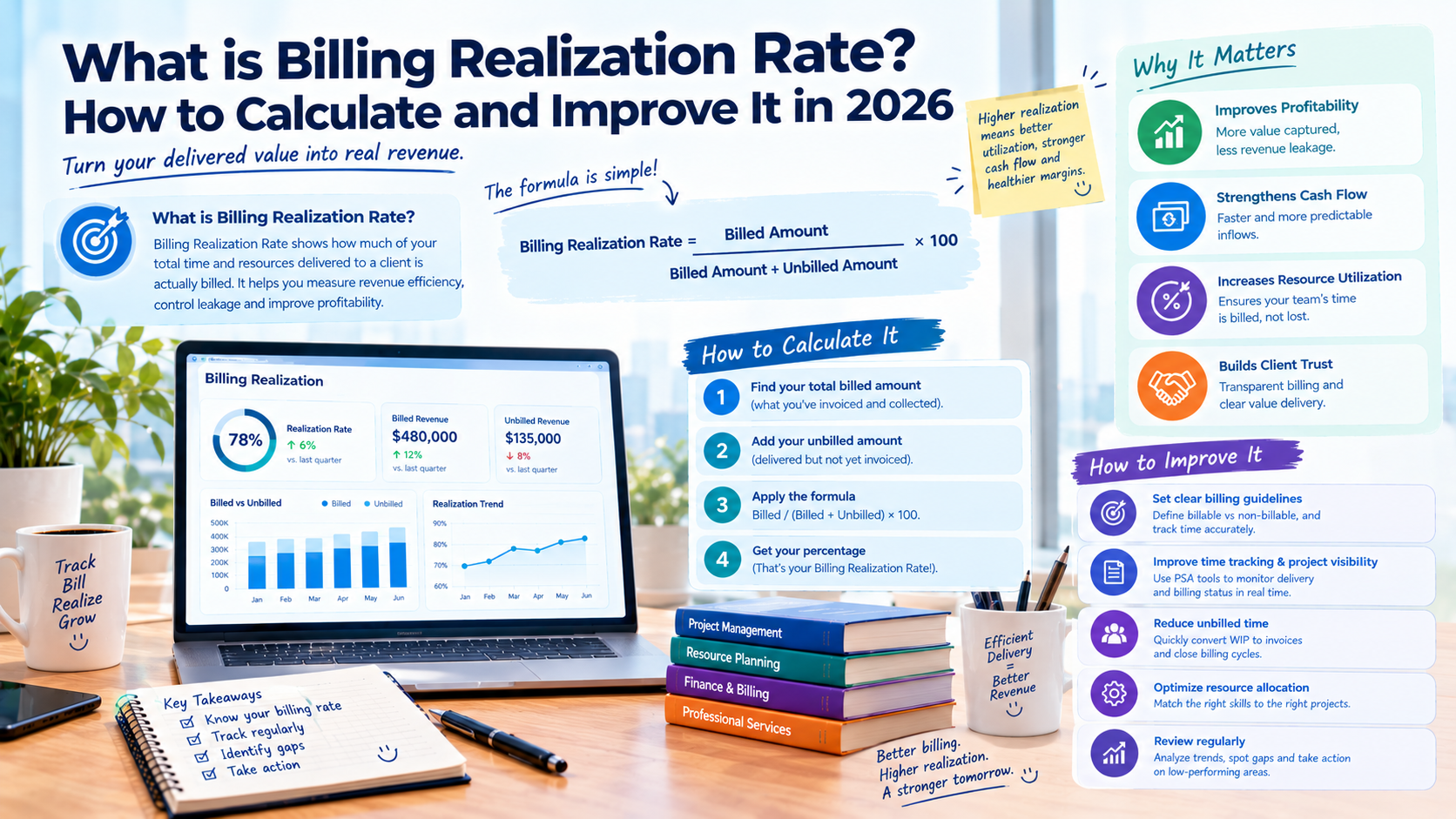
What is Billing Realization Rate? How to Calculate and Improve It in 2026
7 PM tools ranked for professional services. Features, comparison table, and verdict.
Date Posted:
October 21, 2026
Share This:
What is Billing Realization Rate? How to Calculate and Improve It in 2026
Your team delivered the work. The hours are logged. The project closed on time. But when the invoice goes out, the amount billed is meaningfully less than the amount earned. That gap has a name: billing realization rate. It is one of the most important financial health indicators in professional services, and most firms track it too late, too infrequently, or not at all. This guide explains what it is, how to calculate it, what causes it to fall, and how to fix it.
What is Billing Realization Rate?
Billing realization rate (also called billing realization or invoice realization) is the percentage of billable hours actually invoiced and collected relative to the total hours worked and eligible for billing. It measures how efficiently a professional services firm converts its delivered work into actual revenue.
A firm with a 100% billing realization rate invoices every billable hour at the full rate and collects it in full. In practice, no firm hits 100%. Write-downs, discounts, scope overruns absorbed internally, non-billable client requests treated as billable, and collection gaps all erode the realization rate. The question is not whether your rate is perfect but whether you know what it is and whether it is trending in the right direction.
Billing realization rate is the ratio of revenue actually billed (and collected) to the maximum possible revenue from all hours worked at standard rates. It tells you what fraction of your delivered value you are actually capturing as cash.
How to Calculate Billing Realization Rate
There are two common versions of this calculation depending on whether you are measuring at the billing stage or the collection stage.
Version 1: Billing Realization (Invoice Stage)
Version 2: Collection Realization (Cash Stage)
Most professional services firms track billing realization (version 1) as their primary metric and monitor collection realization separately as a DSO and AR health indicator. Both matter: a high billing rate with poor collection is still a revenue loss.
What Inputs Do You Need?
| Input | What It Is | Where It Comes From |
|---|---|---|
| Total billable hours worked | All hours logged against billable projects | Timesheet system or PSA |
| Standard billing rate | Published or agreed per-hour rate per role | Rate card in PSA or finance system |
| Total billable value | Hours x standard rate = theoretical max revenue | Calculated from above two |
| Actual amount invoiced | What was actually billed to the client | Invoice records in billing/PSA system |
| Actual cash collected | What was paid by the client | AR/collections in accounting system |
The reason most firms struggle to calculate realization rate accurately is that these inputs live in different systems: timesheets in one tool, rate cards in another, invoices in the finance system, and AR in the accounting platform. If these are not connected in a single PSA data model, calculating realization rate requires manual reconciliation that is slow, error-prone, and always looking backward.
Billing Realization Rate vs. Utilization Rate: What is the Difference?
These two metrics are often confused because they both involve billable hours. They measure completely different things.
| Metric | What It Measures | Formula | What a Low Score Means |
|---|---|---|---|
| Utilization Rate | What proportion of a resource's available hours are spent on billable work | Billable Hours / Total Available Hours | People are not being deployed on billable work (bench, internal, non-billable) |
| Billing Realization Rate | What proportion of billable work was actually invoiced and captured as revenue | Actual Invoiced / Billable Value at Standard Rates | Delivered work is being discounted, written off, or not invoiced correctly |
A firm can have 85% utilization and 70% realization. It means the team is busy and billing, but a significant portion of the delivered value is being lost to discounts, write-downs, and scope gaps before it becomes cash.
You need both metrics to get a complete picture of revenue health. High utilization with low realization means your people are working hard but the firm is not capturing the value. High realization with low utilization means billing is efficient but capacity is being wasted. The target is high utilization AND high realization.
Industry Benchmarks: What is a Good Billing Realization Rate?
Benchmarks vary by firm type, billing model, and client mix. The following ranges are drawn from SPI Research, Deltek, and independent PSA benchmark analysis for 2025 and 2026.
IT services firms and consulting organizations with fixed-price project models typically achieve higher realization rates because billing is predetermined. T&M firms with variable rates across senior and junior resources, or firms with complex client discount arrangements, typically see more variance and need more active management of realization by project and client.
Why Billing Realization Rate Drops: The 6 Most Common Causes
Hours logged but not billed because the PM decided the work was over scope, the client disputed hours, or quality issues led to credit notes. The most direct hit to realization rate.
Volume discounts, relationship pricing, and negotiated rate reductions that are applied at invoice but not reflected in the project financial model, making realization calculations inaccurate.
Work delivered beyond the contracted scope that project managers approve and deliver without raising a change order. The hours are real; the billing is not. This is the single largest source of realization loss for fixed-price engagements.
Hours entered in bulk at week or month end, reconstructed from memory rather than captured in real time. Inaccurate timesheets mean inaccurate billing. If the timesheet is wrong, the invoice is wrong.
Resources billed at incorrect rates because of stale rate cards in the billing system, resource level mismatches, or manual invoicing errors. Common in firms where rate management is manual rather than system-driven.
Invoices raised correctly but not paid in full due to client dispute, payment terms issues, or AR management gaps. Billing realization can be healthy while collection realization is poor.
How to Improve Billing Realization Rate in 2026
-
Enforce real-time timesheet capture
Every day of delay between work performed and time logged increases the chance of lost hours, inaccurate categorization, and write-down at billing. Implement daily time entry as a policy and use automated reminders to enforce it. PSA platforms with mobile time capture and timesheet locking reduce late submission rates significantly.
-
Set project-level realization targets, not just firm-wide averages
A 90% firm-wide average can hide a project running at 60% and another at 110%. Track realization by project, client, practice area, and delivery manager. Surface outliers in real time so PMs can intervene before billing, not after.
-
Build change order discipline into every project
Every out-of-scope request should trigger a change order conversation, not a PM decision to absorb it. Create a standard change order workflow in your PSA so that scope changes are reviewed, documented, and billed rather than written off silently. Scope creep is the most preventable source of realization loss.
-
Automate rate card management
Rate cards should live in the PSA, not in a spreadsheet that someone updates twice a year. Automated rate assignment by resource level, project type, and client agreement eliminates billing errors at the source. Audit invoices against system rate cards before they go out.
-
Review write-downs before billing, not after
Most firms discover write-downs when they reconcile the invoice against the timesheet after the fact. Move this review to a pre-billing workflow: a PM-approved billing review step that flags hours eligible for write-down and requires documented justification before they are removed from the invoice.
-
Track realization weekly, not monthly
Monthly realization reviews are too late to intervene on active projects. Weekly realization dashboards by project and practice allow PMs and finance teams to act while the project is still open rather than doing a post-mortem on closed work.
 How KEBS Tracks Billing Realization
KEBS connects timesheet data, rate cards, project budgets, and invoice records in a single data model, which means billing realization rate is always calculated from live data rather than manually reconciled at month end. Project managers see project-level realization in real time. Finance sees firm-wide and client-level realization trends without building spreadsheet reports.
KII (KEBS Inform, part of the KAIS AI Suite) proactively flags projects where realization is trending below target before billing runs, giving PMs the window to review write-downs, raise change orders, and correct rate mismatches while the project is still active. KIA automates billing triggers, invoice generation, and collection follow-ups based on configurable rules, reducing the manual steps where billing errors most often occur.
For IT services firms and consulting teams managing high volumes of billable resources across multiple projects and clients, KEBS eliminates the manual reconciliation that keeps most realization dashboards permanently out of date. Customers including Maveric Systems, Zifo Technologies, and Mindsprint use KEBS to monitor realization and utilization across their full delivery portfolio in real time.
Frequently Asked Questions
Stop Leaving Revenue on the Table. Track Realization in Real Time with KEBS.
KEBS connects timesheets, rate cards, and invoicing in one platform so billing realization is always live, always accurate, and always actionable. AI alerts flag at-risk projects before billing runs. No manual reconciliation. No month-end surprises.
Book a Free Demo →