What Is IT Service Management (ITSM) for Professional Services Firms?
7 PM tools ranked for professional services. Features, comparison table, and verdict.
Date Posted:
October 9, 2026
Share This:
What Is IT Service Management (ITSM) for Professional Services Firms?
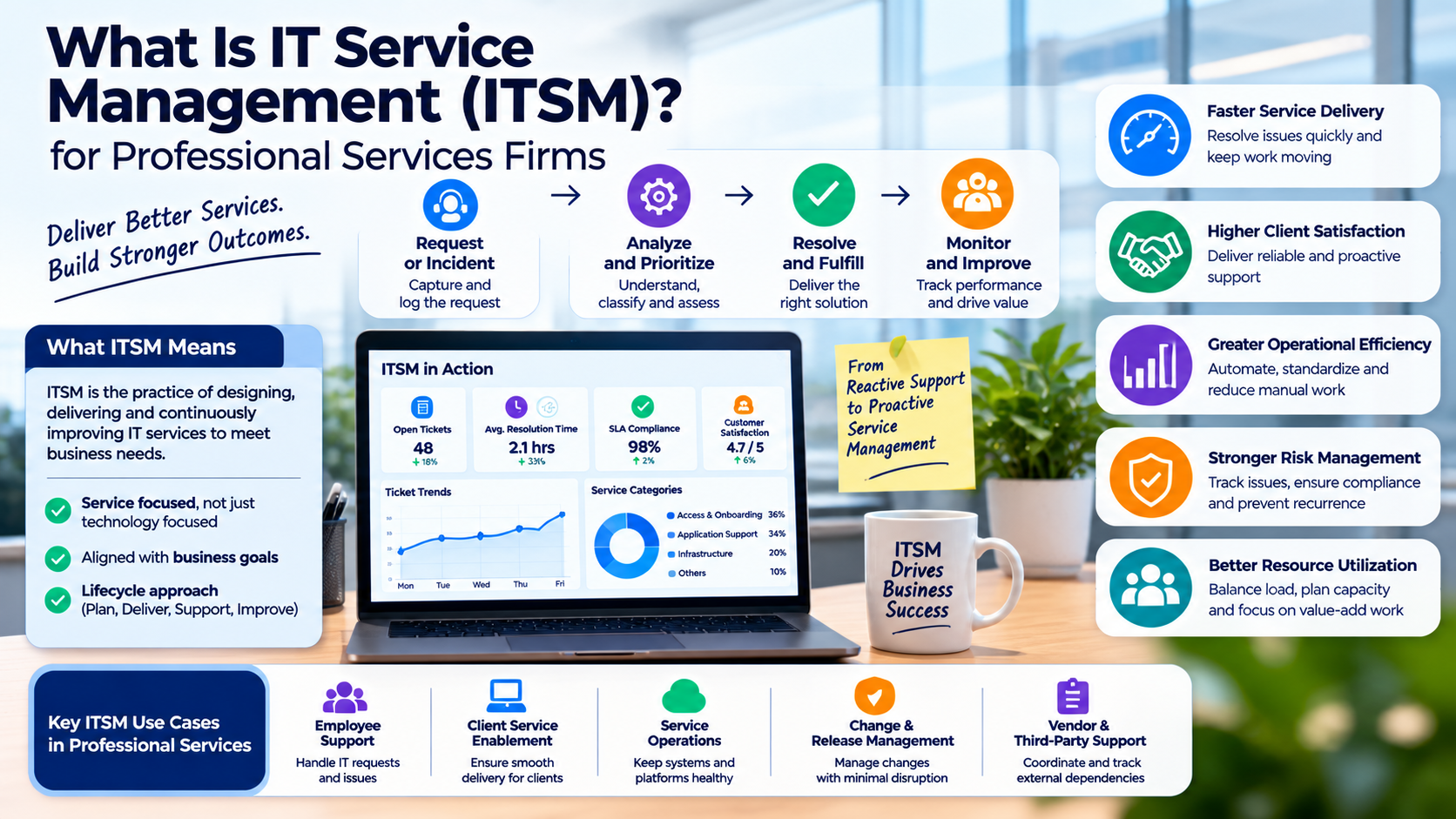
IT Service Management (ITSM) is the framework that governs how IT services are designed, delivered, managed, and improved. For product companies with internal IT teams, ITSM means managing the employee helpdesk and keeping internal systems running. For professional services firms, the equation is entirely different: ITSM is how you deliver on client commitments, track service obligations, manage incidents that directly affect client revenue, and ensure that every support interaction is accounted for in your delivery and billing operation. This guide explains what ITSM means specifically for professional services firms and why the standard tools built for internal IT are the wrong starting point.
ITSM for professional services is the structured management of client-facing IT services: ticket intake, incident resolution, change management, SLA tracking, and service reporting, connected to the delivery and billing operation so that service work is visible, billable, and accounted for. It is not about managing your own IT. It is about managing the IT services you sell.
What Is ITSM? The Definition That Matters for PS Firms
ITSM stands for IT Service Management. At its core, it is the set of policies, processes, and tools that govern how an organization delivers and manages IT services to its customers. The ITIL framework (Information Technology Infrastructure Library) is the most widely adopted ITSM methodology, providing a structured approach to incident management, problem management, change management, service request fulfillment, and service level management.
For a product company, ITSM is primarily an internal discipline: manage the IT help desk, keep systems running, reduce downtime. For a professional services firm delivering IT services to clients, ITSM is an external delivery discipline: manage the client service desk, meet contracted SLAs, resolve incidents that affect client operations, and ensure that every service interaction is traceable from ticket to invoice. The word is the same; the operating context is completely different.
ITSM vs. Generic IT Support: Why the Distinction Matters
| Dimension | Generic IT Support | ITSM for Professional Services |
|---|---|---|
| Primary customer | Internal employees | External clients with contractual SLAs |
| Ticket resolution goal | Fix the problem quickly | Fix the problem within SLA and document billable effort |
| Financial connection | Cost center, no billing | Revenue center: tickets must connect to invoices |
| SLA breach consequence | Internal dissatisfaction | Contractual penalty, credit obligation, client churn risk |
| Reporting audience | IT manager, internal leadership | Client stakeholder, account manager, delivery lead |
| Change management scope | Internal system changes | Client environment changes governed by change advisory process |
| Problem management goal | Reduce ticket volume | Reduce client impact, improve margin, prevent SLA breach |
Core ITSM Processes Professional Services Firms Must Manage
Restoring normal service operation as quickly as possible after an unplanned interruption. For PS firms this means categorized intake, priority routing by SLA tier, resolution tracking against contracted response and resolution times, and client communication throughout.
Identifying the root cause of recurring incidents and eliminating them permanently. Reduces ticket volume, improves client satisfaction, and protects margin by preventing the same issue from consuming billable support hours repeatedly.
Governing changes to client environments in a controlled, approved process. Changes implemented without proper CAB (Change Advisory Board) process are a leading cause of client environment incidents and the SLA breaches that follow.
Handling standard, pre-approved requests (access provisioning, software installation, configuration updates) through a defined workflow that tracks effort, meets service commitment timelines, and feeds billable time to the invoicing system.
Monitoring response and resolution performance against contracted service levels in real time, escalating tickets approaching breach before they breach, and reporting SLA attainment to clients with enough transparency to maintain trust.
Using ticket data, SLA performance trends, and client feedback to systematically improve service delivery. The firms that retain managed services contracts long-term are those that can demonstrate improving service quality over time, not just adequate quality at contract renewal.
Why Professional Services Firms Need ITSM Differently
The ITSM tools built for internal IT teams (ServiceNow, Jira Service Management, Freshservice) are designed around the assumption that the IT team is a cost center serving internal employees. The metrics they optimize for are ticket volume, resolution time, and employee satisfaction. These are the wrong primary metrics for a professional services firm.
For a PS firm delivering managed IT services, the metrics that matter are: billable hours captured per ticket type, SLA attainment rate by client and service tier, revenue per support contract, cost to resolve by incident category, and client retention correlated with service quality. None of these are first-class outputs of tools built for internal IT.
A generic helpdesk tool tells you how fast you closed tickets. A PS-native ITSM tells you how much you billed, whether you met your SLA, and whether the client is likely to renew.
ITIL and Professional Services: What to Adopt and What to Skip
ITIL 4 (the current version) is a comprehensive framework that most internal IT organizations implement partially, adopting the processes most relevant to their size and complexity. For professional services firms, the same selective adoption applies, but the selection criteria are different.
| ITIL Practice | Priority for PS Firms | Why |
|---|---|---|
| Incident Management | Essential | Every incident is a client-facing event with SLA implications and billing consequences |
| Service Level Management | Essential | SLA attainment is a contractual obligation with financial penalties for breach |
| Service Request Fulfillment | Essential | Standard requests must be tracked for billing and SLA compliance |
| Problem Management | High Priority | Root cause elimination protects margin by reducing recurring ticket volume |
| Change Management | High Priority | Uncontrolled changes to client environments are a leading cause of SLA breaches |
| Knowledge Management | Moderate | Resolution knowledge base reduces resolution time and improves consistency |
| Asset Management | Moderate | Relevant for managed services with client infrastructure ownership |
| Capacity Management | Moderate | Relevant for firms managing client infrastructure at scale |
The ITSM-PSA Gap: Where Revenue Leaks
The most expensive operational problem in IT services delivery is the gap between where service work happens and where billing happens. This gap exists in almost every firm that runs a separate ticketing tool from its PSA. The ticket lives in Jira Service Management or ServiceNow. The billing lives in the PSA or ERP. The hours worked on the ticket are either manually transferred between systems (slow, error-prone, always partially lost) or they are not transferred at all (revenue leakage).
-
Ticket created in helpdesk tool
Engineer works the ticket, logs time in the helpdesk tool. The ticket closes. The time lives in the helpdesk system.
-
Manual transfer to billing system
At billing cycle end, someone extracts hours from the helpdesk tool and enters them into the PSA or billing system. This step introduces errors, omissions, and a time lag of days to weeks.
-
Billable hours lost in translation
Industry data shows 25 to 40% of billable support hours are lost in this manual transfer process. They are either not transferred, transferred to the wrong client, or transferred at the wrong billing rate.
-
Invoice does not reflect actual effort
The client receives an invoice that understates the support effort delivered. The firm recognizes less revenue than it earned. The margin on the support contract is lower than the actual service delivery justified.
The solution is not better manual transfer. It is eliminating the gap by running ITSM and PSA in the same platform, where every ticket hour is natively connected to the billing and revenue recognition workflow from the moment it is logged.
What Good ITSM Looks Like for a PS Firm
When a ticket is created, it is automatically associated with the client contract, the applicable SLA tier, and the billing rule that governs whether the effort is billable, covered under retainer, or out-of-scope. No manual classification required at billing time.
Response and resolution timers begin the moment a ticket is created. Escalation alerts fire when a ticket approaches breach, not after it has breached. The SLA management system is proactive, not retrospective.
Engineer time entered against a ticket is automatically staged for billing in the invoicing workflow, classified by billing rule, and included in the next billing cycle without manual extraction or transfer.
Monthly service reports showing SLA attainment, ticket volume by category, resolution time trends, and incident patterns are generated from live data without requiring a manual reporting exercise at period end.
KEBS integrates ITSM directly into the PSA delivery and billing workflow rather than running it as a separate system. Tickets created in KEBS are automatically associated with the client contract, the applicable SLA tier, and the billing rule from the moment of creation. Engineer time logged against tickets flows directly into the billing queue without manual transfer. SLA timers start automatically and KII (KEBS Inform) escalates tickets approaching breach before they breach.
For IT services firms and managed service providers, this means the gap between service delivery and billing is eliminated at the architecture level, not patched with manual processes. Client-facing SLA reports are generated from live ticket data with one click. Revenue from support contracts is recognized automatically as tickets are resolved and time is approved. The entire managed services lifecycle, from ticket creation through resolution, billing, and revenue recognition, runs in one connected system.
KEBS integrates with Jira, Azure DevOps, and ServiceNow for firms that need to maintain a separate ticketing system for specific reasons, with native bidirectional sync that ensures time and status data flows without manual extraction. For IT/ITeS firms, GCCs, and managed service providers, KEBS eliminates the ITSM-PSA gap that costs most firms 25 to 40% of their support contract revenue.
Frequently Asked Questions
Connect Your Client Service Desk to Your Delivery and Billing Operation with KEBS.
KEBS runs ITSM natively inside the PSA so every ticket hour flows to billing, every SLA is tracked in real time, and every support contract is profitable. No manual transfer. No revenue leakage. Rated 4.7/5 on G2.
Book a Free Demo →