Agentic PSA: What It Means, What It Does, and What Is Still Marketing
7 PM tools ranked for professional services. Features, comparison table, and verdict.
Date Posted:
September 18, 2026
Share This:
Agentic PSA: What It Means, What It Does, and What Is Still Marketing
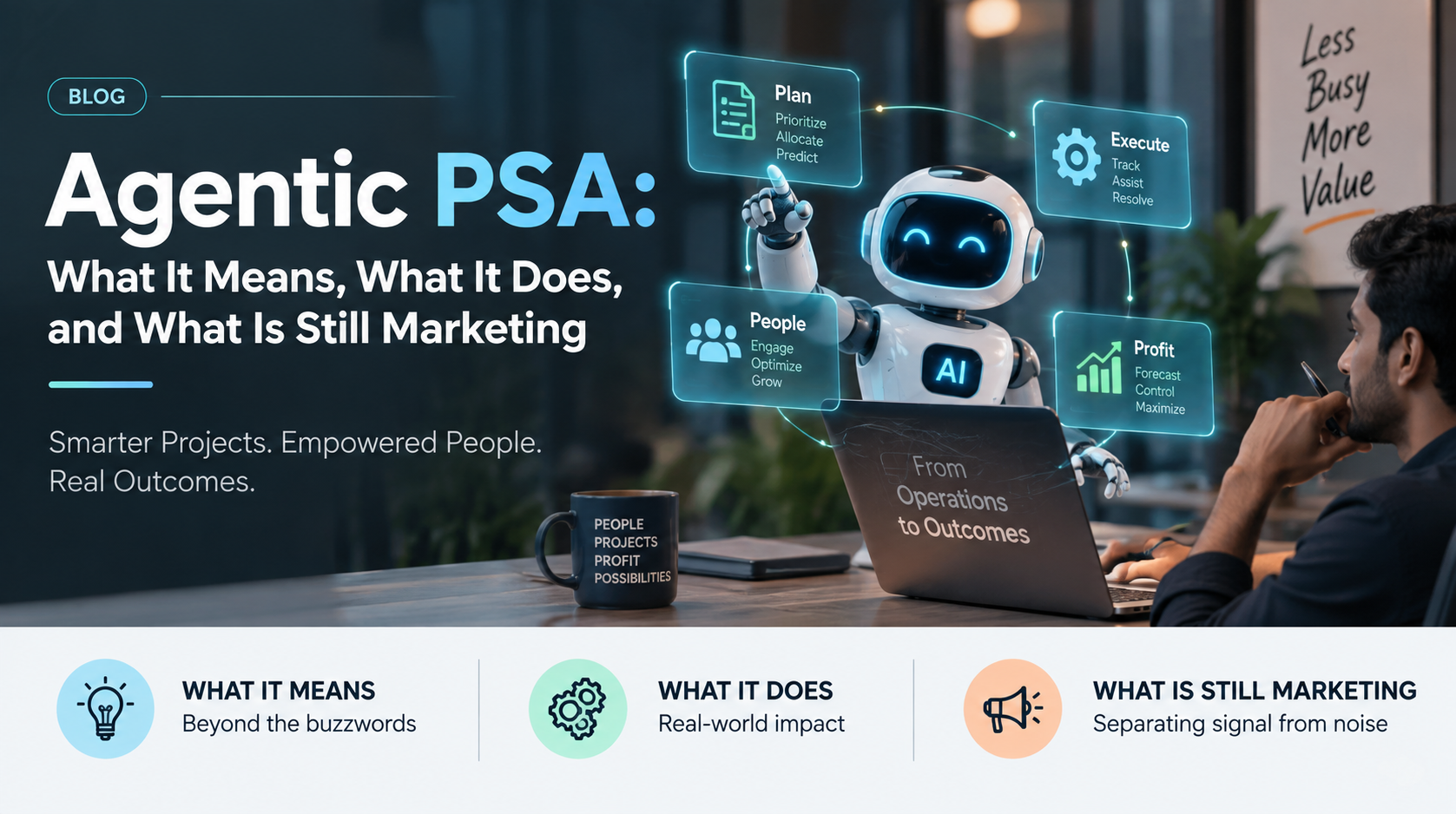
Every PSA vendor in 2026 claims to be building toward agentic AI. Most of them are describing dashboards with smarter alerts. A genuinely agentic PSA does not just show you what is happening in your delivery operation; it takes actions, triggers workflows, and executes decisions within defined parameters, the way a capable operations team member would, operating continuously across the full delivery pool without sleeping or going on leave. This guide explains what agentic PSA actually means, what the three layers of agentic capability look like in practice, where the human-in-the-loop requirement remains non-negotiable, and how to evaluate whether a vendor's AI claims reflect genuine agentic capability or relabelled reporting.
An agentic PSA is a professional services automation platform in which AI agents monitor the delivery operation continuously, recommend actions with supporting rationale, and execute approved action classes autonomously, functioning as an always-on operations layer between the data and the human decision-maker.
What Agentic PSA Means: Precise Definition
The word "agentic" comes from AI architecture, where an agent is a system that perceives its environment, selects actions based on goals, executes those actions using available tools, and learns from the results. Applied to PSA, agentic means the platform does not wait to be queried. It watches, infers, acts, and reports.
| Platform Type | What Triggers Action | What the System Does | Role of Human |
|---|---|---|---|
| Traditional PSA | Human runs a report or logs in and checks a dashboard | Displays data and generates static reports | Primary actor: detects problems, decides responses, executes manually |
| AI-assisted PSA | Threshold breach (utilization below target, budget burn above threshold) | Fires an alert to a human inbox | Receives alert, reviews data, decides response, executes manually |
| Agentic PSA | Continuous monitoring detects a developing condition before it becomes a problem | Surfaces intelligence (KII), generates specific ranked recommendations (KIR), executes approved action classes autonomously (KIA) | Sets approval boundaries, reviews exceptions, makes high-judgment decisions that require client context |
The critical distinction is the last column. In a traditional PSA, the human does all the work. In an AI-assisted PSA, the human receives better information but still does all the work. In an agentic PSA, the system handles the high-volume, low-judgment execution while the human handles exceptions, approvals, and decisions requiring client context and organizational judgment.
The Evolution: PSA 1.0 to PSA 3.0
| Generation | Era | Core Capability | Primary Limitation |
|---|---|---|---|
| PSA 1.0 | 2000 to 2015 | Timesheet capture, basic project management, manual billing assembly | Primarily a data collection and storage system. No intelligence layer. Required extensive human effort to extract value from the data captured. |
| PSA 2.0 | 2015 to 2023 | Integrated dashboards, basic automation (invoice generation from timesheets), reporting rules, alert thresholds | Intelligence is reactive: it answers questions humans ask and fires alerts when thresholds are breached. Does not proactively surface emerging conditions or recommend specific actions. |
| PSA 3.0 (Agentic) | 2024 onward | Continuous monitoring, predictive intelligence, ranked recommendations with rationale, autonomous execution of approved action classes | Dependent on input data quality. High-judgment decisions (client relationships, complex staffing trade-offs, commercial negotiations) remain human. Benefits require investment in data foundations before full agentic capability is realised. |
The move from PSA 2.0 to PSA 3.0 is not primarily a technology change; it is an operational architecture change. The question shifts from "how do we give managers better information?" to "which decisions can the system make autonomously within defined parameters, and which ones require human judgment?" Getting this boundary right is the core design challenge of agentic PSA.
The Three Agent Layers of a PSA 3.0 Platform
The agent watches the full delivery operation continuously: every timesheet, every allocation, every project budget burn rate, every pipeline movement. It surfaces patterns and emerging conditions before they become problems. Example: KII detects that a cloud architect cohort has three members rolling off projects in the same week while the pipeline shows two high-probability opportunities requiring that skill in two weeks. It surfaces this convergence proactively, before either bench or delivery failure occurs.
Given the intelligence from Layer 1, the agent generates specific, ranked recommendations with supporting rationale. Example: KIR responds to the cloud architect bench risk by surfacing the top three allocation candidates for each pipeline opportunity, with fit scores across skills, availability, cost rate, and delivery history. The resource manager reviews ranked candidates and approves, rather than searching the talent pool manually. Recommendation quality is the primary differentiator between mature and immature AI platforms in this layer.
For action classes that have been explicitly approved by the operations leader, the agent executes without requiring per-instance human approval. Example: KIA is configured to automatically stage invoices from approved timesheets within 24 hours of period close, route pre-bench alerts to resource managers when resources enter the 7-day rolloff window, and escalate to practice head when no allocation is confirmed by day 10. The agent acts; humans review exceptions and modify the approval parameters.
Where Agents Act in the PS Delivery Lifecycle
| Lifecycle Stage | What the Agent Does | What Remains Human |
|---|---|---|
| Pipeline | Monitors pipeline stage changes and probability weights; fires capacity gap alerts when demand exceeds supply in 30 to 90 day horizon; surfaces pipeline opportunities that match surplus skills in the bench pool | Deal strategy; client relationship management; pricing decisions; final proposal approval |
| Resource allocation | Generates ranked resource recommendations for every open demand request; fires pre-bench alerts 7 to 14 days before rolloff; initiates pre-allocation conversations by surfacing the match to the resource manager | Final allocation decision; client-facing team composition conversations; performance-based exclusions |
| Project delivery | Monitors budget burn vs completion continuously; flags out-of-scope hours and routes to project manager for change order action; detects margin deviation above threshold and alerts delivery manager | Client scope conversations; change order commercial negotiations; delivery quality judgments |
| Billing | Generates draft invoices from approved timesheets within hours of period close; applies rate cards automatically; stages milestone invoices when milestones are approved; flags expense claims not yet included in billing queue | Invoice approval before delivery; pricing dispute resolution; credit note decisions |
| Revenue recognition | Calculates percentage-of-completion for fixed-price engagements; creates revenue recognition journal entries for standard contract types; flags variable consideration for human review before recognition | Complex contract modification treatment; revenue restatement decisions; external audit queries |
The Human-in-the-Loop Requirement: Where It Stays
The most important design principle of an agentic PSA is knowing which decisions the agent should not make autonomously, regardless of confidence level. Overreach in the agentic layer erodes trust in the system and creates commercial and relationship risks that are harder to recover from than the inefficiency the agent was trying to solve.
Data Preconditions: Why Most Firms Are Not Ready for Agentic PSA Yet
Agentic AI in PSA requires better data quality than traditional reporting-based PSA, because the agent acts on data rather than just displaying it. The same data error that produces a wrong number on a dashboard produces a wrong action in an agentic system, with more direct operational consequences.
| Data Requirement | Minimum Quality Standard | What Breaks Without It |
|---|---|---|
| Daily timesheet submission | >90% of billable resources submitting daily | Bench monitoring fires on stale data; billing automation generates incomplete draft invoices |
| Skills profiles current | >80% of resources, validated within 12 months | Resource matching recommendations are unreliable; bench risk scoring is inaccurate |
| Allocation end dates confirmed | 100% of active allocations have end dates in PSA | Pre-bench alerts fire at wrong times or not at all; capacity forecasting is unreliable |
| Contract rate cards in PSA | 100% of active clients with current rate card version | Billing automation applies wrong rates; rate card errors scale with automation volume |
| Pipeline resource requirements | Opportunities at 60%+ have skill and headcount fields populated | Capacity gap forecasting is headcount-only; skill-level gap intelligence unavailable |
The practical implication is that firms should not deploy agentic PSA features until the data quality prerequisites are met. A data readiness sprint (typically 4 to 8 weeks) before enabling agentic features produces significantly better early outcomes than deploying immediately on incomplete data and eroding trust in the system with low-accuracy recommendations.
Claims vs Reality: Evaluating Agentic PSA Vendor Claims
| Vendor Claim | What to Ask | Red Flag Response | Good Response |
|---|---|---|---|
| "AI-powered resource management" | Does the AI recommend specific resources for specific demand with fit scores and rationale, or does it alert you that a resource is available? | "It shows you available resources filtered by skill." | "It ranks candidates from the full pool by skills fit, availability, cost rate, and delivery history, with a per-candidate fit score and the specific gap, if any." |
| "Automated billing" | Does billing generate draft invoices automatically from approved timesheets, or does a human still initiate the invoice generation? | "Finance can generate invoices from the billing report." | "Approved timesheets flow to the billing queue automatically; draft invoices are generated within 24 hours of period close and routed to finance for approval." |
| "AI forecasting" | Does the forecast update continuously from pipeline and allocation changes, or is it run manually on a schedule? | "You can run a capacity forecast from the reports menu." | "The forecast recalculates every time a pipeline stage changes or an allocation is updated; gap alerts fire automatically when the model detects a developing imbalance." |
| "Autonomous AI agents" | Which specific actions does the agent execute autonomously, and what are the approval parameters? | Vague answers; inability to describe specific action classes that are automated without per-instance human approval. | Specific enumeration of automated action classes (e.g. billing staging, pre-bench alerts, escalation routing), with description of the approval gate and exception handling model. |
KEBS KAIS: The Agentic PSA in Practice
KEBS KAIS operates across all three agentic layers in production, not as a roadmap item. KII (KEBS Inform) monitors the full delivery operation continuously: bench risk scores by resource, utilization by practice and role, margin deviation by engagement, and capacity gaps by skill category in each planning horizon. KII does not wait to be queried; it watches and surfaces emerging conditions before they cost money.
KIR (KEBS Recommend) generates ranked recommendations in response to KII signals. A pre-bench alert from KII immediately triggers KIR to surface the top 5 allocation candidates from the full talent pool, scored across skills fit, availability, cost rate, and delivery history, with the specific gap between each candidate's profile and the demand requirements. The resource manager reviews ranked candidates and approves with one click, rather than searching and evaluating manually.
KIA (KEBS Act) executes configured action classes autonomously. Billing staging from approved timesheets happens within hours of period close, without finance initiating the process. Pre-bench alerts route to the correct resource manager and escalate to the practice head if no allocation is confirmed by day 10. Out-of-scope hours flag and route to the project manager for change order action before approval. Milestone completion triggers invoice generation. KIA acts within the parameters the operations leader configures; humans review exceptions and update parameters as the operation evolves.
The KEBS KAIS data readiness score on the KAIS dashboard shows which agentic features are fully active, which are operating in partial mode due to data quality gaps, and what specific data improvements would unlock full capability. This transparency means KEBS customers can see exactly what is needed to move from AI-assisted to fully agentic operation, and track their progress toward it.
Customers including Maveric Systems, Zifo Technologies, Mindsprint, and Agilisium operate KEBS KAIS at production scale across IT services delivery pools ranging from 50 to 1,000+ billable resources. Common outcomes within two quarters: bench rate reduced by 40 to 60%, billing leakage recovered of $150,000 to $400,000 annually, resource manager time on allocation tasks reduced by 60 to 70%, and margin problem detection lead time extended from post-close discovery to 3 to 6 weeks early warning.
Frequently Asked Questions
See What an Agentic PSA Looks Like When It Actually Works. Book a KEBS KAIS Demo.
KII monitors your delivery pool continuously. KIR surfaces ranked recommendations before problems begin. KIA executes your billing, alerting, and escalation workflows autonomously. From $5/user. Rated 4.7/5 on G2.
Book a Free Demo →