KEBS vs Scoro vs Kantata: Which PSA Platform is Right for Your Team in 2026?
7 PM tools ranked for professional services. Features, comparison table, and verdict.
Date Posted:
October 15, 2026
Share This:
KEBS vs Scoro vs Kantata: Which PSA Platform is Right for Your Team in 2026?
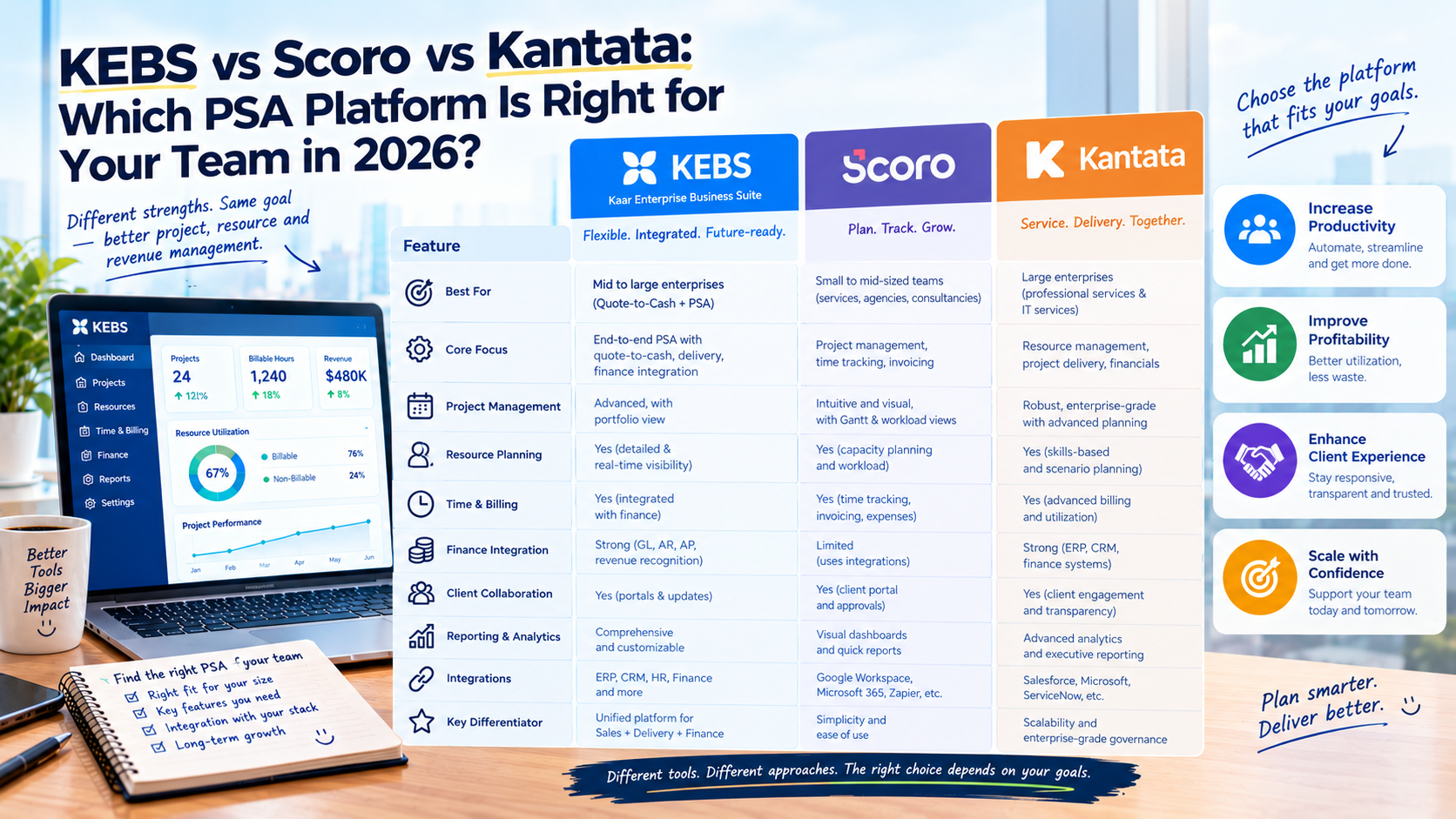
Three platforms dominate shortlists for mid-market and enterprise professional services teams in 2026: Scoro for agencies and consultancies that want an all-in-one work management platform, Kantata for large enterprises that need deep resource forecasting, and KEBS for IT/ITeS, GCC, and consulting firms that need AI-native automation across the full Quote-to-Cash lifecycle without Salesforce dependency or module pricing. This comparison cuts through the marketing to show exactly where each platform wins, where it falls short, and which team profile it actually fits.
KEBS wins on AI depth, full lifecycle coverage, pricing flexibility, and fit for IT services and GCC delivery models. Scoro wins on agency UI, CRM integration, and mid-market accessibility for non-IT professional services. Kantata wins on enterprise resource management depth for large PS organizations willing to absorb higher cost and longer implementation. No single platform is best for every team. This guide tells you which one is best for yours.

IT/ITeS, GCC, Consulting

Agencies and consultancies

Large PS organizations
Platform Overview: What Each One Is Actually Built For
KEBS is an AI-native Professional Services Automation platform built by KaarTech (SAP Gold Partner) for IT services firms, GCCs, BPOs, and consulting organizations. It covers the full Quote-to-Cash lifecycle natively: deal management, skills-based resource allocation, project delivery, multi-entity billing, and revenue recognition in a single data model. KAIS (KEBS AI Suite) is a three-layer intelligence engine that surfaces gaps (KII), recommends actions (KIR), and automates them (KIA) across the delivery lifecycle. Pricing runs from $5 to $49 per user per month, role-based. G2 rating: 4.7/5.
Scoro is a work management platform designed for agencies, consultancies, and mid-market professional services teams. It connects CRM, quoting, project management, time tracking, billing, and financial reporting in a single platform with a clean, modern interface. Strong on financial dashboards and reporting breadth for agency-style delivery. Pricing from $26 per user per month (5-seat minimum). G2 rating: 4.5/5.
Kantata (formerly Mavenlink + Kimble) is an enterprise PSA focused on resource management, demand forecasting, and financial governance for large professional services organizations. Available in a Salesforce-native version or open deployment. Pricing is custom contract, typically $25,000 to $60,000+ per year minimum. G2 rating: 4.1/5.
At-a-Glance Scorecard
Pricing and Total Cost of Ownership
Role-based pricing from $5 (Resource) to $49 (Executive) per user per month. A 50-person IT services firm with a typical role mix typically pays $15,000 to $35,000 per year in licensing. Implementation with KaarTech backing does not require a separate SI engagement. 36+ native integrations reduce supplementary tool costs. Estimated 3-year TCO: $60,000 to $120,000.
Entry at $26 per user per month, but Pro or Ultimate tiers (where advanced resource planning, financial reports, and workflow automation live) typically cost $40 to $63 per user. A 50-person firm on Pro pays $24,000 to $38,000 per year in licensing, plus $5,000 to $15,000 in setup. Features most PS firms need sit in higher tiers. Estimated 3-year TCO: $80,000 to $140,000.
Custom contract only. Minimum annual commitment typically $25,000 to $60,000. Implementation runs 3 to 6 months with SI involvement ($30,000 to $80,000). Ongoing Salesforce admin overhead if on the Salesforce-native version adds $15,000 to $25,000 per year. Estimated 3-year TCO for a 50-person firm: $180,000 to $350,000.
KEBS wins on price at every scale. For a 50-person IT services firm, KEBS delivers a 3-year TCO 2x to 4x lower than Kantata while covering more of the lifecycle. Scoro sits in the middle but its tier escalation closes the gap with more capable alternatives at scale.
AI and Automation Depth
KAIS (KEBS AI Suite) is a three-layer engine built specifically for professional services operations. KII (Inform): surfaces real-time utilization gaps, bench risk, project margin warnings, and delivery health across the portfolio. KIR (Recommend): suggests specific resource-to-project matches based on skills, availability, cost rate, and delivery history. KIA (Act): automates staffing assignments, billing triggers, escalation alerts, and three-year revenue forecasting without manual intervention. This is not a productivity AI layer bolted onto a PSA: it was designed to run delivery operations.
Scoro has introduced AI-assisted features including AI-generated project plans, automated time entry suggestions, and intelligent reporting summaries. These features improve productivity within the existing workflow but do not observe delivery risk, recommend resource assignments, or act on delivery data automatically. Scoro's AI is useful for reducing manual work; it does not run the delivery operation.
Kantata is developing AI capabilities within its resource management and forecasting modules, including AI-assisted demand planning and utilization prediction. These features are maturing but are not yet at the depth of KAIS. Kantata's AI roadmap is enterprise-focused and promising, but in 2026 it remains a step behind purpose-built AI-native platforms for operational automation.
KEBS wins decisively. KAIS is purpose-built for PSA operations with three layers of intelligence that no other platform in this comparison currently matches. Scoro and Kantata are both adding AI but remain in the emerging category in 2026.
Resource Management
KEBS RMG (Resource Management Group) module handles skills-based resource matching, bench management, capacity forecasting, and cross-geography allocation natively. KIR recommends specific resources for specific projects based on skill profile, availability, cost rate, and past delivery performance. Bench visibility is real-time: managers see who is available, when, and at what cost. Multi-entity and multi-geography allocation is supported without workarounds. Built for the IT services and GCC delivery model where skills taxonomy and bench utilization are first-class operations.
Scoro covers resource planning through workload views, capacity charts, and time-based scheduling. It works well for agency-style delivery where teams are relatively stable and projects are scoped in hours and weeks. Skills-based matching and bench management at IT services scale require workarounds. For firms managing large resource pools across skills, geographies, and cost centers, Scoro's resource management depth is insufficient without supplementary tools.
Kantata's resource management is its strongest differentiator. Demand forecasting, capacity planning, skills-based matching, and utilization analytics at enterprise scale are all first-class capabilities. For large PS organizations managing hundreds of resources across multiple practices, Kantata's resource management depth is the best in this comparison. The trade-off is cost and implementation complexity: this depth comes with a 3 to 6 month setup and custom enterprise pricing.
Kantata has the deepest resource management for large enterprises. KEBS wins for IT services, GCC, and mid-market consulting teams that need AI-driven staffing automation without Kantata's implementation overhead. Scoro serves agency-scale resource planning adequately but is not designed for IT delivery operations.
Financial Management and Revenue Recognition
KEBS covers the full financial arc from quote through revenue recognition natively. Multi-entity billing (INR and USD, cross-geography), milestone billing, T&M, retainer, and hybrid models are all supported. Revenue recognition and three-year forecasting are automated through KIA. Finance integration with SAP, NetSuite, QuickBooks, and Tally is native. For IT services firms and GCCs managing complex multi-entity financial structures, KEBS handles it without supplementary tools or workarounds.
Scoro covers quoting, project budgeting, invoicing, and financial reporting with genuine depth for agency-style delivery. Standard billing models (T&M, fixed price, retainer) are well supported. Multi-entity billing and complex revenue recognition at enterprise scale require workarounds. Scoro's financial dashboards are among the best in its class for mid-market reporting, but the depth for IT services financial governance (multi-entity, multi-currency at scale) is limited.
Kantata offers enterprise-grade financial governance: multi-entity billing, complex revenue recognition, project accounting, and financial forecasting at scale. Its financial management depth is strong, particularly for large professional services organizations with complex multi-country or multi-entity financial structures. The Salesforce-native version benefits from Salesforce data model consistency across CRM, project, and finance workflows.
KEBS and Kantata both offer strong financial management at enterprise depth. KEBS wins for IT services firms because it covers the full lifecycle (including deal management) without requiring Salesforce infrastructure, and its KIA AI automates revenue forecasting. Scoro is sufficient for mid-market agencies but does not match either at enterprise scale.
Project Delivery and Client Visibility
KEBS covers project delivery with task management, milestone tracking, Gantt views, and real-time project health dashboards. The differentiator is KII: delivery managers do not need to check dashboards to find problems because KII surfaces them proactively. Budget burn, schedule drift, resource under-allocation, and margin risk are flagged before they escalate. Strong Jira integration for IT delivery teams that live in agile tooling.
Scoro has one of the cleanest project delivery interfaces in the mid-market PSA category. Gantt views, task boards, time tracking, and project profitability dashboards are well designed and easy to navigate. Delivery teams adopt Scoro more readily than enterprise PSA alternatives because the interface is intuitive. No proactive AI health monitoring, but the visibility tools are strong for teams willing to review them regularly.
Kantata handles portfolio-level delivery governance well for large organizations: programme dashboards, milestone tracking, resource utilization by practice, and margin analysis across large project portfolios. The interface is less intuitive than Scoro and delivery team adoption is a consistent challenge. Kantata is built for delivery governance, not delivery team usability.
Scoro wins on delivery team UI and adoption. KEBS wins on AI-driven delivery health monitoring and Jira integration for IT teams. Kantata handles portfolio governance at enterprise scale but consistently struggles with delivery team adoption at the project level.
Integrations and Ecosystem
36+ pre-built integrations covering CRM (Salesforce, HubSpot), ERP (SAP, NetSuite), HRIS (Keka, Darwinbox), project tools (Jira, Azure DevOps), collaboration (Microsoft 365, Teams, Slack), and finance (QuickBooks, Tally). API-first architecture. SAP Gold Partner backing means enterprise-grade connectivity. Importantly, KEBS integrates with Salesforce without depending on it as infrastructure, making it the only platform in this comparison that works alongside all three CRM ecosystems.
Scoro has native integrations with HubSpot, Xero, QuickBooks, Stripe, Google Workspace, and Microsoft 365, plus 1,000+ connections via Zapier. The breadth is strong for mid-market agencies. Deep SAP, Keka, or enterprise HRIS integration typically requires custom API work. For IT services firms that need enterprise-grade connectivity beyond the Zapier tier, Scoro's integration depth is limited.
Kantata's strongest integration is with Salesforce (native, deep data model alignment). Open version connects via API to other platforms. Microsoft 365 and NetSuite integrations are available. For organizations not on Salesforce, Kantata's integration ecosystem is narrower than KEBS and requires more custom configuration. Enterprise-grade Keka or SAP HRIS integration is not a standard offering.
KEBS wins for IT services and enterprise connectivity. Scoro wins for mid-market breadth via Zapier. Kantata wins for Salesforce-committed enterprises. For the Indian IT/ITeS and GCC segment specifically, KEBS is the only platform in this comparison with native Keka and SAP integration out of the box.
Implementation Speed and Ongoing Admin
Structured onboarding with KaarTech support typically brings teams live within 4 to 8 weeks. No mandatory SI partner required. Operations teams can make workflow changes, update rate cards, and configure reports without filing IT tickets. KaarTech's SAP Gold Partner background means enterprise-grade implementation knowledge is built into the support model, not sold separately.
Scoro's guided setup and onboarding typically takes 4 to 8 weeks for a mid-market team. Initial configuration is manageable without an SI partner for straightforward deployments, but the platform's breadth means configuration decisions accumulate. Multiple G2 reviewers note that initial setup is time-consuming and that process discipline is required to keep the platform operationally clean as the team grows.
Kantata implementations typically run 3 to 6 months with a certified implementation partner. The platform's enterprise depth means significant configuration, data migration, and training investment upfront. Ongoing admin for workflow changes and reporting customization typically requires Kantata or partner involvement. For large enterprises, this is expected; for mid-market teams, it is a structural barrier.
KEBS and Scoro are comparable on speed (both in the 4 to 8 week range). KEBS wins on ongoing admin independence for IT services operations teams. Kantata is significantly slower and requires ongoing partner involvement, which is appropriate for large enterprises but a barrier for mid-market teams.
Who Should Choose Which Platform
Final Verdict
KEBS is the overall winner for IT services, GCC, BPO, and consulting organizations that need AI-native automation, full lifecycle coverage, and scalable pricing without Salesforce dependency. Scoro is the winner for mid-market agencies and consultancies that prioritize a clean UI, native CRM, and accessible pricing without enterprise complexity. Kantata is the winner for large enterprise PS organizations with complex resource management needs that justify custom contract pricing and a 3 to 6 month implementation. The choice depends entirely on your delivery model, team size, and what 'professional services' actually means in your organization.
Frequently Asked Questions
See Why IT Services Teams Choose KEBS Over Scoro and Kantata
KEBS covers the full Quote-to-Cash lifecycle with AI-native automation, transparent role-based pricing from $5 per user, and 36+ integrations including SAP, Keka, and Jira. No Salesforce dependency. Operational in weeks. Rated 4.7/5 on G2.
Book a Free Demo →