Revenue Recognition for Services Contracts: The Complete Guide for 2026
7 PM tools ranked for professional services. Features, comparison table, and verdict.
Date Posted:
September 17, 2026
Share This:
Revenue Recognition for Services Contracts: The Complete Guide for 2026
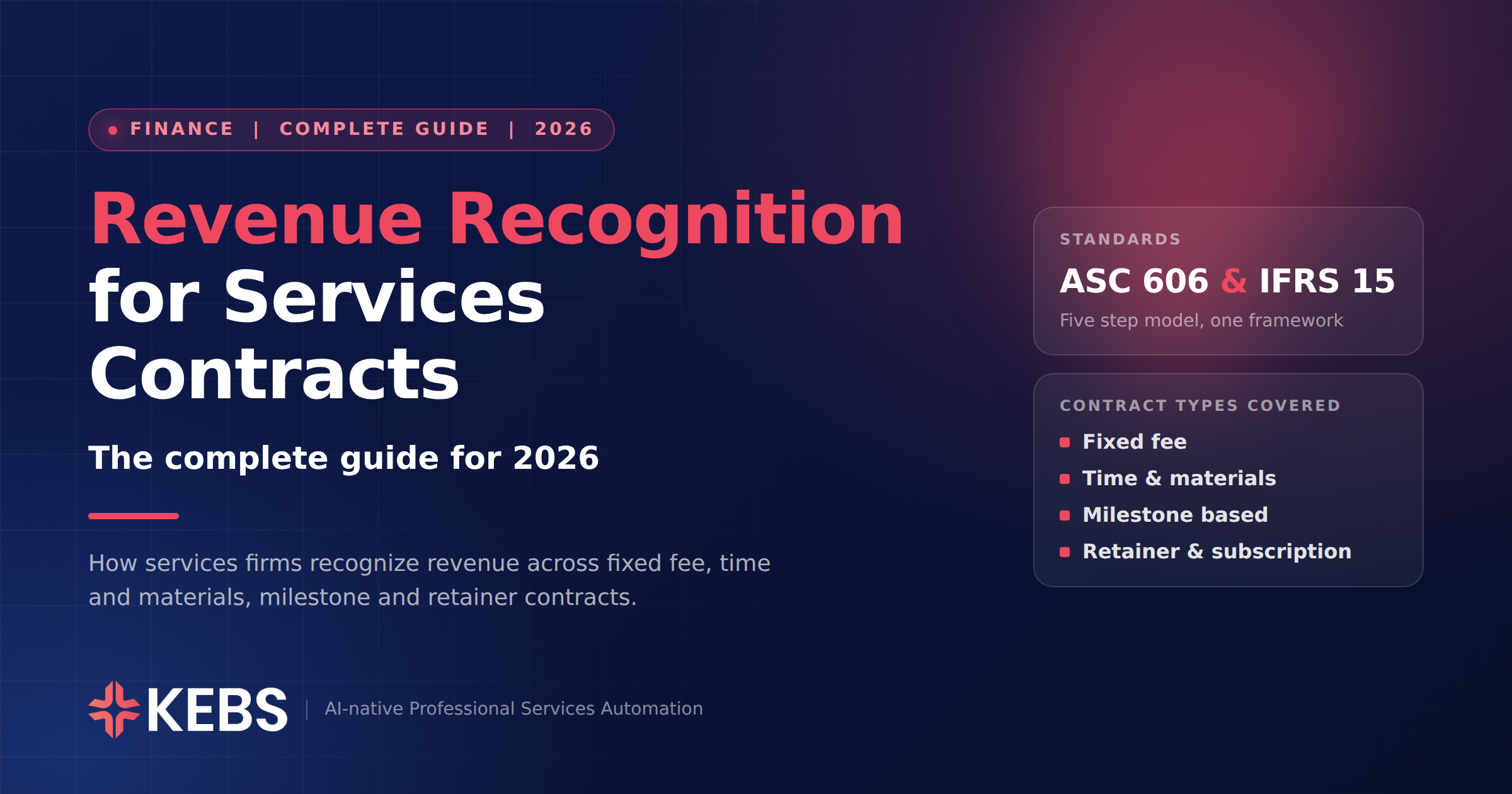
Revenue recognition is one of the most consequential accounting decisions a professional services firm makes, and one of the most frequently mishandled. Recognising revenue when invoiced rather than when earned, treating fixed-price contracts on a cash basis, or failing to identify and separate performance obligations in multi-element arrangements are not just audit risks. They distort period-level profitability, obscure which engagements are actually creating value, and produce financial statements that do not reflect the firm's true economic performance. This guide covers what ASC 606 and IFRS 15 require for PS contracts, how recognition works for each major contract type, where firms consistently go wrong, and how a connected PSA automates the recognition workflow without manual journal entries.
Under ASC 606 and IFRS 15, revenue is recognised when (or as) a performance obligation is satisfied, at the amount of consideration to which the entity expects to be entitled. For professional services, this means revenue follows delivery activity, not invoice timing. A fixed-price contract billed upfront creates deferred revenue until delivery occurs. A T&M contract recognises revenue as hours are worked and approved, not when the invoice is paid.
What Revenue Recognition Means in Professional Services
Revenue recognition is the accounting process of recording revenue in the period it is earned, regardless of when cash is received or an invoice is issued. In professional services, "earning" revenue means satisfying a performance obligation: delivering the agreed scope of services, completing a milestone, or making progress on a fixed-price engagement at a rate proportional to the percentage of completion.
The practical implication is that the timing of invoicing and the timing of revenue recognition are frequently different, and the difference must be tracked as either deferred revenue (billed before earned) or accrued revenue (earned before billed):
| Situation | Balance Sheet Treatment | Example |
|---|---|---|
| Billed before earned | Deferred revenue (liability) until delivery earns the recognition | Fixed-price project billed 50% upfront at contract signature; the upfront billing creates a $50,000 deferred revenue liability that reduces as delivery progresses |
| Earned before billed | Accrued revenue / contract asset (asset) until the invoice is raised | T&M project where 2 weeks of approved hours have not yet been invoiced at period end; the unbilled value is recognised as a contract asset |
| Billed and earned in the same period | No balance sheet entry required; revenue recorded directly in the period | Monthly retainer billed and performed in the same calendar month; straightforward revenue recognition with no timing difference |
ASC 606 and IFRS 15: What They Require
ASC 606 (US GAAP) and IFRS 15 (international) are the two converged revenue recognition standards that govern how professional services firms record revenue. They replaced the previous fragmented standards (SAB 104, IAS 18) with a unified principles-based framework. Both standards require the same five-step model, making the analysis consistent regardless of whether your firm reports under US GAAP or IFRS.
Key terms professional services firms need to understand:
| Term | Definition | PS Application |
|---|---|---|
| Performance obligation | A promise to transfer a distinct good or service to the customer | Each separately identifiable deliverable in a PS contract (e.g., Phase 1 implementation, training program, ongoing support) is a separate performance obligation if the customer can benefit from it independently |
| Transaction price | The amount of consideration to which the entity expects to be entitled in exchange for satisfying performance obligations | Total contract value including fixed fees, estimated T&M amounts, and probability-weighted variable consideration (success fees, milestone bonuses) |
| Standalone selling price | The price at which the entity would sell a distinct good or service separately to a customer | Required to allocate transaction price across multiple performance obligations; typically estimated from standard rate cards for each service element |
| Variable consideration | Consideration whose amount is contingent on future events (bonuses, penalties, success fees, T&M estimates) | Must be estimated and included in transaction price only to the extent it is highly probable it will not be reversed; excess is constrained |
| Over time vs point in time | Performance obligations satisfied continuously (as the customer simultaneously receives and consumes the benefit) vs at a specific moment | Most PS delivery is over time (T&M, managed services); some deliverables are at a point in time (completed document, accepted software build) |
The Five-Step Model Applied to PS Contracts
-
Identify the contract with the customerA contract exists when it has commercial substance, both parties have approved it, rights and payment terms are identified, and collection is probable. For PS firms, this is typically the signed statement of work, master services agreement, or purchase order. Change orders that modify scope are contract modifications that must be assessed for whether they create a new contract or modify the existing one, with recognition implications for each treatment.
-
Identify the performance obligationsDetermine whether the contract contains one performance obligation or multiple distinct obligations that must be accounted for separately. A PS contract that includes implementation, training, and 12 months of post-implementation support likely contains three separate performance obligations, each with its own recognition timing. Failing to separate performance obligations causes revenue to be recognised in the wrong period.
-
Determine the transaction priceCalculate the total consideration expected from the contract. For fixed-price contracts this is straightforward. For T&M contracts, the transaction price includes an estimate of total hours times billing rate. For contracts with variable consideration (success fees, performance bonuses, volume discounts), estimate the variable amount and apply the constraint: include only the amount that is highly probable not to result in a significant revenue reversal.
-
Allocate the transaction price to performance obligationsIf the contract has multiple performance obligations, allocate the transaction price to each based on standalone selling prices. If a PS firm's contract includes implementation ($200,000) and a 12-month support package typically sold at $60,000, but the bundled price is $230,000, the $230,000 must be allocated: $176,900 to implementation and $53,100 to support, based on the ratio of standalone prices. This allocation determines how much revenue each phase can recognise.
-
Recognise revenue when (or as) each performance obligation is satisfiedFor obligations satisfied over time (the majority of PS delivery), choose the correct measurement method: output-based (milestones completed, deliverables accepted) or input-based (percentage of total estimated cost incurred, percentage of total estimated hours worked). For obligations satisfied at a point in time, recognise when control transfers to the customer, typically at client acceptance. The measurement method must be applied consistently throughout the engagement.
Revenue Recognition by PS Contract Type
| Contract Type | Performance Obligation | Recognition Method | Measurement Basis | Balance Sheet Impact |
|---|---|---|---|---|
| Time and Materials | Continuous delivery of professional services; satisfied over time | Over time | Output: hours worked and approved at billing rate per period | Accrued revenue for approved but unbilled hours at period end |
| Fixed-Price (over time) | Completion of defined scope; customer receives benefit continuously | Over time | Input: percentage of completion = cost incurred / total estimated cost | Deferred revenue if billed ahead of % complete; accrued revenue if % complete ahead of billing |
| Fixed-Price (point in time) | Delivery of a specific accepted output (completed system, accepted report) | Point in time | Full recognition at client acceptance; no recognition until acceptance | Deferred revenue for all billings prior to acceptance |
| Milestone-Based | Each milestone is a distinct performance obligation or a measure of progress | Depends on structure | If milestones represent equal proportions of total value: recognize ratably. If unequal: allocate based on standalone selling price per milestone | Deferred revenue if milestone billing exceeds milestone value earned; accrued if earned ahead of billing |
| Retainer | Stand-ready obligation: making services available over a period | Over time (straight-line) | Equal monthly recognition over the retainer period regardless of actual hours consumed | Deferred revenue for pre-billed retainer amounts; recognize monthly as period passes |
| Managed Services | Ongoing service delivery against SLA commitments over contract term | Over time | Straight-line over contract term unless variable utilization affects the allocation | Deferred revenue for pre-billed amounts; SLA credits reduce transaction price when contractually required |
Common Revenue Recognition Traps in Professional Services
Variable Consideration and the Constraint: Practical Application
Variable consideration is the most judgment-intensive aspect of PS revenue recognition. The standard requires entities to estimate the amount of variable consideration using either the expected value method (probability-weighted amount across possible outcomes) or the most likely amount method (most probable single outcome). The chosen method must be applied consistently throughout the contract.
| Variable Consideration Type | Method | Constraint Application | PS Example |
|---|---|---|---|
| T&M estimate for billing cap | Most likely amount (single most probable total) | Include if highly probable; constrain if outcome range is wide | Project estimated at 500 to 700 hours; recognize at 500 hours until hours above 500 are approved |
| Success fee / performance bonus | Most likely amount (binary: earned or not) | Constrain entirely until highly probable the condition will be met | $100,000 success fee payable if project delivers specified savings; recognize only when savings achievement is highly probable |
| SLA penalty / credit | Expected value (multiple probability-weighted outcomes) | Reduce transaction price by expected penalty; update each period | SLA with $5,000 monthly credit if uptime falls below 99.5%; estimate expected credit based on historical performance |
| Volume discount | Expected value (probability-weighted across volume tiers) | Reflect most likely volume tier in transaction price from contract inception | Client contract with tiered rates at 500, 1,000, and 2,000 hours; estimate likely volume and apply corresponding rate from inception |
Multi-Element Arrangements: Separating and Allocating
The majority of complex IT services and consulting engagements contain multiple performance obligations that must be identified and valued separately. The practical steps:
-
List every distinct deliverable in the contractReview the statement of work for every named service, deliverable, or promise. Determine whether each is distinct: can the customer benefit from it independently, and is it separately identifiable from other promises? An implementation service and a 12-month support commitment are usually distinct; a series of interdependent project phases may not be.
-
Determine the standalone selling price for each obligationThe best evidence of standalone selling price is an observable price from actual separate sales. If not available, estimate using adjusted market assessment (what would the market pay for this service separately?), expected cost plus margin (cost to deliver plus appropriate margin), or residual approach (subtract observable standalone prices from total contract price to derive the remaining obligation's price). Document the method and inputs.
-
Allocate the total transaction price based on standalone price ratiosAllocate the bundle price to each performance obligation in proportion to its standalone selling price. If a $300,000 contract includes implementation (standalone $220,000), training (standalone $40,000), and support (standalone $60,000), the $300,000 is allocated: $204,000 to implementation (220/320 x 300), $37,500 to training (40/320 x 300), $56,250 to support (60/320 x 300). Each component can then recognise revenue independently on its own timeline.
Automating Revenue Recognition: What to Look For in a PSA
The PSA must apply different recognition logic to T&M, fixed-price over time, fixed-price point-in-time, milestone, retainer, and managed services contracts automatically. A single recognition rule applied to all contract types produces systematic errors for whichever contract types do not match the rule.
For fixed-price over-time contracts, the completion percentage must be recalculated every period from actual delivery data (cost incurred vs total estimated cost), not from a fixed monthly schedule. The PSA must read actual timesheet and expense data to compute the current completion percentage and update the recognised revenue amount accordingly.
When a change order is approved, the PSA must assess whether it is a new contract or a modification of the existing one, apply the correct treatment (prospective or cumulative catch-up), and update the transaction price and performance obligation allocation automatically, without requiring a manual journal entry adjustment.
The PSA must maintain the deferred revenue and accrued revenue balances for each contract continuously, updating them as billing events and delivery events occur. Period-end balances must be available for financial statement presentation without requiring a separate reconciliation between the billing system and the accounting system.
KEBS Finance applies contract-type-specific recognition logic to every engagement from contract setup. T&M contracts recognise revenue from approved daily timesheet data without waiting for invoice delivery. Fixed-price over-time contracts calculate the completion percentage from actual cost incurred vs total estimated cost, updated every period from live delivery records, and recognise proportional revenue automatically. Milestone contracts trigger recognition entries at milestone approval. Retainer contracts recognise revenue straight-line over the service period from the first day of the period, regardless of billing cycle.
Deferred revenue and accrued revenue balances are maintained per contract in real time. When a fixed-price project bills 40% upfront but completion is at 25%, KEBS creates a $15,000 deferred revenue liability automatically and releases it as delivery progresses through the 40% completion threshold. When T&M hours are approved but not yet invoiced at period end, KEBS records the accrued revenue as a contract asset with the approved hours value at the contracted billing rate.
Contract modifications (change orders) are assessed in KEBS at the point of approval. The system applies the correct accounting treatment based on whether the change order adds distinct services (new contract) or modifies existing scope (contract modification with prospective or cumulative catch-up treatment). Finance is presented with the recognition impact of the change order before approving it, giving the finance team visibility into the revenue recognition consequence of each scope change decision.
Variable consideration (T&M estimates, success fees, SLA credits) is tracked separately in KEBS with constraint flags applied to amounts that do not yet meet the highly-probable threshold. When a success fee becomes highly probable based on delivery milestone achievement, the finance team receives an alert to reassess the constraint and update the transaction price for recognition. For GCC and multi-entity deployments, KEBS maintains separate recognition schedules per entity with INR and USD recognition amounts calculated in parallel from the same delivery records.
Frequently Asked Questions
Stop Recognising Revenue by Invoice Date. KEBS Automates ASC 606-Compliant Recognition from Delivery Data.
Contract-type-specific recognition rules. Percentage-of-completion from live timesheet data. Deferred and accrued revenue tracked per contract. Contract modification handling with finance alert. Multi-entity INR and USD recognition in parallel. From $5/user. Rated 4.7/5 on G2.
Book a Free Demo →