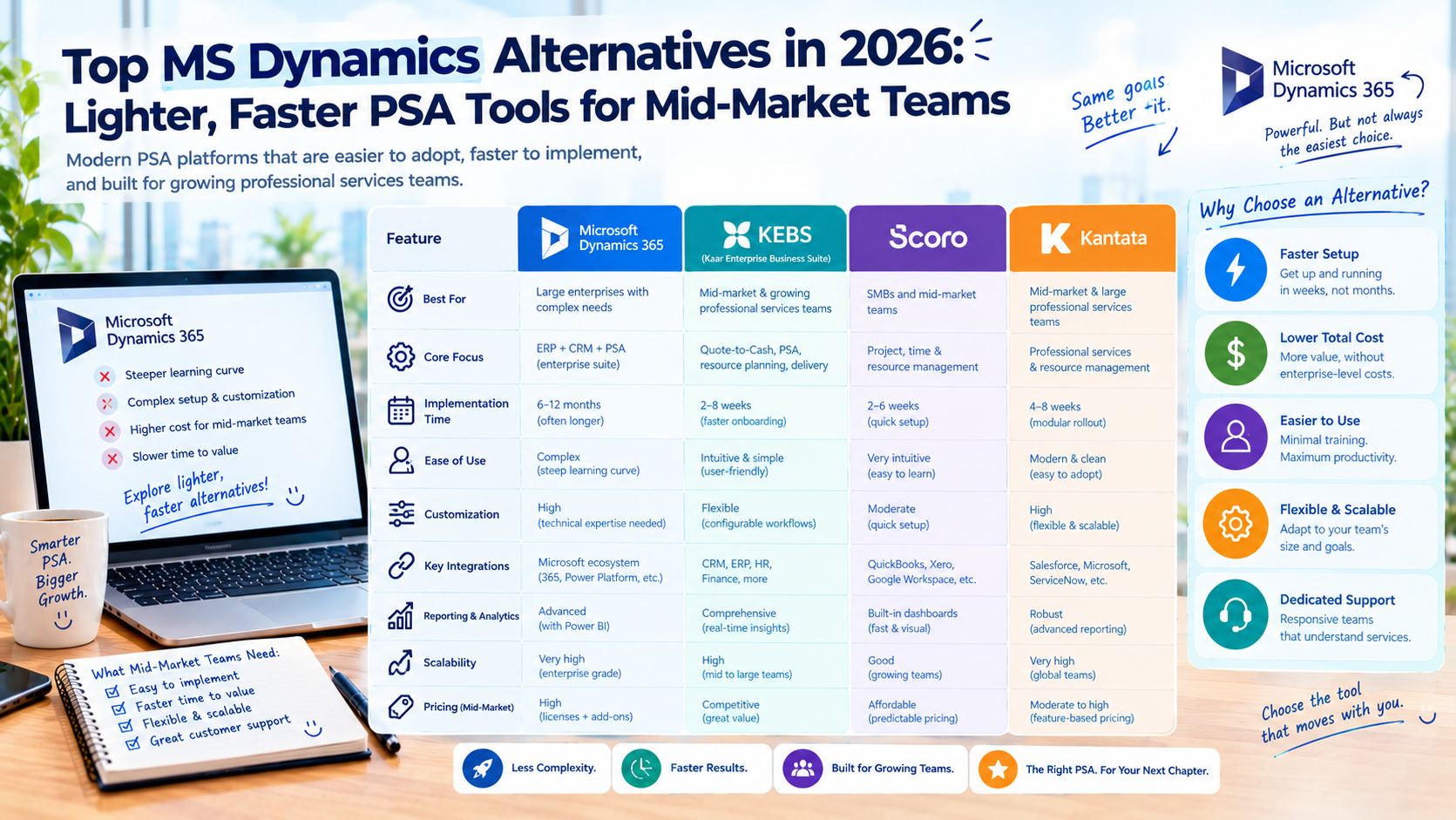
Top MS Dynamics Alternatives in 2026: Lighter, Faster PSA Tools for Mid-Market Teams
7 PM tools ranked for professional services. Features, comparison table, and verdict.
Date Posted:
October 22, 2026
Share This:
Top MS Dynamics Alternatives in 2026: Lighter, Faster PSA Tools for Mid-Market Teams
Microsoft Dynamics 365 Project Operations is, in theory, the everything platform for professional services teams already inside the Microsoft ecosystem. CRM, ERP, project management, resource scheduling, and financial governance, all on Azure, sitting inside the Microsoft 365 stack. For large enterprises with dedicated IT teams and system integrator budgets, that promise holds. For mid-market professional services teams in the 20 to 500 user range, the reality is more painful.
Modular licensing across Sales, Finance, Project Operations, and Business Central creates a complex, expensive stack that grows with every capability added. Implementation timelines stretch 6 to 12 months. Every workflow change requires consultant involvement. Mid-market firms end up paying enterprise prices for capabilities they do not need while accepting IT dependencies that slow every operational decision. This guide evaluates 10 lighter, faster MS Dynamics alternatives in 2026 built specifically for mid-market professional services teams.
For mid-market IT/ITeS, GCC, and consulting firms that want the full professional services lifecycle without Microsoft's modular complexity and consultant dependency, KEBS is the top alternative in 2026. Priced from $5 to $49 per user per month, operational in weeks, and powered by KAIS AI that observes, predicts, and acts across delivery operations. For mid-market agencies, Scoro and Productive offer clean platforms at accessible price points. For Salesforce-committed enterprises, Certinia remains the strongest ecosystem-native option. But none covers the full IT services and GCC lifecycle with AI-native automation like KEBS.
Why Mid-Market Teams Are Moving Beyond MS Dynamics in 2026
Microsoft Dynamics 365 is a powerful platform for enterprises with the IT resources to support it. But for mid-market professional services firms, three structural problems consistently push teams to evaluate alternatives.
Licensing complexity and hidden cost escalation. Dynamics 365 does not have a single price. It has a matrix. Sales Professional, Sales Enterprise, Customer Service, Finance, Project Operations, Business Central: each is a separate per-user per-month fee. A mid-market firm that needs CRM plus PSA plus basic financials is looking at multiple license stacks, a system integrator engagement to configure the modules, and an Azure infrastructure dependency. Total licensing cost for a 50-person firm covering CRM, project operations, and finance commonly runs $30,000 to $60,000 per year before any implementation work begins.
Consultant dependency for every change. Power Apps and Power Automate are marketed as low-code but in practice require IT or developer involvement for anything beyond basic automations. Business users hit barriers quickly, and documentation is frequently too technical for operations teams to act on independently. Every workflow change, every integration update, and every reporting customization typically requires a consultant call and a project ticket.
Implementation timelines that delay ROI. The average Dynamics 365 Business Central or Project Operations implementation for a mid-market firm runs 6 to 12 months with total project costs typically ranging from $75,000 to $300,000. For professional services firms that need to improve utilization visibility and margin management now, a year-long implementation before the system is operational is not a viable path.
Overkill for pure professional services. Dynamics 365 was built for manufacturing, supply chain, retail, and finance-led enterprises. Its PSA capabilities through Project Operations are solid, but the platform's architecture reflects its ERP heritage. Mid-market professional services firms end up paying for supply chain, field service, and retail capabilities they will never use, while the PSA-specific features they need most (AI-driven utilization forecasting, resource recommendation, revenue risk prediction) remain underdeveloped relative to purpose-built PSA platforms.
"Mid-market teams end up paying enterprise prices for capabilities they do not need, while accepting consultant dependencies that slow every change they want to make."
6 Things Mid-Market Teams Should Look For in a Dynamics Alternative
A platform that takes 6 months to implement is costing you before it pays back. Prioritize alternatives with guided onboarding and live operational data in 4 to 8 weeks maximum.
Avoid platforms that charge separately for every capability. Look for unified pricing where CRM integration, resource management, billing, and reporting are included in one per-user rate.
General-purpose ERP AI is not the same as PSA-native intelligence. Look for platforms where AI predicts staffing gaps, recommends resource assignments, and forecasts revenue risk in real time.
Your operations team should be able to make workflow changes, update rate cards, and configure reports without filing a ticket with IT or calling a consultant. No-consultant-required operations is a real filter.
Your PSA should integrate with Microsoft 365, Teams, and Power BI where you already use them, without requiring Azure as infrastructure. API-first integration is the right model for mid-market firms.
Look for platforms built specifically for professional services delivery, not ERP platforms adapted for it. Deal management, resource allocation, project delivery, billing, and revenue recognition should be first-class features, not add-ons.
Lifecycle Coverage: MS Dynamics vs. Purpose-Built PSA Alternatives
Dynamics 365 Project Operations covers the professional services lifecycle through its project management, resource scheduling, time and expense, and project accounting modules. The diagram below shows where purpose-built PSA platforms outperform Dynamics in depth and deployment speed.
Coverage is indicative based on published features and independent PSA reviews 2026. KEBS deploys in weeks; MS Dynamics typically requires 6 to 12 months for a comparable mid-market deployment.
The 10 Best MS Dynamics Alternatives for Mid-Market Teams in 2026

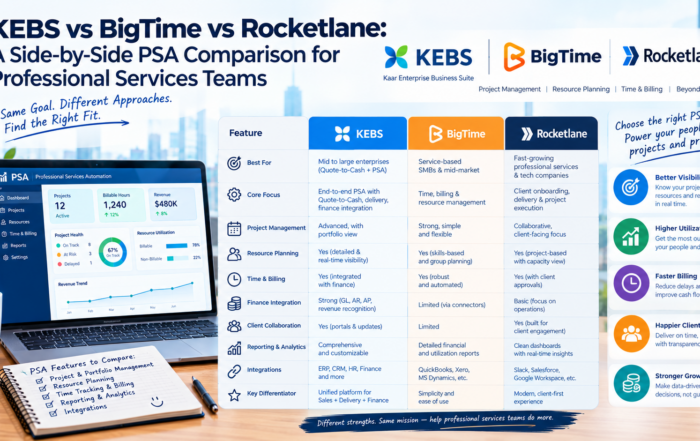
KEBS is the top Dynamics alternative for mid-market IT services, consulting, and GCC teams because it solves the core problem Dynamics creates: a platform that is too complex, too slow to deploy, and too dependent on consultants to run. KEBS covers the complete professional services lifecycle from deal management through resource allocation, project delivery, billing, and revenue recognition in a single platform, at role-based pricing from $5 to $49 per user per month, with no module tax and no mandatory SI partner requirement.
KAIS (KEBS AI Suite) is purpose-built for professional services operations, not a general ERP AI layer. KII surfaces real-time utilization gaps, project margin risk, and delivery health. KIR recommends the right resource for the right project based on skill, availability, cost, and delivery history. KIA automates staffing assignments, billing triggers, project alerts, and three-year revenue forecasting. The contrast with Dynamics' Copilot AI (which is primarily built for productivity and CRM tasks) is direct and significant.
KEBS integrates with Microsoft 365, Teams, SharePoint, Power BI, and Azure AD alongside Salesforce, SAP, Jira, Keka, and 30+ other platforms. It is backed by KaarTech (SAP Gold Partner), holds SOC 2 Type II and ISO 27001 certifications, and is operational in weeks rather than months.
- Full lifecycle in one platform, no module tax
- KAIS AI built for PS delivery, not repurposed ERP AI
- Role-based pricing from $5/user, no minimum contract
- Integrates with Microsoft 365, Teams, SAP, Salesforce, Keka
- Operational in weeks, no mandatory SI partner needed
- SOC 2 Type II, ISO 27001, SAP Gold Partner backing
- Optimized for IT/ITeS, GCC, and consulting verticals
- Full KAIS AI depth requires structured onboarding
- Very small teams (under 10) may not need all modules
Dynamics 365 requires 6 to 12 months to implement, multiple module licenses, and ongoing consultant dependency. KEBS deploys in weeks, charges a single role-based per-user rate, and includes a PSA-native AI engine that Dynamics Copilot does not match for delivery operations. For mid-market IT services and consulting firms, KEBS delivers the full PSA lifecycle at a fraction of the Dynamics TCO.

Scoro is a strong Dynamics alternative for mid-market agencies and consultancies that want a single platform covering CRM, project management, time tracking, billing, and financial reporting without ERP infrastructure overhead. Its clean interface, strong financial dashboards, and 1,000+ integrations make it accessible and practical for firms in the 10 to 200 user range that find Dynamics overbuilt for their needs.
Scoro covers the quote-to-cash workflow with genuine depth for agency and consultancy delivery models. Setup typically takes 4 to 8 weeks and does not require a dedicated systems integrator. The gap vs. Dynamics is in multi-entity ERP depth and AI maturity, but for the majority of mid-market services firms, Scoro's coverage is sufficient and delivers faster ROI.
- No ERP infrastructure dependency, CRM included
- Accessible pricing from $26/user, 1,000+ integrations
- Strong financial dashboards and profitability reporting
- 4 to 8 week setup, no SI partner required
- AI features are emerging, not mature
- Complex billing or multi-entity scenarios may need workarounds
- Not designed for large IT delivery or GCC operations
- Financial complexity scales with tier pricing
Scoro removes the ERP complexity and consultant dependency that makes Dynamics expensive for mid-market teams. It covers the PSA lifecycle mid-market firms actually need at a fraction of the Dynamics TCO. Dynamics leads on multi-entity ERP depth and Microsoft ecosystem integration; Scoro leads on usability, setup speed, and value for professional services delivery teams.

Kantata is the most structurally comparable Dynamics alternative for large professional services enterprises that primarily need PSA capability rather than full ERP coverage. Its resource management, demand forecasting, and financial governance are enterprise-grade, and it does not require Microsoft's ERP infrastructure. For large organizations evaluating Dynamics Project Operations, Kantata offers comparable depth in the PSA-specific modules at a lower infrastructure complexity cost.
The trade-offs are significant: custom contracts starting at $25,000 to $60,000 per year, implementation timelines of 3 to 6 months, and a dated interface. For mid-market firms under 50 users, Kantata is rarely a practical Dynamics alternative. But for large enterprises specifically looking to replace Dynamics Project Operations with a dedicated PSA, Kantata is a credible option.
- Enterprise resource management without Microsoft infrastructure
- Strong financial forecasting and project accounting
- Salesforce-native or open deployment options
- Designed specifically for PS operations, not general ERP
- Custom pricing, minimum $25K+ annual contract
- 3 to 6 month implementation typical
- Not accessible for teams under 50 users
- Interface is dated vs. modern alternatives
Kantata offers enterprise PSA depth without the Microsoft ERP overhead. For large PS organizations using Dynamics primarily for Project Operations and project accounting, Kantata provides a more focused alternative. Dynamics leads on Microsoft ecosystem integration and ERP breadth; Kantata leads on PSA-specific resource management and delivery governance.

BigTime is a practical Dynamics alternative for mid-market professional services firms that primarily need time capture, expense management, and billing automation. It is significantly more accessible than Dynamics in pricing transparency, implementation speed, and operational simplicity. Firms that used Dynamics primarily for project time tracking and invoicing often find BigTime covers those needs at a fraction of the cost and complexity.
BigTime does not match Dynamics on ERP breadth, multi-entity financial governance, or AI capabilities. But for mid-market accounting, engineering, and IT consulting firms where billing workflow is the primary PSA requirement, BigTime delivers strong ROI with a 60-day implementation and no SI partner requirement.
- Transparent pricing from $20/user, no Microsoft dependency
- Strong billing and time capture for mid-market PS firms
- 60-day implementation, no SI partner required
- Good QuickBooks and Sage integration
- No AI-driven forecasting or resource automation
- Not a full ERP or full-lifecycle PSA replacement
- Reporting customization is limited at scale
- Mobile experience weaker than desktop
BigTime replaces the billing and time tracking portion of Dynamics at a fraction of the cost and complexity. For mid-market firms that used Dynamics primarily for project time and invoice management, BigTime is a direct, accessible alternative. For firms that need the full Dynamics ERP scope, BigTime covers only a subset of that functionality.

Rocketlane is the strongest Dynamics alternative for teams where client-facing delivery experience is the primary priority. Its client portal, shared project workspaces, and real-time delivery visibility are the best in the PSA category for customer-facing teams. For SaaS implementation and onboarding organizations that found Dynamics too heavy and too internally focused, Rocketlane provides a lighter, delivery-first alternative that teams actually adopt.
Rocketlane covers projects, time tracking, resource management, billing, and financial operations with transparent pricing starting at $19 per user per month. It deploys in weeks and earns consistently high adoption rates vs. enterprise alternatives. For large-scale IT delivery or GCC operations with complex billing needs, Rocketlane's financial depth is more limited than enterprise PSA alternatives.
- Best-in-class client portal and delivery collaboration
- No Microsoft infrastructure dependency
- Accessible pricing from $19/user, weeks to deploy
- High delivery team adoption vs. enterprise tools
- Advanced AI and revenue recognition on Premium ($69/user)
- Less suited for large IT delivery or GCC operations
- Multi-entity financial governance still maturing
- Minimum 5 seats on all plans
Rocketlane solves the Dynamics adoption problem for delivery teams: it is lighter, faster, and client-facing in a way Dynamics is not. For SaaS implementation and onboarding teams, Rocketlane is a dramatically more appropriate alternative. For firms that need the full Dynamics ERP or project accounting depth, Rocketlane covers only the delivery portion of that scope.

Productive is a high-satisfaction PSA platform that covers the full agency lifecycle from quote to invoice at accessible pricing starting at $10 per user per month. For smaller professional services teams that used Dynamics as an ERP-lite and found it overbuilt, Productive offers a purpose-right alternative: strong financial visibility, fast setup, and high delivery team adoption without the ERP complexity overhead.
Productive is not a full ERP replacement for Dynamics, but for the majority of mid-market agencies and consultancies using Dynamics primarily for project management and billing, it covers the core PSA workflow effectively at a fraction of the cost.
- Accessible pricing from $10/user, no Microsoft dependency
- Strong quote-to-invoice visibility, high G2 satisfaction (4.7/5)
- Fast 1 to 3 week onboarding, high team adoption
- Good HubSpot integration on Ultimate tier
- Not a full ERP replacement for Dynamics
- AI features limited vs. AI-native PSA platforms
- Advanced forecasting gated to highest tier
- Multi-entity support is limited
Productive is a right-sized Dynamics alternative for smaller agencies and consultancies where Dynamics was overkill. It delivers the PSA workflow those teams actually need at 10 to 20 percent of the Dynamics TCO. For firms that need ERP depth, Productive is not a full replacement. For pure PS delivery teams, it often delivers better ROI and adoption.

Certinia is the right Dynamics alternative for enterprise professional services firms that are committed to the Salesforce ecosystem and want to consolidate on CRM-native financial and delivery management. Where Dynamics requires Azure infrastructure and Microsoft licensing stacks, Certinia requires Salesforce infrastructure. For firms already deeply on Salesforce, this is an ecosystem simplification rather than a lateral move.
Certinia covers resource management, project delivery, revenue recognition, and financial governance at enterprise depth, with the Salesforce data model providing tight alignment between sales pipeline and services delivery. For firms not on Salesforce, Certinia adds cost and dependency rather than removing it.
- Native Salesforce integration, single data model
- Deep revenue recognition and multi-entity billing
- Strong PS financial governance at enterprise scale
- Removes Microsoft infrastructure dependency
- Requires Salesforce infrastructure, replaces one dependency with another
- High implementation complexity (4 to 9 months typical)
- Not viable without Salesforce as the CRM backbone
- Delivery team adoption challenges similar to Dynamics
Certinia replaces Microsoft infrastructure dependency with Salesforce infrastructure dependency. For Salesforce-committed enterprises, this is a practical trade. For firms on neither platform, it is a lateral move at comparable cost. For mid-market teams looking for a lighter, faster alternative, Certinia is not the answer.

Accelo is a quote-to-cash automation platform that links sales, project delivery, time tracking, retainers, and invoicing in a single system. For small and mid-size service businesses that used Dynamics for basic project and billing management and found it far too complex, Accelo provides a practical, lighter-weight alternative focused on operational consistency and administrative automation.
Accelo's modular structure lets smaller firms start with the components they need. The full platform at $79 per user per month becomes costly at scale, and resource management and AI depth are limited compared to purpose-built PSA alternatives. But for SMBs where Dynamics was overkill on every dimension, Accelo delivers the operational automation they need.
- No Microsoft infrastructure dependency, modular pricing
- Strong sales-to-billing process automation
- Faster setup than Dynamics (4 to 8 weeks typical)
- Good retainer management for recurring service models
- Full platform at $79/user adds up at scale
- Limited AI and forecasting depth
- Not suited for large IT delivery or GCC operations
Accelo replaces Dynamics for small service firms that need process automation without ERP complexity. It covers the SMB PSA workflow well at a lower TCO and faster deployment. For firms that need enterprise resource management, multi-entity financial governance, or AI-driven forecasting, Accelo does not match Dynamics depth.

Projectworks is a consulting-focused PSA that delivers live project financial visibility, resource planning, and invoicing in a platform built specifically for how consulting and engineering firms actually operate. For these firms that evaluated Dynamics and found it over-engineered for their needs, Projectworks offers a purpose-right alternative with faster deployment and better practitioner usability.
Native integrations with Xero, QuickBooks, MYOB, Jira, Azure DevOps, and Salesforce make it practical for consulting firms with existing tool stacks. The platform does not match Dynamics on ERP breadth or AI depth, but for the consulting and engineering segment, it delivers better ROI and user satisfaction.
- Built for consulting firm financial workflows and profitability
- Real-time project margin visibility, high G2 satisfaction (4.6/5)
- Native Xero, QuickBooks, Jira, Azure DevOps integrations
- No Microsoft infrastructure dependency
- Not suited for large IT delivery or GCC operations
- AI features limited vs. AI-native platforms
- Narrower vertical focus than full-suite PSA
Projectworks is a more focused, accessible Dynamics alternative for consulting and engineering firms. It delivers the financial visibility and PSA workflow those firms need without ERP infrastructure complexity. Dynamics leads on multi-entity ERP breadth and Microsoft ecosystem integration; Projectworks leads on consulting firm usability and faster time to value.

Teamwork is a project and client work platform focused on delivery, client portals, and time tracking for agencies and client-services teams. It is accessible, well-designed, and popular with marketing agencies, creative studios, and smaller consulting firms. For organizations that used Dynamics primarily for project tracking and billing, Teamwork provides a dramatically simpler, lower-cost alternative focused on delivery visibility and client communication.
Teamwork does not replace the ERP or financial governance capabilities of Dynamics. But for teams where Dynamics was used narrowly for project management, and where the complexity overhead was creating more friction than value, Teamwork is a practical simplification.
- Accessible pricing from $13.99/user, 1 to 4 week setup
- Strong client portal and delivery collaboration
- No Microsoft infrastructure dependency
- Not a full PSA or ERP replacement for Dynamics
- Limited financial management and AI capabilities
- Not suited for complex billing or GCC operations
Teamwork is a delivery and client collaboration tool, not a Dynamics replacement. For small agencies where Dynamics was overkill for project tracking, Teamwork provides a practical simplification. For any organization that relied on Dynamics for financial governance or ERP capabilities, Teamwork covers only a narrow subset of that functionality.
Side-by-Side Comparison: MS Dynamics Alternatives in 2026
| Platform | Starting Price | MS Dependency | AI Depth | Impl. Speed | Full PS Lifecycle | Best Fit |
|---|---|---|---|---|---|---|
| KEBS | $5 to $49/user | None (integrates with M365) | Multi-layer KAIS AI | Weeks | Yes | IT/ITeS, GCC, Consulting |
| MS Dynamics 365 | $65+/user (multi-module) | Required (Azure/M365) | Copilot (general ERP AI) | 6 to 12 months | Partial (ERP focus) | Large enterprise ERP |
| Scoro | From $26/user | None | Emerging | 4 to 8 weeks | Broad, agency-focused | Agencies, consultancies |
| Kantata | $60+/user (custom) | None (open version) | Emerging | 3 to 6 months | Partial | Large enterprise PS |
| BigTime | From $20/user | None | Limited | 60 days | Partial (billing focus) | Mid-market billing-first |
| Rocketlane | From $19/user | None | Growing | Weeks | Partial (delivery focus) | SaaS onboarding, PS teams |
| Productive | From $10/user | None | Limited | 1 to 3 weeks | Agency-focused | Creative agencies |
| Certinia PSA | Custom enterprise | Salesforce dependency | Einstein/AgentForce | 4 to 9 months | Partial (Salesforce) | Salesforce enterprise |
| Accelo | $39 to $79/user | None | Minimal | 4 to 8 weeks | Partial | SMB service firms |
| Projectworks | From $37/user | None | Minimal | 4 to 8 weeks | Partial (consulting) | Consulting, engineering |
| Teamwork | From $13.99/user | None | Minimal | 1 to 4 weeks | No | Agencies, client services |
How to Choose the Right MS Dynamics Alternative
Frequently Asked Questions
Lighter, Faster, Smarter Than Dynamics. Built for Mid-Market IT Services Teams.
KEBS is the AI-native Quote-to-Cash PSA built for IT/ITeS firms, GCCs, BPOs, and consulting teams. Full lifecycle coverage. No Microsoft dependency. Transparent pricing from $5 per user. Operational in weeks. Rated 4.7/5 on G2.
Book a Free Demo →